
Official statement
Other statements from this video 8 ▾
- □ Do you really need to optimize your site differently for AI Overviews and AI Mode?
- □ Do you really need to overhaul your SEO strategy for Google's AI features?
- □ Do clicks from AI Overviews actually convert better?
- □ Why does Google really obsess over 'unique value' in content?
- □ Will Search Console's Core Web Vitals recommendations finally make a real difference?
- □ Is the robots.txt file really still useful for controlling AI crawler access in 2024?
- □ Is log analysis really the SEO skill that will outlast everything else?
- □ Should you stop talking about SEO and embrace new terms like AIO, GEO, or LLM optimization instead?
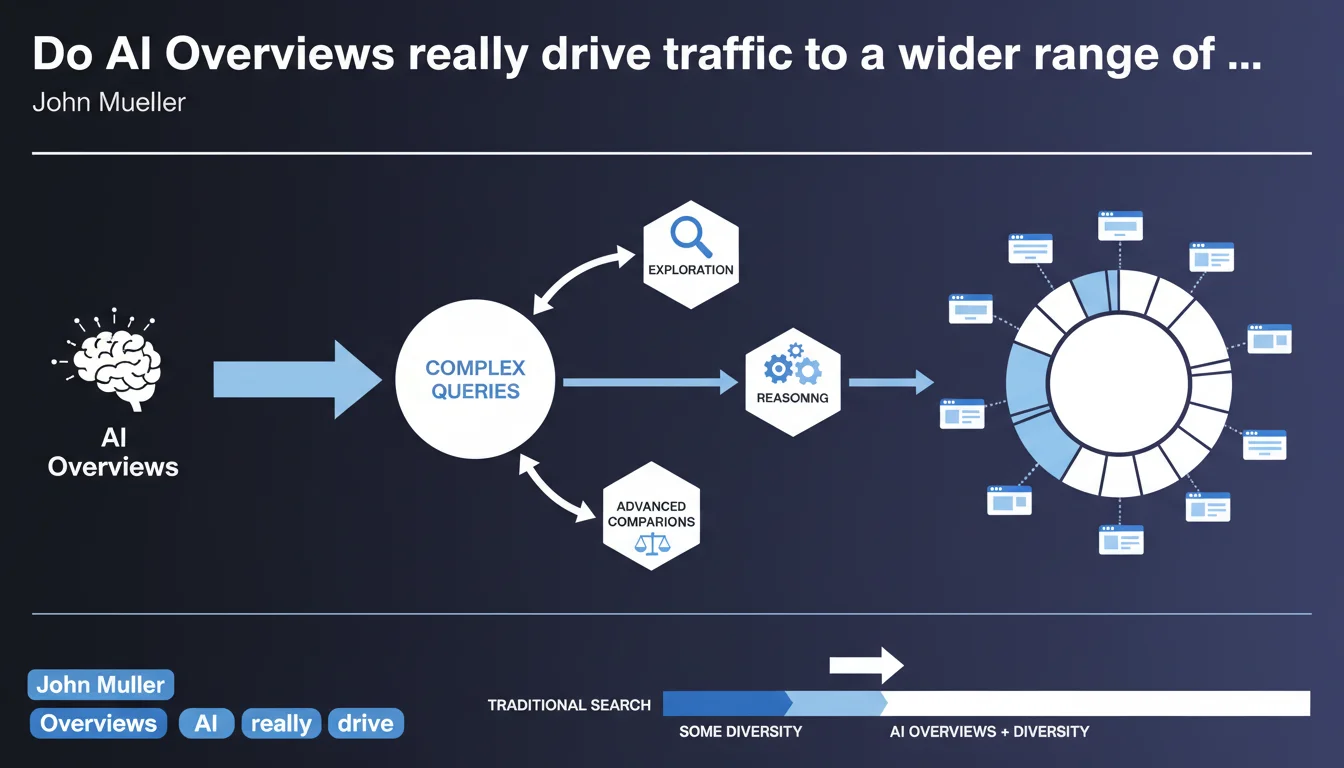
Google claims that AI Overviews redirect users to a broader variety of websites, particularly on complex queries involving exploration, reasoning, or comparisons. This statement suggests a shift in how organic traffic is distributed, with potentially less concentration on the usual dominant players.
What you need to understand
What exactly changes for site visibility with this claim?
Google claims that AI Overviews (the AI summaries at the top of SERPs) don't cannibalize traffic in favor of a handful of dominant sites. Instead, they would direct clicks toward a more diversified range of sources, especially on queries where the user seeks to compare, explore, or reason through options.
This is a significant shift if verified — until now, the dominant hypothesis was that these synthetic summaries would siphon off traffic without redistributing it. Google seems keen to reassure: AI doesn't kill SEO, it just redistributes it differently.
Which queries benefit from this increased diversity?
Complex queries are at the heart of this mechanism. Think of those requiring multi-step reasoning, in-depth comparisons, or exploration of varied perspectives. Not simple definitions or single-answer factual questions.
Google implicitly cites questions like "how do I choose between X and Y" or "what are the pros and cons of Z." On these grounds, the AI would need to draw from multiple sources to build a credible answer — hence the diversity.
Why is Google emphasizing this point now?
Because pressure is mounting. Publishers, media outlets, and content sites fear massive traffic losses to AI summaries. This statement looks like a PR move to calm things down.
But let's be honest: Google has every incentive to keep sites producing quality content. Without them, the AI has nothing to index or synthesize. Diversity isn't a gift — it's a structural necessity for the ecosystem to survive.
- AI Overviews redirect to varied sources, especially on complex queries
- Queries requiring exploration, reasoning, or comparisons are most affected
- This statement likely aims to reassure publishers worried about traffic drops
- Google depends on content diversity to feed its AI models
SEO Expert opinion
Is this claim consistent with real-world observations?
Hard to settle without longitudinal data spanning several months. Some observers report traffic dispersing to lesser-known sites, while others see the opposite: concentration on established authorities. [To verify] with Search Console analysis on representative panels.
The problem is Google shares no transparent metrics. No breakdown by sector, no before/after comparison of AI Overviews at macro scale. We're supposed to take them at their word — and that's where it breaks down.
What nuances should we add to this claim?
Diversity doesn't necessarily mean equity. A site can appear in the sources cited by an AI Overview without capturing traffic if the user already has their answer without clicking. Visibility doesn't automatically convert to clicks.
Furthermore, this diversity may be true for niche or low-volume queries, but remains unproven on ultra-competitive verticals (health, finance, tech). Dominant players have authority and trust signals Google prioritizes — hard to imagine a total upheaval.
In which cases might this rule not apply?
On simple factual queries, the AI Overview gives a direct answer without need to click elsewhere. No diversity here — just traffic capture at the top of SERP. Sites that lived off these basic queries are hit first.
Similarly, in YMYL verticals (health, finance, legal), Google will likely continue favoring ultra-authoritative sources over true diversity. Caution wins over exploration. This aligns with their E-E-A-T policy.
Practical impact and recommendations
What specifically should you optimize to benefit from this dynamic?
If Google truly pushes toward more diversity on complex queries, you must target in-depth content that demonstrates expertise, reasoning, and comparison. Out goes surface-level articles — in comes detailed analysis, multi-angle guides, case studies.
Build your expertise signals: identified author with credible bio, cited sources, transparent methodology. The AI needs to understand why your content deserves to be cited in a synthetic summary.
What mistakes should you avoid with AI Overviews?
Don't rely entirely on simple factual queries. If your traffic depends on "what is X" or "definition of Y," you're in danger. The AI captures these queries without redirecting. Pivot to richer angles: "how to choose X based on Y" or "detailed comparison between A and B."
Another trap: believing diversity = easy access. Even if Google cites more sites, it will favor those with flawless technical architecture, top Core Web Vitals, and coherent internal linking. Diversity doesn't excuse technical mediocrity.
How can you verify your site benefits from this redistribution?
Analyze your Search Console performance on complex queries in your sector. Compare impressions and CTR before/after AI Overviews rollout in your market. If you see rising impressions without rising clicks, that's a bad sign — you're cited but not clicked.
Also monitor featured snippets and People Also Ask. These formats are often the sources AI Overview exploits. If you dominate them, you have better chances of appearing in AI summaries.
- Produce in-depth, multi-perspective content on complex queries
- Strengthen expertise signals: identified author, cited sources, clear methodology
- Abandon the race for simple definitions in favor of comparative analysis
- Optimize technical execution flawlessly: speed, structure, internal linking
- Track performance on complex queries via Search Console
- Target featured snippets and PAA as gateways to AI Overviews
❓ Frequently Asked Questions
Les AI Overviews vont-ils tuer mon trafic organique sur requêtes simples ?
Comment savoir si mon site est cité dans les AI Overviews ?
La diversité promise par Google est-elle réelle sur tous les secteurs ?
Faut-il optimiser différemment pour les AI Overviews que pour les featured snippets ?
Google partage-t-il des métriques sur le trafic redistribué par AI Overviews ?
🎥 From the same video 8
Other SEO insights extracted from this same Google Search Central video · published on 01/07/2025
🎥 Watch the full video on YouTube →
💬 Comments (0)
Be the first to comment.