
Official statement
What you need to understand
Legal pages (legal notices, privacy policy, terms and conditions, etc.) are often perceived as low-value content by SEO practitioners. Many choose to block them via robots.txt or noindex tags, thinking they are protecting their crawl budget or avoiding quality dilution.
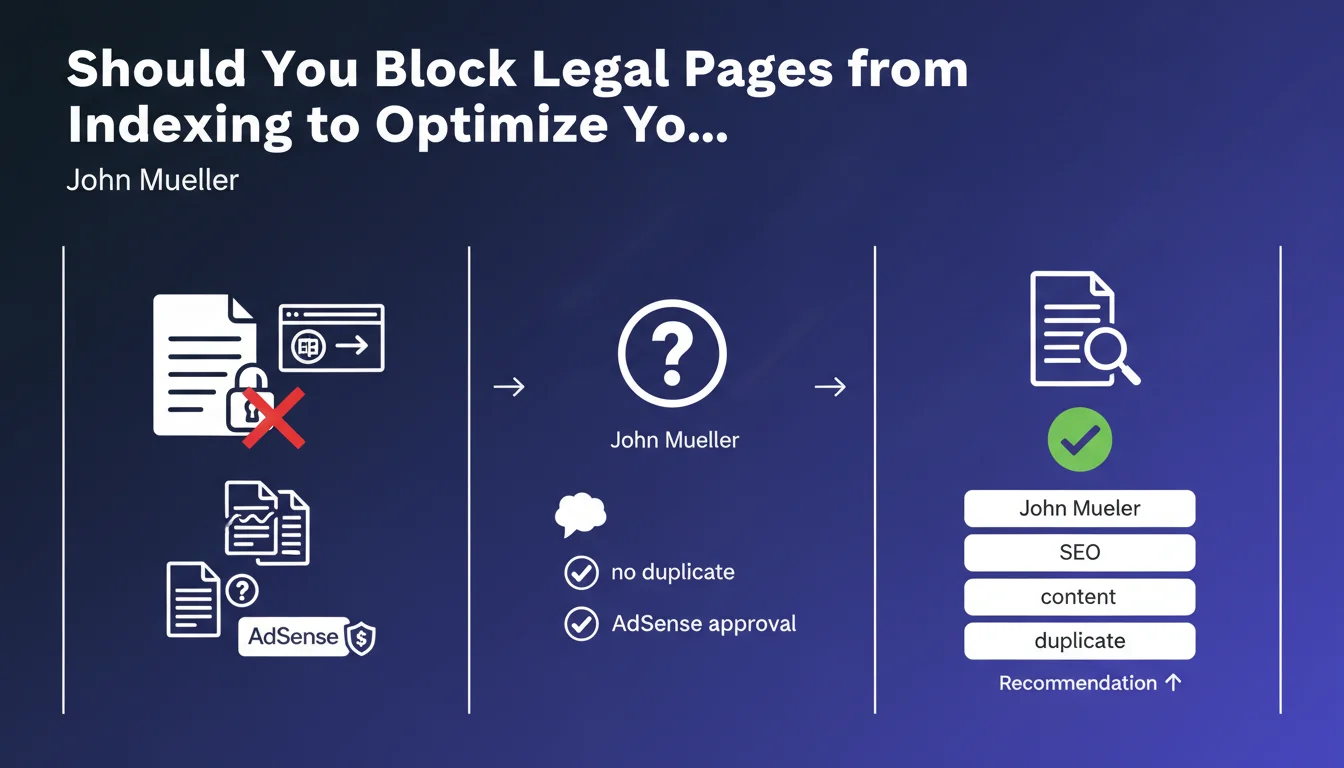
Google clarifies its position: these pages pose no indexing problem. They do not create problematic duplicate content, even if their content is standardized. They also do not penalize AdSense approval, contrary to some concerns.
The official recommendation is therefore to leave these pages indexable. Although this is not a critical ranking factor, this approach avoids creating unnecessary obstacles in the site architecture.
- Legal pages do not negatively affect SEO
- Duplicate content on these specific pages is not penalized
- Blocking these pages provides no measurable benefit
- Indexing these pages is the default recommended practice
SEO Expert opinion
This position from Google is consistent with field observations. Sites that leave their legal pages indexed do not actually suffer any visible penalty. Algorithms are sophisticated enough to identify this standard content without considering it spam.
Nevertheless, some nuances deserve to be noted. On very large sites (several thousand pages), every URL counts in the crawl budget. If your strategic pages struggle to be crawled regularly, prioritizing crawl can make sense, but legal pages should not be the priority of this optimization.
The pragmatic approach remains to not over-optimize these secondary aspects. SEO energy should focus on value-added content and user experience rather than on micro-optimizations with no measurable impact.
Practical impact and recommendations
- Check your current configuration: if your legal pages are noindexed or blocked by robots.txt without strategic reason, remove these restrictions
- Maintain a clean architecture: ensure these pages are accessible from the footer, with consistent URLs and only one version per language
- Don't over-optimize: no need to work on title tags or meta descriptions of these pages as you would strategic content
- For multilingual sites: use hreflang tags on your legal pages or centralize them on a single version with appropriate canonicals
- Prioritize your time: focus your SEO efforts on pages that generate traffic and conversions rather than on this mandatory content
- Conduct comprehensive audits: integrate legal page verification into your regular technical audits without making it a blocking point
The technical management of indexing and optimization of a site's overall architecture often require an overview and deep expertise. These decisions about crawl configuration, canonicalization, and resource prioritization can have significant impacts depending on your specific context. Working with an experienced SEO agency can provide you with personalized support to identify the real performance levers on your site, without wasting time on secondary optimizations.
💬 Comments (0)
Be the first to comment.