
Official statement
Other statements from this video 17 ▾
- □ Should you worry about changing page titles frequently—or is Google totally fine with it?
- □ Can you really erase the SEO past of a purchased domain?
- □ Should you really disavow links that don't match your current niche anymore?
- □ Should you really remove backlinks pointing to your domain's old content?
- □ Do server errors really kill your Google rankings?
- □ Should you include your brand name in news article titles for better search visibility?
- □ Why does changing only the title of copied content fool absolutely nobody?
- □ Should you really be putting dates in your article titles?
- □ Does adding categories to your URLs really boost your SEO rankings?
- □ Why does Google crawl pages it never adds to its index?
- □ What's the real secret to getting Google to index all your content?
- □ Are backlinks to your non-indexed pages really wasting your SEO potential?
- □ Does server response time really impact your Google rankings?
- □ Should you really update your backlinks after a domain migration?
- □ Should you really block pages with robots.txt if Google can index them without any content?
- □ Does image alt text in a link carry the same SEO weight as visible anchor text?
- □ Does retouched product photography actually hurt your review rankings?
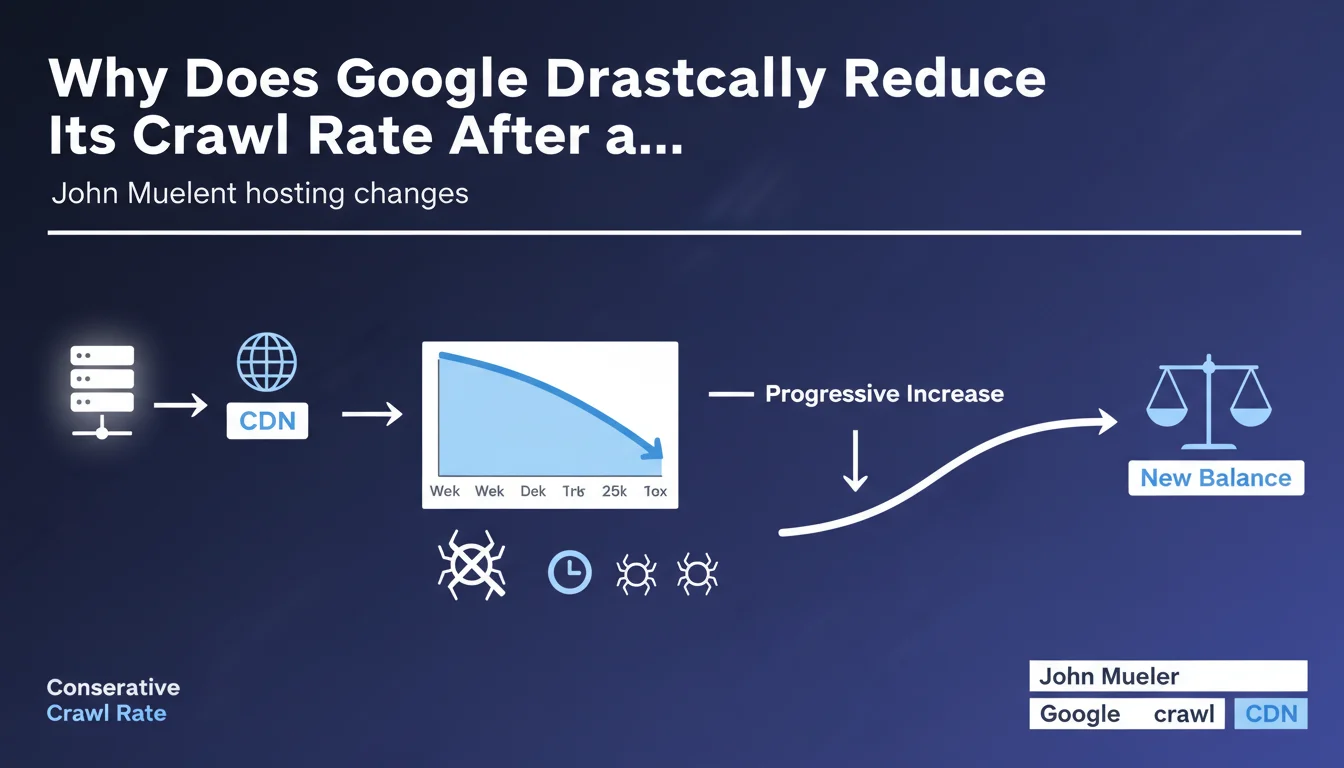
Google adopts a conservative crawl approach after a major hosting migration (to or from a CDN). The crawl rate decreases initially, then gradually increases over several weeks or even a month, as the algorithm finds a new equilibrium with the infrastructure.
What you need to understand
Why This Sudden Caution from Googlebot?
When a site migrates to or from a CDN, the technical infrastructure changes radically. Google must relearn the server response characteristics: latency times, load capacity, connection stability. This learning phase requires a temporary reduction in crawl rate.
This decrease is not a penalty — it's a precautionary measure. Googlebot avoids saturating an infrastructure it doesn't yet understand. It tests, observes, then gradually adjusts.
How Long Does This Ramp-Up Phase Last?
Mueller mentions a few weeks or a month. This aligns with field observations: most migrations show a return to normal between 3 and 6 weeks. But be careful — this duration depends on site size, post-migration stability, and the quality of signals sent to Google.
A site with 100,000 pages will likely recover faster than a massive 10 million-URL behemoth.
What Signals Does Google Monitor During This Period?
Google analyzes HTTP response times, server error rates, and response consistency. If the new CDN is unstable or misconfigured, the conservative phase can extend indefinitely.
Conversely, a clean migration with excellent response times accelerates the return to normal.
- Crawl becomes conservative immediately after a CDN migration or major hosting change
- The gradual increase typically lasts a few weeks to a month
- This decrease is normal and expected — not a penalty
- Google seeks a new equilibrium suited to the infrastructure
- Duration depends on the technical stability of the new environment
SEO Expert opinion
Is Google's Caution Really Justified?
Yes — and it's actually logical from an infrastructure standpoint. A CDN fundamentally changes network topology: multiple IPs, distributed edge servers, caching behavior. Googlebot must map this new architecture before crawling at full speed.
What's more problematic is Google's lack of proactive communication. How many migrations result in unnecessary panic because crawl rates collapse without explanation? Mueller could have specified that Search Console now displays a specific warning in these cases — but it doesn't.
What If Crawl Doesn't Increase After a Month?
This is where it gets tricky. Mueller deliberately remains vague about the criteria that trigger the increase. [To be verified]: Google claims to analyze stability, but what thresholds? What error rate does it tolerate? No concrete data.
If after 6 weeks crawl remains abnormally low, consider several hypotheses:
- The CDN returns inconsistent HTTP codes (200 from some edges, 404 from others)
- Response times vary too much depending on geographic region
- Intermittent DNS errors disrupt resolution
- Crawl budget was already saturated before migration — the problem lies elsewhere
Does This Rule Apply to All Types of Migrations?
Mueller speaks of "significant hosting change." Deliberately vague. A simple datacenter switch with the same host? Probably minimal impact. Migration from shared server to dedicated infrastructure? Minimal impact.
But migration to Cloudflare, Fastly, Akamai — then yes, guaranteed impact. The criterion appears to be: does the IP change and does network behavior change radically? If both answers are yes, expect a temporary decrease.
Practical impact and recommendations
How to Anticipate This Crawl Decrease Before Migration?
First rule: never migrate to a CDN during a strategic period (product launch, e-commerce peak season). Plan the migration at least 6 weeks before any critical event.
Second rule: implement strict monitoring. Configure crawl rate alerts in Search Console, monitor server logs daily, track response times by geographic region.
What Mistakes to Avoid Absolutely?
Don't test the CDN before full cutover. Some deploy a misconfigured Cloudflare, discover massive 520 errors, and panic. Test first on a subdomain, verify that Googlebot crawls correctly, only then switch the main domain.
Another classic trap: enabling CDN + massive URL structure changes simultaneously. Google can't differentiate the CDN's impact from the restructuring's impact. One major change at a time.
- Plan the migration at least 6 weeks before any critical business deadline
- Set up daily crawl rate monitoring (Search Console + server logs)
- Test the CDN on a subdomain before full cutover
- Verify that response times are stable from all regions
- Don't couple CDN migration with structural redesign
- Prepare a rollback checklist in case of major issues
- Document crawl levels before migration for comparison
- Monitor CDN-specific HTTP errors (520, 521, 522)
❓ Frequently Asked Questions
Le crawl diminue toujours après une migration CDN, même si le CDN est plus rapide ?
Peut-on forcer Google à crawler plus rapidement après migration ?
Une migration d'un CDN vers un autre provoque-t-elle la même baisse ?
Search Console affiche-t-il un avertissement pendant cette période ?
Faut-il désactiver le CDN si le crawl reste bas après 2 mois ?
🎥 From the same video 17
Other SEO insights extracted from this same Google Search Central video · published on 04/02/2022
🎥 Watch the full video on YouTube →
💬 Comments (0)
Be the first to comment.