
Official statement
Other statements from this video 17 ▾
- □ Should you worry about changing page titles frequently—or is Google totally fine with it?
- □ Can you really erase the SEO past of a purchased domain?
- □ Should you really disavow links that don't match your current niche anymore?
- □ Should you really remove backlinks pointing to your domain's old content?
- □ Do server errors really kill your Google rankings?
- □ Why does changing only the title of copied content fool absolutely nobody?
- □ Should you really be putting dates in your article titles?
- □ Does adding categories to your URLs really boost your SEO rankings?
- □ Why does Google crawl pages it never adds to its index?
- □ What's the real secret to getting Google to index all your content?
- □ Are backlinks to your non-indexed pages really wasting your SEO potential?
- □ Why Does Google Drastically Reduce Its Crawl Rate After a CDN Migration?
- □ Does server response time really impact your Google rankings?
- □ Should you really update your backlinks after a domain migration?
- □ Should you really block pages with robots.txt if Google can index them without any content?
- □ Does image alt text in a link carry the same SEO weight as visible anchor text?
- □ Does retouched product photography actually hurt your review rankings?
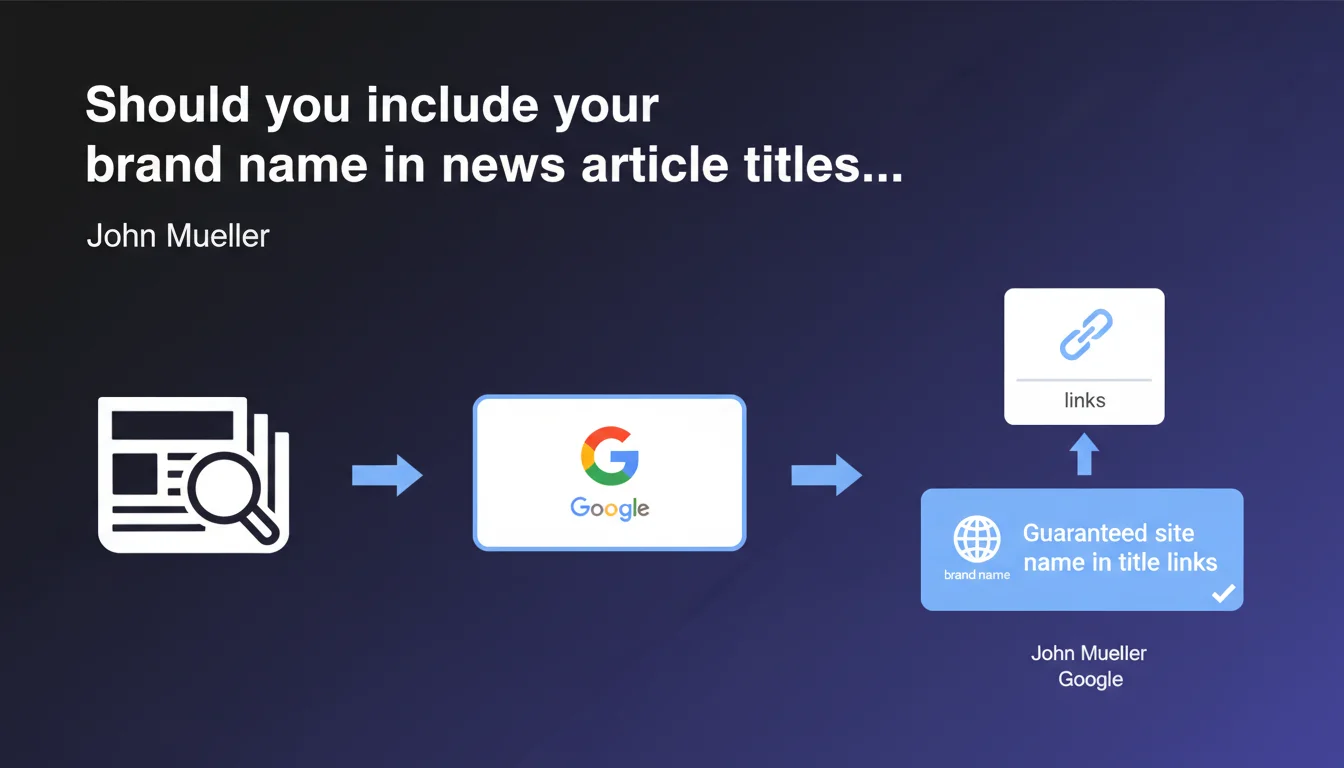
Google recommends news websites to integrate their brand name in title tags. While the search engine attempts to automatically display the site name in title links, adding it manually guarantees that it appears consistently, especially on deep pages.
What you need to understand
Why does Google insist on news websites specifically?
News websites operate on particular terrain. The authority and credibility of the source carries significant weight in a user's decision to click when scanning news results. A title without visible branding is a missed opportunity to capitalize on brand recognition.
Google states that it attempts to automatically display the site name in title links for lower-level pages. The problem? This "attempts" leaves room for uncertainty. If the algorithm fails or makes a poor decision, you lose that visibility.
What exactly are "lower-level pages"?
These are pages beyond the homepage — individual articles, category pages, topic folders. These pages represent the bulk of a media outlet's organic traffic, and this is precisely where brand identification becomes critical.
On the homepage, the domain name is usually enough to identify the site. But when an article appears isolated in the SERPs, often through Google News or Discover, readers need to immediately know who published it.
What's the difference between the title tag and the displayed title link?
The <title> tag is what you write in the HTML code. The title link is what Google actually chooses to display in search results. These two elements don't always match.
Google reserves the right to rewrite your titles if it judges they don't match the query or lack contextual information. By including your brand yourself, you maximize the chances it remains visible even after this rewriting.
- Google attempts to automatically display the site name, but without absolute guarantee
- News websites must capitalize on their notoriety and authority
- Manually including the brand in the title secures its display in the SERPs
- The difference between HTML title and displayed title link can be significant
SEO Expert opinion
Is this recommendation really new?
No. SEO best practices have recommended including the brand name in titles for years, especially for media sites. What's interesting here is that John Mueller frames it as an official, targeted recommendation.
The nuance lies in "attempts to display". Google implicitly admits that its automatic system is not infallible. This is a rare acknowledgment of its limitations — and a clear signal that it's better to control this element manually rather than rely on the algorithm.
What title structure should you adopt in practice?
The question of placement arises: brand at the beginning or end of the title? For news websites, the dominant convention remains "Article Title | Media Name". This structure prioritizes content while ensuring brand visibility.
Some media outlets occasionally reverse this on topics where their authority outweighs the headline itself. A major national newspaper might use "The New York Times | Investigation into...", capitalizing immediately on its reputation. This is more of an editorial choice than an SEO rule.
Does this advice apply beyond news websites?
The recommendation explicitly targets news websites, but it logically extends to any site where brand recognition influences click-through rate. Established e-commerce, well-known SaaS platforms, recognized expert blogs — all benefit from signing their content.
However, for an unknown site or an affiliate SEO project without strong branding, adding a name that means nothing to anyone dilutes the title without providing benefit. In this case, it's better to maximize available space for descriptive content.
Practical impact and recommendations
What specifically needs to be changed on a news website?
If your titles don't already include your brand, start with a systematic audit. Check how Google currently displays your articles in the SERPs — use Search Console or manually crawl a representative sample.
Then adapt your CMS templates. Most platforms (WordPress, Drupal, custom systems) allow you to automate the brand addition through SEO plugins or templating rules. Ensure the syntax follows coherent logic across the entire site.
How do you measure the impact of this change?
The primary metric to monitor is organic CTR in Search Console. Compare data before and after deployment over equivalent periods (accounting for seasonal and event-based variations).
Be careful though: isolating the specific effect of adding the brand is complex. If you simultaneously modify other elements (title structure, length, keywords), you won't be able to clearly attribute variations. Ideally, test on a subset of pages in an A/B scenario.
What common mistakes should you avoid?
Don't blindly duplicate the brand if it already appears naturally in the editorial title. "The Guardian announces | The Guardian" is redundant and wastes space. Always prioritize readability and clarity.
Also avoid whimsical or inconsistent separators. Pipe "|", dash "–", colon ":" — choose one and stick with it across the entire site. Consistency matters as much to Google as to user experience.
- Audit current title display in the SERPs via Search Console
- Modify CMS templates to automatically add the brand
- Adopt a consistent structure (e.g., "Title | Media Name")
- Verify that titles don't exceed 60-70 characters after brand addition
- Monitor organic CTR before and after modification
- Avoid redundancy and standardize separators
❓ Frequently Asked Questions
Faut-il placer la marque au début ou à la fin du title ?
Google affiche-t-il toujours le nom de marque même si je ne l'inclus pas ?
Cette recommandation s'applique-t-elle aussi aux sites e-commerce ou corporate ?
Combien de caractères cela consomme-t-il sur le title ?
Peut-on automatiser cet ajout via un plugin SEO ?
🎥 From the same video 17
Other SEO insights extracted from this same Google Search Central video · published on 04/02/2022
🎥 Watch the full video on YouTube →
💬 Comments (0)
Be the first to comment.