
Official statement
Other statements from this video 17 ▾
- □ Should you worry about changing page titles frequently—or is Google totally fine with it?
- □ Can you really erase the SEO past of a purchased domain?
- □ Should you really disavow links that don't match your current niche anymore?
- □ Should you really remove backlinks pointing to your domain's old content?
- □ Do server errors really kill your Google rankings?
- □ Should you include your brand name in news article titles for better search visibility?
- □ Why does changing only the title of copied content fool absolutely nobody?
- □ Should you really be putting dates in your article titles?
- □ Why does Google crawl pages it never adds to its index?
- □ What's the real secret to getting Google to index all your content?
- □ Are backlinks to your non-indexed pages really wasting your SEO potential?
- □ Why Does Google Drastically Reduce Its Crawl Rate After a CDN Migration?
- □ Does server response time really impact your Google rankings?
- □ Should you really update your backlinks after a domain migration?
- □ Should you really block pages with robots.txt if Google can index them without any content?
- □ Does image alt text in a link carry the same SEO weight as visible anchor text?
- □ Does retouched product photography actually hurt your review rankings?
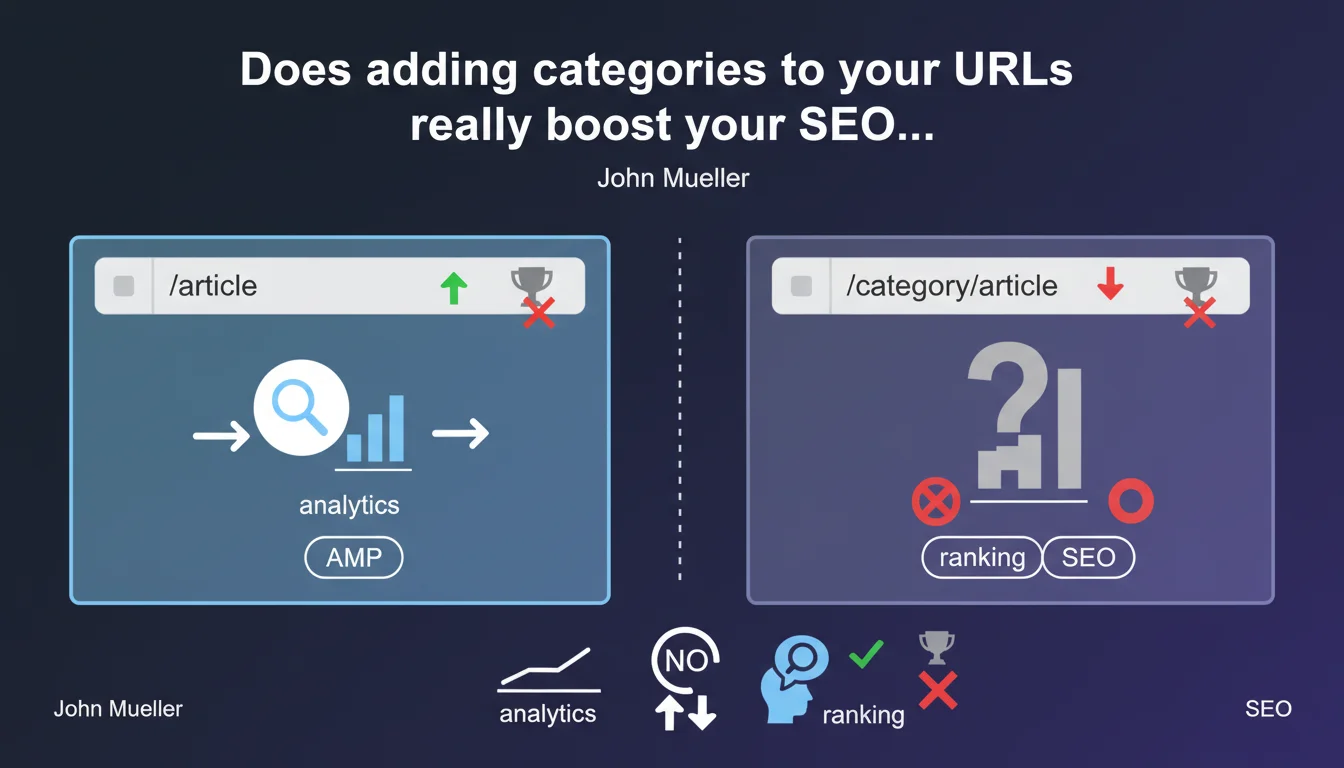
According to Mueller, structuring your URLs with categories (/category/article) delivers no measurable SEO benefit compared to a flat structure (/article). The only real value is organizational—useful for analytics tracking to identify popular categories, but with no visible impact on rankings. A statement that challenges years of established industry practices.
What you need to understand
Why does this statement contradict common SEO practices?
For years, we've been told that hierarchical URL structures help Google understand your site's thematic organization. The reasoning? A URL like /smartphones/samsung/galaxy-s23 would be more meaningful than a simple /galaxy-s23.
Mueller dismisses this argument outright. No visible SEO effect. What actually matters is that Google can deduce your site's thematic structure through internal linking, breadcrumbs, and semantic markup—not through the URL path itself.
What does "no visible impact" actually mean in practice?
Google isn't saying URL structure is completely ignored. It's saying that between /category/article and /article, you won't see a measurable difference in rankings. Both approaches are equivalent in the algorithm's eyes.
The notable exception: tracking. If you need to quickly identify in Analytics which categories are driving traffic, the /category/ structure makes segmentation and filtering easier. That's an operational benefit, not an algorithmic one.
Does this principle apply to all websites?
Mueller speaks in general terms, but reality is more nuanced. For a simple blog or brochure site, it's probably accurate. For an e-commerce platform with 50,000 products spread across hundreds of categories? The question deserves a different framing.
URL structure also impacts technical management: redirects, migrations, .htaccess rules. Changing /category/article to /article on a large site can become a nightmare. "No SEO impact" doesn't mean "change everything."
- URL structure with categories doesn't improve rankings according to Google
- The main value remains analytics tracking and human organization
- Internal linking and semantic markup matter more than URL path
- On large sites, URL structure has major technical implications beyond SEO
SEO Expert opinion
Is this statement consistent with what we observe in the field?
Let's be honest: A/B tests on URL structure are rare. Few teams dare to massively modify URLs on a live site just to measure the impact. The result? We're missing solid empirical data to confirm or refute Mueller. [Worth verifying]
What we do observe is that sites with flat structures (WordPress using /post-name/) rank just as well as sites using /category/subcategory/post-name/. But correlation isn't causation—other factors (content, backlinks, technical performance) obviously play a role.
What nuances should we add to this claim?
Mueller is talking about SEO impact, not user experience. A clear, descriptive URL (/smartphones/samsung/) remains more readable than a cryptic ID (/p12345/). And UX indirectly influences SEO through click-through rates, social sharing, and memorability.
Another point: URL structure influences internal PageRank distribution. On a site with /cat1/cat2/article, you're potentially creating additional depth levels. If your internal linking is weak, that can dilute authority. But again, that's a linking issue, not a URL problem per se.
In which cases might this rule not apply?
On marketplaces and aggregators, URL facets (filters by color, price, brand) generate thousands of combinations. Here, structure becomes critical for avoiding duplicate content and managing crawl budget. But that's a different topic from simple /category/ inclusion in the path.
For multilingual or multi-region sites, the structure /fr/category/article vs /category/article-fr can have implications for geographic targeting. Google actually recommends subdirectories for hreflang. Here, URL structure matters—but for geo-signaling reasons, not direct ranking boost.
Practical impact and recommendations
What should you actually do with this information?
If your site already exists with a /category/article structure, leave it alone. The theoretical benefits of switching to a flat structure don't justify the risks (broken redirects, lost backlinks, technical bugs). It's not worth the effort.
For a new site, ask yourself about analytics needs. If you need to easily segment performance by category in GA4, keep /category/. If you prioritize simplicity and long-term flexibility, opt for a flat structure and use Custom Dimensions to track categories.
How do you optimize URL structure without falling into traps?
Whatever structure you choose, ensure your URLs remain short, descriptive, and readable. Avoid excessive depth (/cat1/subcat1/subsubcat1/article) that complicates crawling and dilutes authority.
Strengthen your internal linking and structured breadcrumbs using Schema.org BreadcrumbList. This is where Google truly understands your thematic architecture—far more than through the URL path. Strong linking easily compensates for an imperfect URL structure.
What common mistakes should you avoid with URL management?
Don't mix different structures on the same site (/category/article for some sections, /article for others). It confuses users and complicates maintenance. Consistency first.
Also avoid URL migrations without real business or SEO justification. Every URL restructure carries risks: 302 redirects instead of 301, redirect chains, lost backlinks. Don't change things just to change them.
- Never modify a live site's URL structure solely for this reason
- On new projects, decide based on your analytics and maintenance needs
- Always prioritize short, descriptive, and stable URLs over time
- Strengthen your internal linking and Schema.org breadcrumb markup
- Document your structure choice to prevent inconsistencies down the road
- Test redirects on a sample before any large-scale deployment
❓ Frequently Asked Questions
Dois-je migrer mon site de /category/article vers /article pour améliorer mon SEO ?
La structure d'URL influence-t-elle le taux de clic dans les SERP ?
Comment Google comprend-il alors l'organisation thématique de mon site ?
Les sous-répertoires /fr/ ou /en/ pour le multilingue suivent-ils la même règle ?
Quelle structure choisir pour un nouveau site e-commerce ?
🎥 From the same video 17
Other SEO insights extracted from this same Google Search Central video · published on 04/02/2022
🎥 Watch the full video on YouTube →
💬 Comments (0)
Be the first to comment.