
Official statement
Other statements from this video 20 ▾
- □ Does Google really index iframe content as part of the parent page — or treats it as completely separate?
- □ Should you really prioritize a hierarchical structure for large websites?
- □ Is blocking crawl via robots.txt really the miracle solution against toxic links?
- □ Should you translate your URLs to boost international SEO rankings?
- □ Does Googlebot really ignore the meta prerender-status-code 404 tag in JavaScript applications?
- □ Are double slashes in URLs really hurting your SEO performance?
- □ Is your video being penalized by Google for appearing below the fold, and how can you fix it?
- □ How can you successfully transfer your image rankings to new URLs without losing search visibility?
- □ Should you really worry about 404 errors on your website?
- □ Is returning HTTP 200 on a 404 page really cloaking or just a soft 404?
- □ Should you force your sitemap file indexation in Google?
- □ Should you worry when Googlebot crawls your API endpoints and generates 404 errors?
- □ Is web accessibility really a Google ranking factor or just a smoke screen?
- □ Does Google really penalize paid link purchases, or is it just a myth?
- □ Should you still report bad backlinks to Google in 2024?
- □ Why does blocking crawl via robots.txt prevent Google from seeing your noindex directive?
- □ Is Google really rejecting the idea of a magic formula to rank higher?
- □ Why is Google displaying your special characters as gibberish in search results?
- □ Why are the data discrepancies between Google Analytics and Search Console causing so much confusion for SEO professionals?
- □ Should you really be chasing perfect SEO?
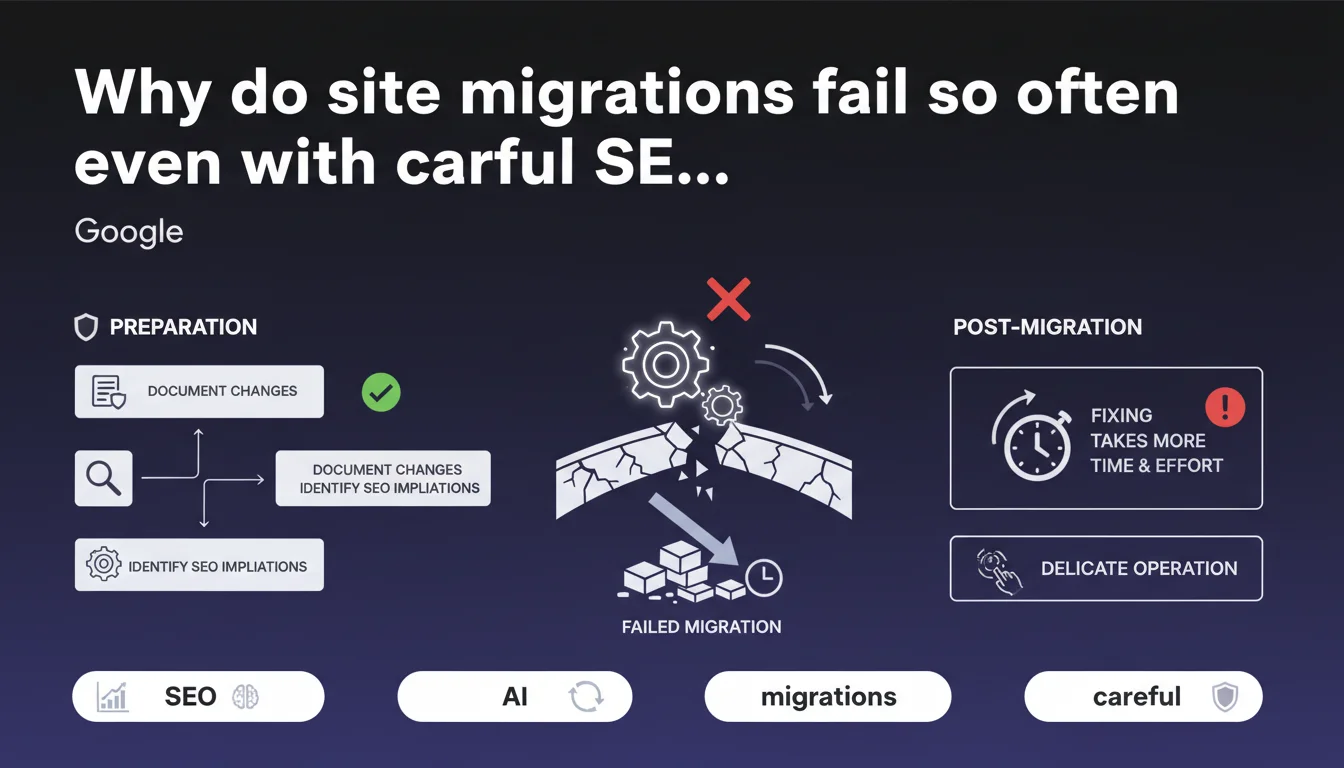
Google reminds us that a site migration remains a delicate exercise even with rigorous preparation. Fixing a failed migration requires infinitely more time and resources than proper upfront planning. Comprehensive documentation of every change and precise identification of SEO impacts are the two pillars of a successful migration.
What you need to understand
What exactly does the term "site migration" mean according to Google?
Google does not provide a restrictive definition. A migration can involve a domain name change, a complete architecture overhaul, a switch to HTTPS, URL modifications, or even a merger of multiple sites.
The common thread? Each type of migration carries its own specific SEO risks. A CMS change does not require the same precautions as a domain change. Hence Google's insistence on documentation: you need to know exactly what is changing to anticipate the consequences.
Why does Google emphasize documentation so heavily?
Because the majority of migrations fail due to lack of traceability. When you do not document every modification — old URL, new URL, HTTP status, meta tags, internal linking — you lose track.
It becomes impossible to diagnose why a particular section loses 60% of its traffic three weeks after going live. Documentation becomes your map to navigate during and after the migration.
Fixing a failed migration: how much time should you really budget?
Google speaks of "significantly more time", without providing specific figures. From field experience: a poorly executed migration can require 6 to 12 months of intensive corrections, compared to 2-3 months of well-executed initial preparation.
The major problem? Errors compound and create domino effects. A 302 redirect instead of 301, multiplied by 10,000 URLs, generates a massive confusion signal for Googlebot. Repairing that takes time — a lot of time.
- A site migration encompasses highly varied changes: domain, structure, protocol, CMS
- Comprehensive documentation is the non-negotiable prerequisite to anticipate SEO impacts
- Fixing a failed migration requires 3 to 4 times more resources than rigorous preparation
- Even with excellent preparation, migrations remain high-risk operations
SEO Expert opinion
Does this statement reflect the reality on the ground for site migrations?
Absolutely. Google is stating the obvious, but it needs to be said. Too many migrations are still treated as pure IT projects, without SEO involvement from the start.
Result: SEO teams discover the new structure on the day of go-live. Impossible to make up for it. Redirects are poorly executed, canonical tags point to nowhere, internal linking collapses. Three weeks later, organic traffic has dropped by 40% and nobody knows where to start fixing it.
What nuances should be added to this statement?
Google speaks of "delicate migrations" even with good preparation. Let's be honest: some migrations are riskier than others. A domain change while maintaining the exact same URL structure remains manageable. A complete overhaul with new architecture, new CMS, and new domain? That's a triple somersault.
Timing matters too. A progressive migration, done section by section, allows you to detect and correct errors before they contaminate the entire site. A big bang cutover on a Friday evening? Good luck.
[To be verified] Google provides no figures on the average recovery time after a successful migration. Field observation: budget at least 3 to 6 months to return to your original traffic level, even without major errors.
In what cases does this rule not fully apply?
Micro technical migrations — HTTPS migration alone, adding a language, migrating a subsection — carry less risk. Preparation remains important, but the cost of an error remains limited and localized.
Conversely, e-commerce site migrations with thousands of products and strong seasonality? There, the slightest error can cost hundreds of thousands of euros in lost revenue. Preparation is no longer optional, it's mandatory insurance coverage.
Practical impact and recommendations
What exactly needs to be documented before a migration?
Every existing URL and its future destination. Each 301 redirect must be mapped in a master file, with the old URL, the new one, the target HTTP status, and the reason for the change.
Also document the current architecture: depth of each section, internal linking, title tags/meta descriptions, structured data, sitemap files. If you do not know what you have before, you will not be able to verify that everything is in place after.
What errors must you avoid during a migration?
First fatal error: failing to test in a staging environment. Deploying directly to production is playing Russian roulette with your organic visibility.
Second error: forgetting to update the robots.txt file and submit new sitemaps. Googlebot arrives, finds prohibitions or 404s, and begins to deindex your pages.
Third error: not actively monitoring the first days post-migration. 404 errors, redirect loops, canonicalization issues must be detected and corrected in real time.
How do you verify that the migration went smoothly?
Monitor Search Console like a hawk. Crawl errors should remain stable or decrease, not explode. The number of indexed pages should stabilize at the expected level within 2-3 weeks.
Compare organic traffic by section before/after. A localized drop signals a problem with redirects or broken internal linking. A generalized drop? More serious issue — forgotten noindex tags, misconfigured robots.txt, 302 redirects instead of 301.
- Create a master file with all 301 redirects, old URLs and new URLs
- Document the current architecture: depth, linking, tags, structured data
- Thoroughly test in staging before go-live
- Verify robots.txt, sitemaps, and Search Console immediately after migration
- Monitor 404 errors and organic traffic trends daily for 30 days
- Have a rollback plan ready in case of critical unresolved issues within 72 hours
❓ Frequently Asked Questions
Combien de temps faut-il pour récupérer son trafic après une migration réussie ?
Faut-il migrer un site d'un coup ou progressivement ?
Quelle est l'erreur la plus fréquente lors d'une migration de site ?
Peut-on annuler une migration si elle se passe mal ?
Faut-il prévenir Google avant une migration de site ?
🎥 From the same video 20
Other SEO insights extracted from this same Google Search Central video · published on 18/12/2023
🎥 Watch the full video on YouTube →
💬 Comments (0)
Be the first to comment.