
Official statement
Other statements from this video 20 ▾
- □ Should you really prioritize a hierarchical structure for large websites?
- □ Is blocking crawl via robots.txt really the miracle solution against toxic links?
- □ Should you translate your URLs to boost international SEO rankings?
- □ Does Googlebot really ignore the meta prerender-status-code 404 tag in JavaScript applications?
- □ Why do site migrations fail so often even with careful SEO preparation?
- □ Are double slashes in URLs really hurting your SEO performance?
- □ Is your video being penalized by Google for appearing below the fold, and how can you fix it?
- □ How can you successfully transfer your image rankings to new URLs without losing search visibility?
- □ Should you really worry about 404 errors on your website?
- □ Is returning HTTP 200 on a 404 page really cloaking or just a soft 404?
- □ Should you force your sitemap file indexation in Google?
- □ Should you worry when Googlebot crawls your API endpoints and generates 404 errors?
- □ Is web accessibility really a Google ranking factor or just a smoke screen?
- □ Does Google really penalize paid link purchases, or is it just a myth?
- □ Should you still report bad backlinks to Google in 2024?
- □ Why does blocking crawl via robots.txt prevent Google from seeing your noindex directive?
- □ Is Google really rejecting the idea of a magic formula to rank higher?
- □ Why is Google displaying your special characters as gibberish in search results?
- □ Why are the data discrepancies between Google Analytics and Search Console causing so much confusion for SEO professionals?
- □ Should you really be chasing perfect SEO?
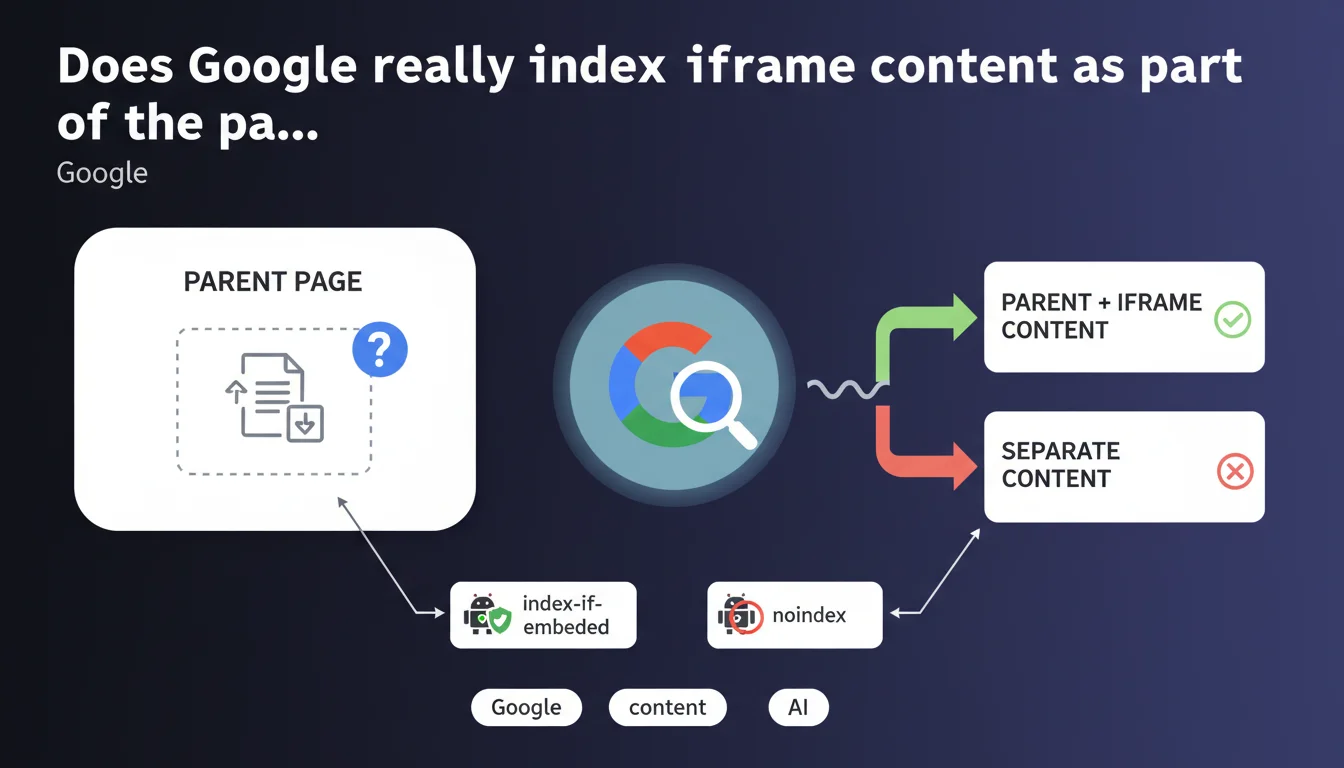
Google attempts to associate iframe content with the parent page during indexing, but there's no guarantee — both remain distinct HTML pages. To force a subpage to be indexed only as a component of the main page, combine 'noindex' and 'index-if-embedded' on the subpage itself.
What you need to understand
Why is Google suddenly talking about content association?
The phrasing "attempts to associate" is critical. Google is acknowledging here that there is absolutely no guarantee that iframe content is actually linked to the parent page in the index. Each URL remains an autonomous entity, even though the iframe creates visual inclusion.
This statement clarifies a historical gray area: for years, SEOs assumed Google ignored or devalued iframes. Yet Google crawls and indexes both pages separately — then tries to make the contextual connection. The word "tries" signals a clear algorithmic limitation.
What does 'index-if-embedded' actually mean in practice?
This meta robots directive is poorly documented and rarely used. It tells Google: "only index this page if it's accessed through an iframe, never in direct access". Combined with 'noindex' on the subpage, it creates strict lockdown.
The problem? This tag only works if Google actually detects the iframe when crawling the parent page. If the bot doesn't render the JavaScript that loads the iframe, or if content is loaded via late lazy-loading, the association fails.
What on-the-ground situations trigger this type of configuration?
Typical use cases involve third-party widgets, payment modules, authentication systems, or syndicated content. When site A embeds content from site B via iframe, B often doesn't want that widget page indexed alone — it makes no sense outside context.
The risk without this directive? Google indexes the subpage URL independently, creating an orphaned page with no value that dilutes crawl budget and pollutes SERPs with incomplete results.
- Google crawls each iframe as a distinct URL with no guarantee of association to parent
- The 'index-if-embedded' directive forces conditional indexing only if the page is embedded
- Combining 'noindex' + 'index-if-embedded' prevents autonomous indexing of the subpage
- This mechanism heavily depends on Google's ability to detect the iframe during rendering
SEO Expert opinion
Is this statement consistent with real-world observations?
Partially. In practice, Google does effectively index iframe content since years ago — Search Console confirms this when you see subpage URLs appearing in coverage reports. But contextual association remains random.
I've observed cases where Google attributes iframe content to the parent page in rich snippets, and others where it treats the iframe as a completely independent page with its own ranking. [To verify]: Google has never published precise criteria defining when association works or fails.
What nuances should we add about 'index-if-embedded'?
Let's be honest: this directive is underused because it's underdocumented. Google never specifies whether it's respected by Bing, Yandex, or other search engines. So we're relying on a proprietary standard with no cross-engine compatibility guarantee.
Second nuance: this tag solves nothing if your iframe loads content via post-render JavaScript. Google must see the iframe in initial HTML to make the connection. If content loads later after user interaction, association simply fails.
In what cases does this rule not apply?
If your iframe loads content already indexed elsewhere — for example, a blog article embedded in a product page — Google may ignore the directive and maintain indexing of the original URL. Implicit canonicalization takes precedence.
Another exception: same-origin iframes (same domain, same protocol). Google has fewer security constraints for crawling this type of content, and contextual association works better. But nothing is guaranteed — which is why the explicit directive matters even in this case.
Practical impact and recommendations
What should you do concretely with your current iframes?
Start with a complete audit: identify all iframes present on your site, whether same-origin or cross-origin. Use a crawler (Screaming Frog, Oncrawl) configured to detect <iframe> tags and extract source URLs.
For each iframe detected, ask yourself this question: should this subpage exist alone in the index, or only as a component of the parent page? If the answer is "component only", add meta robots tags on the subpage.
What mistakes should you avoid during implementation?
Classic mistake: adding 'noindex' alone without 'index-if-embedded'. Result: the subpage disappears from the index, even when embedded. Google makes no distinction — 'noindex' is absolute unless overridden.
Another pitfall: deploying these tags on iframe pages that generate direct organic traffic. First verify in Analytics or Search Console whether these URLs receive impressions/clicks. If yes, deindexing would be a loss of visibility.
How do you verify the configuration is working correctly?
Test with Search Console's URL inspection tool. Request indexing of the parent page, then check if Google detects the iframe during rendering. The "Coverage" section should show whether the subpage is excluded with the status "Excluded by 'noindex' tag".
Then monitor the coverage report for 2-3 weeks. If subpage URLs keep appearing as indexed despite the directive, either Google isn't associating the iframe properly — rendering issue or directive ignored.
- Audit all iframes on your site with a crawler configured for this purpose
- Add 'noindex' + 'index-if-embedded' on subpages that shouldn't be indexed alone
- Verify in Search Console that Google detects the iframe during parent page rendering
- Check coverage reports for subpage URLs still indexed despite the directive
- Never deindex an iframe generating direct organic traffic without prior analysis
❓ Frequently Asked Questions
La directive 'index-if-embedded' est-elle reconnue par tous les moteurs de recherche ?
Si je mets 'noindex' seul sur une page iframe, Google l'indexe-t-il quand même si elle est embarquée ?
Une iframe same-origin est-elle mieux associée à la page parente qu'une iframe cross-origin ?
Comment savoir si Google détecte bien mes iframes lors du rendu ?
Peut-on utiliser une balise canonical sur une page iframe pour pointer vers la page parente ?
🎥 From the same video 20
Other SEO insights extracted from this same Google Search Central video · published on 18/12/2023
🎥 Watch the full video on YouTube →
💬 Comments (0)
Be the first to comment.