
Official statement
Other statements from this video 20 ▾
- □ Does Google really index iframe content as part of the parent page — or treats it as completely separate?
- □ Is blocking crawl via robots.txt really the miracle solution against toxic links?
- □ Should you translate your URLs to boost international SEO rankings?
- □ Does Googlebot really ignore the meta prerender-status-code 404 tag in JavaScript applications?
- □ Why do site migrations fail so often even with careful SEO preparation?
- □ Are double slashes in URLs really hurting your SEO performance?
- □ Is your video being penalized by Google for appearing below the fold, and how can you fix it?
- □ How can you successfully transfer your image rankings to new URLs without losing search visibility?
- □ Should you really worry about 404 errors on your website?
- □ Is returning HTTP 200 on a 404 page really cloaking or just a soft 404?
- □ Should you force your sitemap file indexation in Google?
- □ Should you worry when Googlebot crawls your API endpoints and generates 404 errors?
- □ Is web accessibility really a Google ranking factor or just a smoke screen?
- □ Does Google really penalize paid link purchases, or is it just a myth?
- □ Should you still report bad backlinks to Google in 2024?
- □ Why does blocking crawl via robots.txt prevent Google from seeing your noindex directive?
- □ Is Google really rejecting the idea of a magic formula to rank higher?
- □ Why is Google displaying your special characters as gibberish in search results?
- □ Why are the data discrepancies between Google Analytics and Search Console causing so much confusion for SEO professionals?
- □ Should you really be chasing perfect SEO?
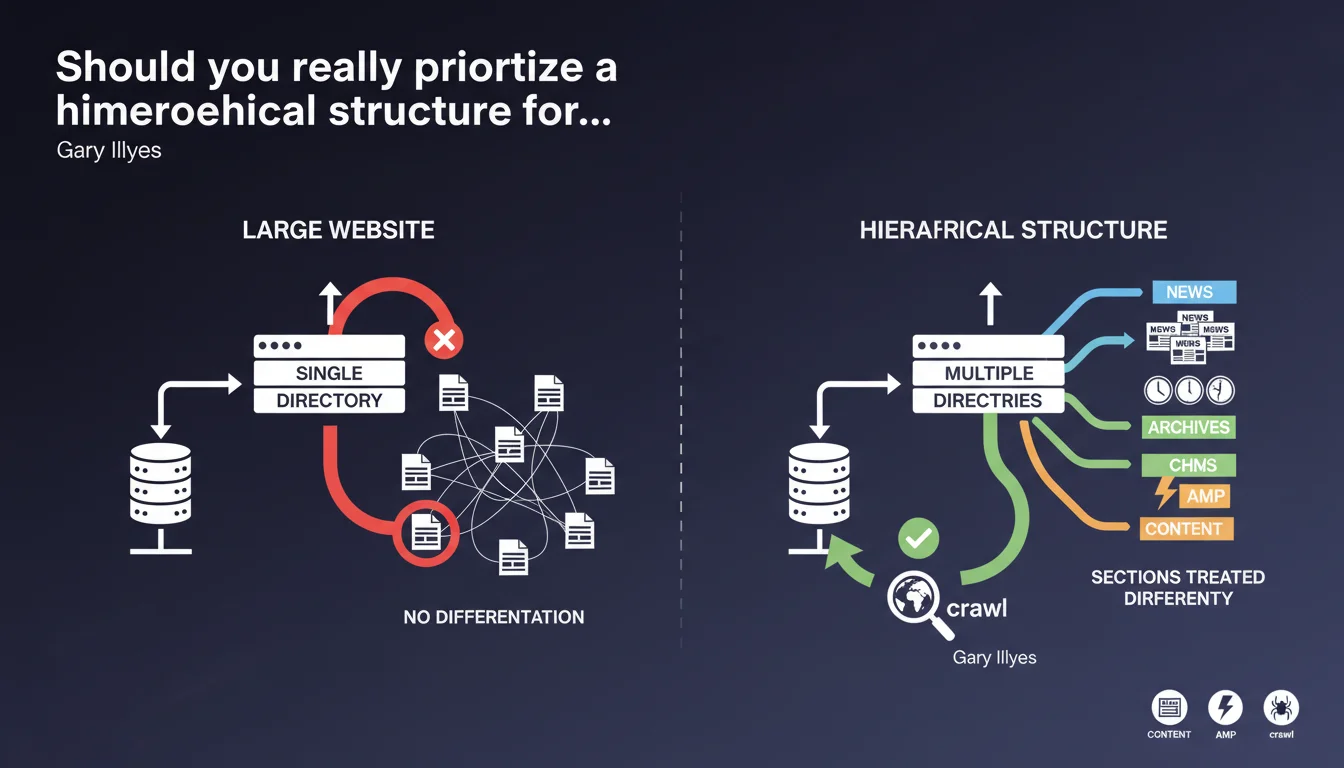
Google explicitly recommends a hierarchical structure for large websites because it allows differentiated crawl treatment by section. Without this organization into distinct directories (e.g., /news/ vs /archives/), it's impossible to optimize crawl frequency by content type.
What you need to understand
Why does Google insist on hierarchical structure for large websites?
Gary Illyes' answer is clear: hierarchical structure provides a crawl control lever that flat structure does not allow. In practical terms, by isolating your content in dedicated directories (/news/, /blog/, /products/), you give structural clues to Googlebot to adapt its crawl strategy.
The example of the 'news' directory is revealing. If your news content is located in /news/, Google can crawl these URLs more frequently than your static archives. If everything is at the same level (flat structure), this differentiation becomes impossible — or at least much more complex to manage through other signals.
What characterizes a flat vs hierarchical structure?
Flat structure: all pages at the same level (example.com/page1, example.com/page2, example.com/page3). No visible logical organization in the URL. Relevant for small websites of 20-50 pages maximum where this distinction has no measurable impact.
Hierarchical structure: organization into directories and subdirectories that reflects the logic of content (example.com/category/subcategory/page). This approach facilitates crawl budget management and thematic understanding by search engines.
In which cases does this recommendation really apply?
Google explicitly mentions "large websites". Let's be honest: if you manage 100 pages, this issue probably doesn't concern you. The critical threshold is rather around 1000+ pages, or as soon as you have content with different lifecycle cycles (news, products, archives, blog, etc.).
E-commerce sites, media outlets, content platforms and multi-section corporate websites are directly concerned. For a 30-page brochure website, this optimization remains anecdotal.
- Hierarchical structure = granular crawl control by section
- Flat structure = no differentiation possible based on architecture
- The critical threshold is around 1000+ pages or multi-type content
- The /news/ example illustrates differentiated crawl frequency optimization
- Without hierarchy, Google must rely solely on other signals (freshness, popularity, etc.)
SEO Expert opinion
Is this statement consistent with real-world observations?
Absolutely. Empirical tests confirm that Google crawls differently depending on the depth and location of URLs. Directories identified as "news" or "blog" do indeed benefit from higher crawl frequency, provided the content is actually fresh and regularly updated.
But be careful — and this is where it gets tricky. Creating a /news/ directory is not enough: if you publish one article per month there, Google will adjust its frequency downward. The structure provides the clue, but it's the editorial behavior that validates or invalidates this clue.
What nuances should be added to this recommendation?
Gary Illyes doesn't specify a crucial point: the hierarchy must remain logical and shallow. A structure like /category/subcategory/sub-subcategory/sub-sub-subcategory/page becomes counterproductive. Beyond 3-4 levels of depth, you dilute crawl budget and complicate indexation.
Another limitation: this approach assumes your sections are clearly defined. If you have hybrid content (a blog article that is also a product update), structuring becomes more delicate. [To verify] Google has never specified how it handles cross-section content in this context.
In which cases does this rule not apply?
For websites with fewer than 500 pages, the impact remains marginal. Flat structure can even be preferable if it reduces crawl depth — a product accessible in 1 click rather than 3 clicks through a complex hierarchy.
Monolingual sites with high internal PageRank can also afford a flat structure: if each page receives enough juice through linking, Googlebot will crawl them frequently regardless of their position. But let's be clear: this is a minority scenario.
Practical impact and recommendations
What should you do concretely on a large website?
Audit your current architecture. List your content types (news, products, in-depth articles, corporate pages) and verify if they are isolated in distinct directories. If everything is mixed at the same level, you're leaving optimization on the table.
Define a coherent directory strategy: /news/ for daily-updated news content, /blog/ for evergreen content, /products/ for catalog, etc. Each directory should correspond to an editorial reality and homogeneous update frequency.
How can you verify that your structure is effective?
Analyze server logs or Google Search Console to identify crawl frequency by directory. If /news/ is crawled as rarely as /archives/, either your publication rhythm doesn't justify this section, or Google hasn't yet understood its nature.
Use differentiated XML sitemaps: one sitemap for /news/ with daily frequency, another for archives with monthly frequency. This reinforces the structural signals given by your URLs.
What mistakes should you avoid when overhauling architecture?
Don't create artificial hierarchy just to "look good". If your categories don't have strong business or editorial logic, you're complexifying the structure without gain. The structure must reflect actual usage, not a theoretical ideal.
Avoid over-segmentation: 15 root directories for 200 total pages makes no sense. Focus on large content masses (100+ pages per section) that justify clear separation.
- Audit current architecture and identify content types
- Create distinct directories for each editorial type (/news/, /blog/, /products/)
- Limit depth to 3-4 levels maximum
- Analyze logs to verify crawl frequency by directory
- Use differentiated XML sitemaps with adapted frequencies
- Avoid over-segmentation (too many directories for few pages)
- Ensure URL structure reflects editorial reality (update frequency)
- Implement clean 301 redirects in case of redesign
❓ Frequently Asked Questions
Un site de 300 pages doit-il obligatoirement adopter une structure hiérarchique ?
Peut-on changer de structure sans perdre du trafic ?
Comment Google sait-il qu'un répertoire /news/ contient de l'actualité ?
Une structure plate peut-elle être plus performante dans certains cas ?
Faut-il créer un répertoire distinct pour chaque catégorie de produits ?
🎥 From the same video 20
Other SEO insights extracted from this same Google Search Central video · published on 18/12/2023
🎥 Watch the full video on YouTube →
💬 Comments (0)
Be the first to comment.