
Official statement
Other statements from this video 20 ▾
- □ Comment Google indexe-t-il réellement le contenu des iframes ?
- □ Faut-il vraiment privilégier une structure hiérarchique pour les grands sites ?
- □ Bloquer le crawl via robots.txt : solution miracle contre les liens toxiques ?
- □ Faut-il traduire ses URLs pour améliorer son référencement international ?
- □ Pourquoi Googlebot ignore-t-il la balise meta prerender-status-code 404 dans les applications JavaScript ?
- □ Pourquoi les migrations de sites échouent-elles si souvent malgré une préparation SEO ?
- □ Les doubles slashes dans les URLs sont-ils un problème pour le SEO ?
- □ Pourquoi Google pénalise-t-il les vidéos hors du viewport et comment y remédier ?
- □ Comment transférer efficacement le classement de vos images vers de nouvelles URLs ?
- □ Faut-il vraiment s'inquiéter des erreurs 404 sur son site ?
- □ HTTP 200 sur une page 404 : soft 404 ou cloaking ?
- □ Faut-il forcer l'indexation de son fichier sitemap dans Google ?
- □ Faut-il s'inquiéter si Googlebot crawle vos endpoints API et génère des 404 ?
- □ L'accessibilité web est-elle vraiment un facteur de classement Google ou un écran de fumée ?
- □ L'achat de liens reste-t-il vraiment sanctionné par Google ?
- □ Faut-il encore signaler les mauvais backlinks à Google ?
- □ Pourquoi bloquer le crawl via robots.txt empêche-t-il Google de voir votre directive noindex ?
- □ Pourquoi Google refuse-t-il l'idée d'une formule magique pour ranker ?
- □ Pourquoi Google affiche-t-il mal vos caractères spéciaux dans ses résultats ?
- □ Faut-il vraiment viser le SEO parfait ?
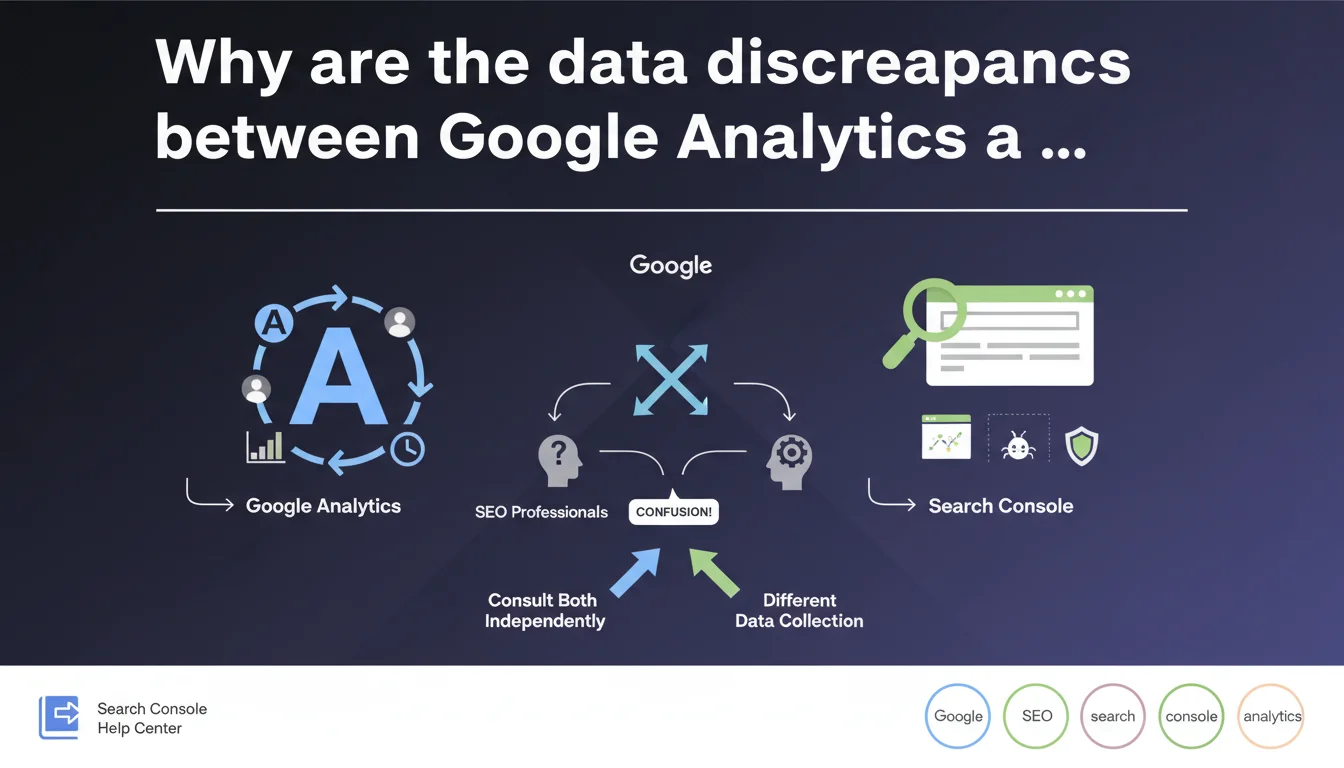
Google confirms that Analytics and Search Console collect user data in fundamentally different ways. The gaps between the two tools are not bugs but normal methodological divergences. An SEO practitioner should consult both sources independently rather than trying to reconcile them.
What you need to understand
Why does Google emphasize these collection differences?
The two platforms serve distinct objectives. Search Console measures performance in Google search results — impressions, clicks, average position — before a user even reaches the site. Analytics, on the other hand, starts tracking when the visitor loads a page with the measurement tag.
In concrete terms? A click recorded in Search Console may never appear in Analytics if the user closes their browser before the page fully loads. Conversely, Analytics captures visits that don't come from Google organic search — social networks, paid campaigns, direct access.
What are the main methodological divergences?
Search Console operates on the Google server side: every time an internet user sees your URL in the SERPs and clicks on it, it's counted. Analytics requires the successful execution of a JavaScript script in the browser — ad blockers, disabled scripts, quick exits, all of this creates losses.
Update delays also differ. Search Console can display data with a 2-3 day lag, while Analytics runs in near real-time. Time segmentation, time zones, attribution rules — nothing is synchronized between the two.
What should you keep in mind for professional use?
- No single truth: the numbers never perfectly align, and that's normal
- Search Console = view of performance in Google Search
- Analytics = view of user behavior on site
- Gaps of 10-20% between organic sessions SC and GA are common and acceptable
- Use each tool for what it does best, not to validate the other
SEO Expert opinion
Is this statement consistent with real-world observations?
Absolutely. For years, SEO practitioners have observed sometimes massive gaps between organic sessions reported by Analytics and clicks in Search Console. Google is formalizing here what is technically obvious — two different measurement systems produce different results.
What's missing is granularity. Google remains vague about what constitutes an acceptable gap. A 5% delta? 30%? At what threshold should you investigate a technical issue? [To verify]: no numerical data provided.
What nuances should you add in practice?
The statement implies that the two tools complement each other, but it sidesteps a recurring problem: some clients demand numbers that match. When a decision-maker sees 1000 clicks in Search Console and 750 organic sessions from Google in Analytics, they ask legitimate questions.
You need to educate stakeholders about the nature of the metrics. Search Console captures clicks that don't result in a measurable visit (quick close, blocked JS, bots). Analytics captures organic traffic that doesn't necessarily come from Google Search (Google Images, Google News, Google Discover if poorly tagged).
When does this rule not apply?
On sites with very low traffic (less than 100 sessions/day), statistical variations become difficult to interpret. Natural fluctuations cloud the comparison. Conversely, on high-volume sites, a consistent and stable gap between SC and GA becomes a reference metric in itself.
Sites with server-side tracking or alternative solutions to Google Analytics may observe different behaviors — some tools capture ephemeral clicks better than GA4 on the client side.
Practical impact and recommendations
What should you do concretely to leverage both tools?
Build separate dashboards with distinct objectives. Search Console to track visibility in Google (queries triggering impressions, click-through rate, positions), Analytics to measure engagement (bounce rate, duration, conversions).
Stop trying to reconcile numbers to the decimal point. Instead, use relative trends: if Search Console shows +20% clicks over a month and Analytics shows +18% organic Google sessions, the direction is confirmed, that's sufficient.
What mistakes should you avoid in cross-tool analysis?
Never use Search Console figures as absolute truth to dispute Analytics data, or vice versa. Each tool has its methodology, limits, biases. A Search Console click is not an Analytics session — they are two different events in the user journey.
Also avoid creating non-aligned time segments. Search Console often displays data with 48-72 hour delays, especially on new Properties. Comparing yesterday's traffic in SC with yesterday's in GA creates artificial inconsistencies.
How do you effectively track SEO performance within these constraints?
- Define primary KPIs by tool: impressions/CTR/positions in SC, conversions/engagement in GA
- Document the average SC/GA gap on your site to establish a normal baseline
- Investigate only if the gap changes dramatically without obvious reason
- Cross-reference trends over long periods (30-90 days) rather than daily
- Use Search Console to identify keyword opportunities, Analytics to measure their business impact
- Implement clean tracking: UTMs on external campaigns, anti-spam filters in GA, regular tag validation
❓ Frequently Asked Questions
Quel écart entre Search Console et Analytics est considéré comme normal ?
Pourquoi mes clics Search Console sont-ils toujours supérieurs à mes sessions Analytics ?
Peut-on importer les données Search Console dans Analytics pour les croiser ?
Quel outil privilégier pour mesurer le ROI SEO ?
Les données Search Console sont-elles échantillonnées comme celles d'Analytics ?
🎥 From the same video 20
Other SEO insights extracted from this same Google Search Central video · published on 18/12/2023
🎥 Watch the full video on YouTube →
💬 Comments (0)
Be the first to comment.