
Official statement
Other statements from this video 20 ▾
- □ Comment Google indexe-t-il réellement le contenu des iframes ?
- □ Faut-il vraiment privilégier une structure hiérarchique pour les grands sites ?
- □ Bloquer le crawl via robots.txt : solution miracle contre les liens toxiques ?
- □ Faut-il traduire ses URLs pour améliorer son référencement international ?
- □ Pourquoi Googlebot ignore-t-il la balise meta prerender-status-code 404 dans les applications JavaScript ?
- □ Pourquoi les migrations de sites échouent-elles si souvent malgré une préparation SEO ?
- □ Les doubles slashes dans les URLs sont-ils un problème pour le SEO ?
- □ Pourquoi Google pénalise-t-il les vidéos hors du viewport et comment y remédier ?
- □ Comment transférer efficacement le classement de vos images vers de nouvelles URLs ?
- □ Faut-il vraiment s'inquiéter des erreurs 404 sur son site ?
- □ HTTP 200 sur une page 404 : soft 404 ou cloaking ?
- □ Faut-il forcer l'indexation de son fichier sitemap dans Google ?
- □ Faut-il s'inquiéter si Googlebot crawle vos endpoints API et génère des 404 ?
- □ L'accessibilité web est-elle vraiment un facteur de classement Google ou un écran de fumée ?
- □ L'achat de liens reste-t-il vraiment sanctionné par Google ?
- □ Faut-il encore signaler les mauvais backlinks à Google ?
- □ Pourquoi bloquer le crawl via robots.txt empêche-t-il Google de voir votre directive noindex ?
- □ Pourquoi Google refuse-t-il l'idée d'une formule magique pour ranker ?
- □ Pourquoi Google affiche-t-il mal vos caractères spéciaux dans ses résultats ?
- □ Google Analytics et Search Console : pourquoi ces différences de données posent-elles problème ?
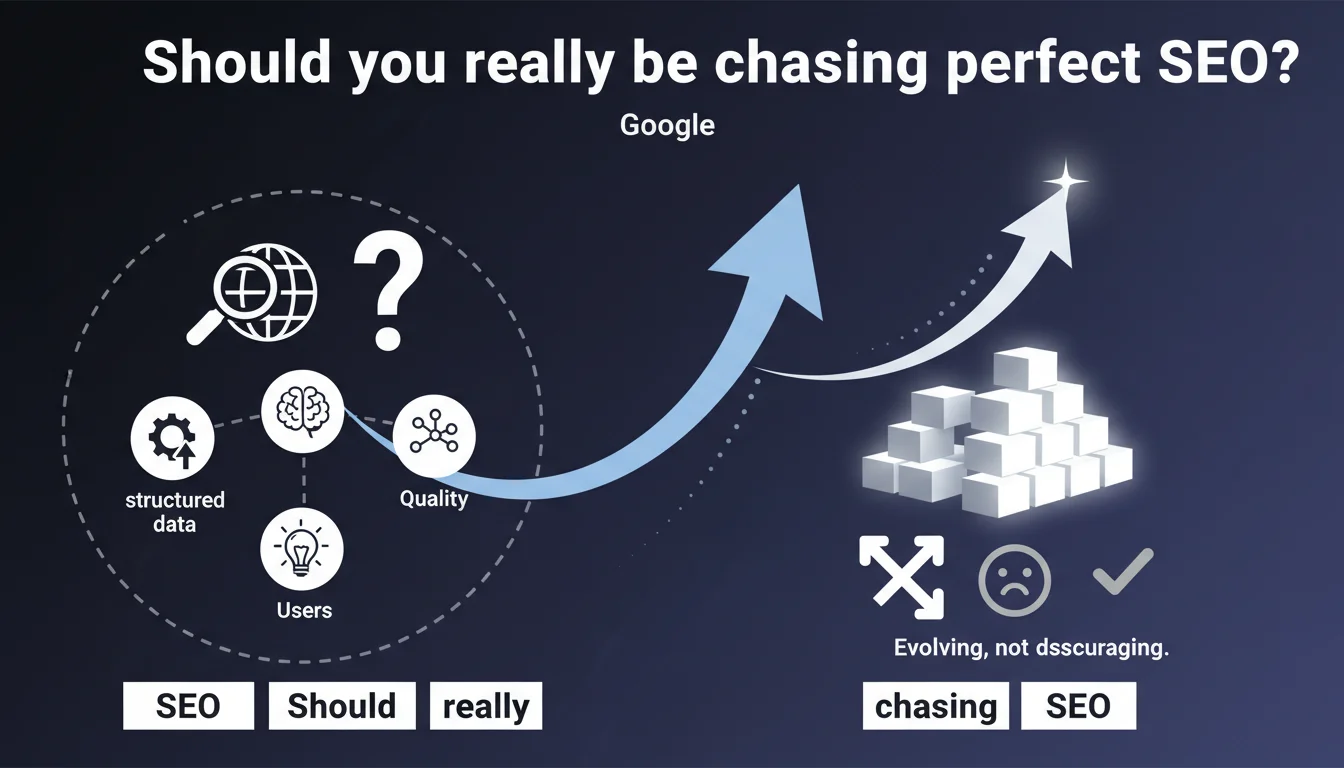
Google claims that no SEO is perfect and that pursuing this goal is illusory. The internet, algorithms, and user behavior are constantly evolving, so SEO must continuously adapt. The absence of perfection shouldn't discourage action — continuous improvement trumps absolute optimization.
What you need to understand
Why does Google insist on the impossibility of perfect SEO?
This statement aims to defuse an unrealistic expectation: that of a site permanently optimized that would maintain its rankings without evolving. Google reminds us that its ecosystem relies on three variables in constant motion — web infrastructure, its own algorithms, and search intent.
Concretely, a site can check all the technical boxes today and find itself obsolete in six months, not through negligence, but because the standards themselves have shifted. Structured data is a prime example: Schema.org regularly enriches its types, Google tests new rich formats, and what was optional sometimes becomes discriminatory.
What exactly does this notion of constant evolution encompass?
Google explicitly mentions two axes: the technical (including structured data) and quality. On the technical side, Core Web Vitals, security protocols, mobile-first management — all of this is refined through updates. Thresholds change, measurement methods too.
On the quality side, it's even murkier. E-E-A-T criteria evolve, expectations regarding content freshness vary by sector, and algorithmic updates (Helpful Content, Product Reviews) regularly reshape what "quality" means.
Is this statement an excuse or a factual observation?
It can be both. On one hand, it's a fact: no serious SEO professional will claim to have a site frozen in an eternally optimal state. On the other, it allows Google to justify the volatility of results and minimize frustration when a well-optimized site suddenly loses ground.
The underlying message: stop looking for the magic formula. Invest in continuous improvement, not a one-time audit meant to fix everything.
- SEO is an iterative process, not a one-shot configuration
- Technical and quality standards evolve at the pace of Google updates
- The goal isn't perfection, but permanent adaptation
- Structured data and E-E-A-T are cited as examples of moving criteria
SEO Expert opinion
Is this statement consistent with what we observe in the field?
Yes and no. Yes, because we genuinely see technically flawless sites lose ground after a Core Update or a shift in search intent interpretation. E-E-A-T signals remain opaque, and what worked in January might become insufficient by June.
No, because Google omits a crucial detail: certain technical fundamentals remain stable. A fast site, well-structured, with coherent title tags and clean internal linking will always retain an advantage. What changes is the relative weight of each lever and expectations regarding content.
What nuances should be added to this discourse?
First, constant evolution doesn't affect everything equally. Crawl/indexation fundamentals shift little: robots.txt, XML sitemaps, server-side JavaScript management — these remain stable. What fluctuates are peripheral signals: user behavior, brand signals, source diversity.
Second, Google conflates two distinct things. The evolution of algorithms is one thing; the evolution of search formats is another. If tomorrow Google pushes featured snippets or video carousels, it's not your SEO that's imperfect — it's the SERP that's changing in nature. [To verify]: Google never clearly states whether "perfect SEO" refers to technical optimization or alignment with emerging search result formats.
In what cases does this rule not really apply?
For stable transactional queries with little algorithmic volatility, a well-optimized site can maintain its rankings for a long time without major intervention. Example: a niche product query, low competition, with a clean e-commerce site and regular user reviews.
Similarly, certain sectors — notably those tied to health or finance — see their quality criteria evolve slowly. E-E-A-T requirements are high there, but once satisfied, they offer relative stability. Here again, Google is overgeneralizing.
Practical impact and recommendations
What should you do concretely in light of this reality?
Adopt a logic of continuous monitoring rather than one-off audits. Monitor algorithmic evolutions, regularly test new features (structured data, rich formats), and adjust content based on Search Console and Analytics feedback.
Concretely, this means budgeting time for SEO maintenance — not just content creation or link building. Revising old articles, updating obsolete schemas, verifying that Core Web Vitals hold over time.
What mistakes should you avoid in light of this statement?
Don't fall into paralyzing perfectionism. Some SEO professionals spend weeks fine-tuning technical details (ultra-precise microformats, pixel-perfect crawl budget optimization) while the site lacks fresh content or relevant backlinks.
Another trap: believing that an exhaustive SEO audit guarantees lasting rankings. An audit is a snapshot at that moment in time. Six months later, if you haven't monitored anything or made adjustments, you're already falling behind.
How to structure a viable SEO approach in this context?
Favor an iterative strategy: small regular improvements rather than massive overhauls every two years. Break projects into sprints — this month we improve internal linking, next month we enrich structured data, etc.
Document changes and their impacts. If you modify Hn tags or add structured FAQ sections, note the date and monitor traffic variations on affected pages. This allows you to validate or invalidate empirically what works, rather than blindly following Google recommendations.
- Implement monthly monitoring of Core Web Vitals and Search Console errors
- Plan quarterly reviews of priority content (updates, section additions, semantic enrichment)
- Test new structured data types as soon as they launch and measure their impact on CTR
- Monitor SERP fluctuations on your target queries — a format change can require content adaptation
- Document each significant SEO modification and its observable result at 30/60/90 days
❓ Frequently Asked Questions
Est-ce que viser le SEO parfait est une perte de temps ?
Les données structurées sont-elles vraiment si mouvantes ?
Un audit SEO reste-t-il utile dans ce contexte ?
Peut-on quand même se fixer des objectifs SEO stables ?
Comment savoir si mon SEO est suffisamment bon ?
🎥 From the same video 20
Other SEO insights extracted from this same Google Search Central video · published on 18/12/2023
🎥 Watch the full video on YouTube →
💬 Comments (0)
Be the first to comment.