
Official statement
Other statements from this video 20 ▾
- □ Comment Google indexe-t-il réellement le contenu des iframes ?
- □ Faut-il vraiment privilégier une structure hiérarchique pour les grands sites ?
- □ Bloquer le crawl via robots.txt : solution miracle contre les liens toxiques ?
- □ Faut-il traduire ses URLs pour améliorer son référencement international ?
- □ Pourquoi Googlebot ignore-t-il la balise meta prerender-status-code 404 dans les applications JavaScript ?
- □ Pourquoi les migrations de sites échouent-elles si souvent malgré une préparation SEO ?
- □ Les doubles slashes dans les URLs sont-ils un problème pour le SEO ?
- □ Pourquoi Google pénalise-t-il les vidéos hors du viewport et comment y remédier ?
- □ Comment transférer efficacement le classement de vos images vers de nouvelles URLs ?
- □ Faut-il vraiment s'inquiéter des erreurs 404 sur son site ?
- □ HTTP 200 sur une page 404 : soft 404 ou cloaking ?
- □ Faut-il forcer l'indexation de son fichier sitemap dans Google ?
- □ Faut-il s'inquiéter si Googlebot crawle vos endpoints API et génère des 404 ?
- □ L'accessibilité web est-elle vraiment un facteur de classement Google ou un écran de fumée ?
- □ L'achat de liens reste-t-il vraiment sanctionné par Google ?
- □ Pourquoi bloquer le crawl via robots.txt empêche-t-il Google de voir votre directive noindex ?
- □ Pourquoi Google refuse-t-il l'idée d'une formule magique pour ranker ?
- □ Pourquoi Google affiche-t-il mal vos caractères spéciaux dans ses résultats ?
- □ Google Analytics et Search Console : pourquoi ces différences de données posent-elles problème ?
- □ Faut-il vraiment viser le SEO parfait ?
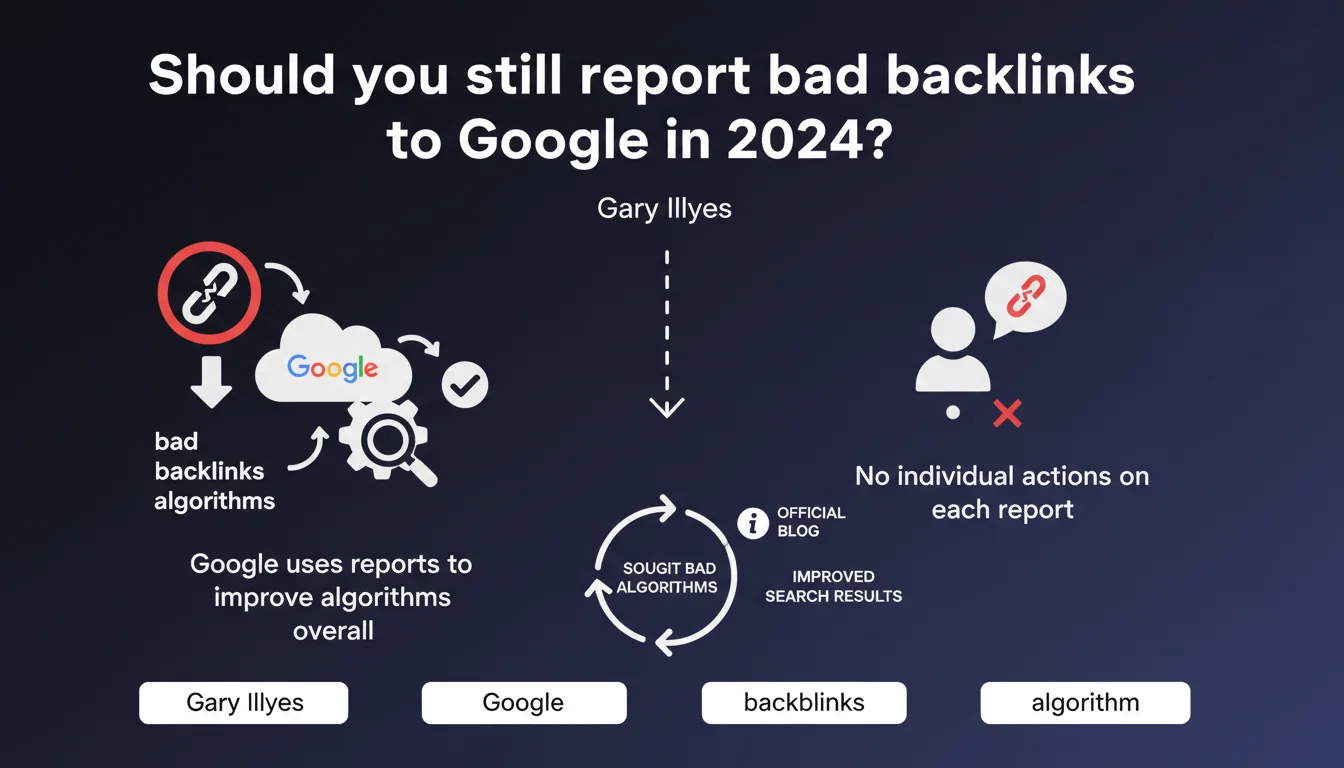
Google uses bad link reports submitted via the disavow tool to improve its detection algorithms — but doesn't handle each report individually. The bottom line: your disavow file mainly serves to train automated systems, not to clean up your link profile site by site.
What you need to understand
What happens to backlink reports you submit to Google?
When you disavow links via Search Console, Google doesn't send an engineer to manually review your list. The team uses this data to refine the overall detection of artificial link schemes.
Concretely, your reports feed the machine learning models that identify PBN networks, worthless directories, spam comments. You're participating in algorithm training — but your site doesn't get priority treatment as a result.
Does Google act on each report individually?
No. That's the central point of this statement. Sending a disavow file triggers no targeted manual action on your link profile.
Google aggregates the data, detects recurring patterns, updates its filters. Your report contributes to the training database — but if you were hoping a human would review your 500 lines of disavow, forget it.
What's the real value of the disavow file today?
It remains useful in two specific cases: if you've inherited a manual penalty for artificial links, or if you want to protect a site from a massive and documented negative SEO attack.
In all other scenarios, the real-time integrated Penguin algorithm already ignores toxic links without human intervention. The disavow becomes psychological insurance rather than a technical lever.
- Backlink reports serve to train algorithms, not to process each case
- No manual action is triggered by a disavow file
- The tool remains relevant in case of manual penalty or proven negative SEO attack
- For most sites, Penguin already handles toxic links automatically
SEO Expert opinion
Is this statement consistent with observed practices?
Yes. Since Penguin's real-time integration, we observe that Google simply ignores suspicious links instead of penalizing. Negative signals are neutralized, not sanctioned — except in extreme cases.
Field audits confirm it: a site receiving 200 poor backlinks from a PBN network generally suffers no ranking drop. The algorithms have learned to devalue without punishing. The disavow becomes a relic of the pre-2016 era.
What nuances should we add?
Caution: if you've received a manual notification for "artificial links," the disavow file becomes essential for reconsideration. In this context alone, Google reviews your cleanup.
Another subtlety: Gary Illyes doesn't specify what timeframe separates a report submission from its integration into learning models. [To verify] We don't know if data is processed in monthly batches or continuously.
In what cases does this rule not apply?
If you detect a documented negative SEO attack — sudden spike of 10,000 backlinks from casino sites in 48 hours —, the disavow remains a safety net. Google claims to handle this automatically, but nobody would bet their online store on it.
Same goes for sites in ultra-sensitive niches (health, finance) where the slightest link profile ambiguity can cool down the E-E-A-T algorithm. The precautionary principle applies.
Practical impact and recommendations
What should you actually do with the disavow file?
Stop submitting disavow files out of reflex. Reserve this tool for documented situations: active manual penalty, massive negative SEO attack with timestamped evidence, acquisition of a poor-quality domain.
For a standard site with no problematic history, focus your energy on acquiring quality natural links rather than obsessively cleaning backlinks that Google already ignores.
What mistakes should you avoid?
Don't disavow links just because an SEO tool assigns them a toxic score. These proprietary metrics (DA, Trust Flow, etc.) do not reflect Google's actual assessment.
Also avoid disavowing entire domains out of caution — you risk cutting off residual positive signals that the algorithm still values. Page-level disavow is more surgical.
How should you adjust your link-building strategy?
Since Google uses your reports to train its algorithms, focus on creating linkable content and digital PR relationships. Natural editorial links remain the only lasting lever.
Audit your profile regularly with Search Console — but intervene only if you spot a glaring anomaly correlated with a traffic drop. Everything else is noise.
- Use the disavow tool only in case of manual penalty or proven attack
- Don't blindly trust toxic scores from third-party tools
- Prefer page-level disavow over entire domain disavow
- Invest in acquiring natural editorial links
- Monitor Search Console without falling into cleanup paranoia
❓ Frequently Asked Questions
Dois-je supprimer mon fichier disavow actuel ?
Les outils SEO qui détectent des liens toxiques sont-ils fiables ?
Comment savoir si je subis une attaque negative SEO ?
Le disavow tool a-t-il encore un impact SEO direct ?
Combien de temps faut-il pour qu'un fichier disavow soit pris en compte ?
🎥 From the same video 20
Other SEO insights extracted from this same Google Search Central video · published on 18/12/2023
🎥 Watch the full video on YouTube →
💬 Comments (0)
Be the first to comment.