
Official statement
Other statements from this video 20 ▾
- □ Does Google really index iframe content as part of the parent page — or treats it as completely separate?
- □ Should you really prioritize a hierarchical structure for large websites?
- □ Is blocking crawl via robots.txt really the miracle solution against toxic links?
- □ Should you translate your URLs to boost international SEO rankings?
- □ Does Googlebot really ignore the meta prerender-status-code 404 tag in JavaScript applications?
- □ Why do site migrations fail so often even with careful SEO preparation?
- □ Are double slashes in URLs really hurting your SEO performance?
- □ Is your video being penalized by Google for appearing below the fold, and how can you fix it?
- □ How can you successfully transfer your image rankings to new URLs without losing search visibility?
- □ Should you really worry about 404 errors on your website?
- □ Is returning HTTP 200 on a 404 page really cloaking or just a soft 404?
- □ Should you force your sitemap file indexation in Google?
- □ Should you worry when Googlebot crawls your API endpoints and generates 404 errors?
- □ Is web accessibility really a Google ranking factor or just a smoke screen?
- □ Should you still report bad backlinks to Google in 2024?
- □ Why does blocking crawl via robots.txt prevent Google from seeing your noindex directive?
- □ Is Google really rejecting the idea of a magic formula to rank higher?
- □ Why is Google displaying your special characters as gibberish in search results?
- □ Why are the data discrepancies between Google Analytics and Search Console causing so much confusion for SEO professionals?
- □ Should you really be chasing perfect SEO?
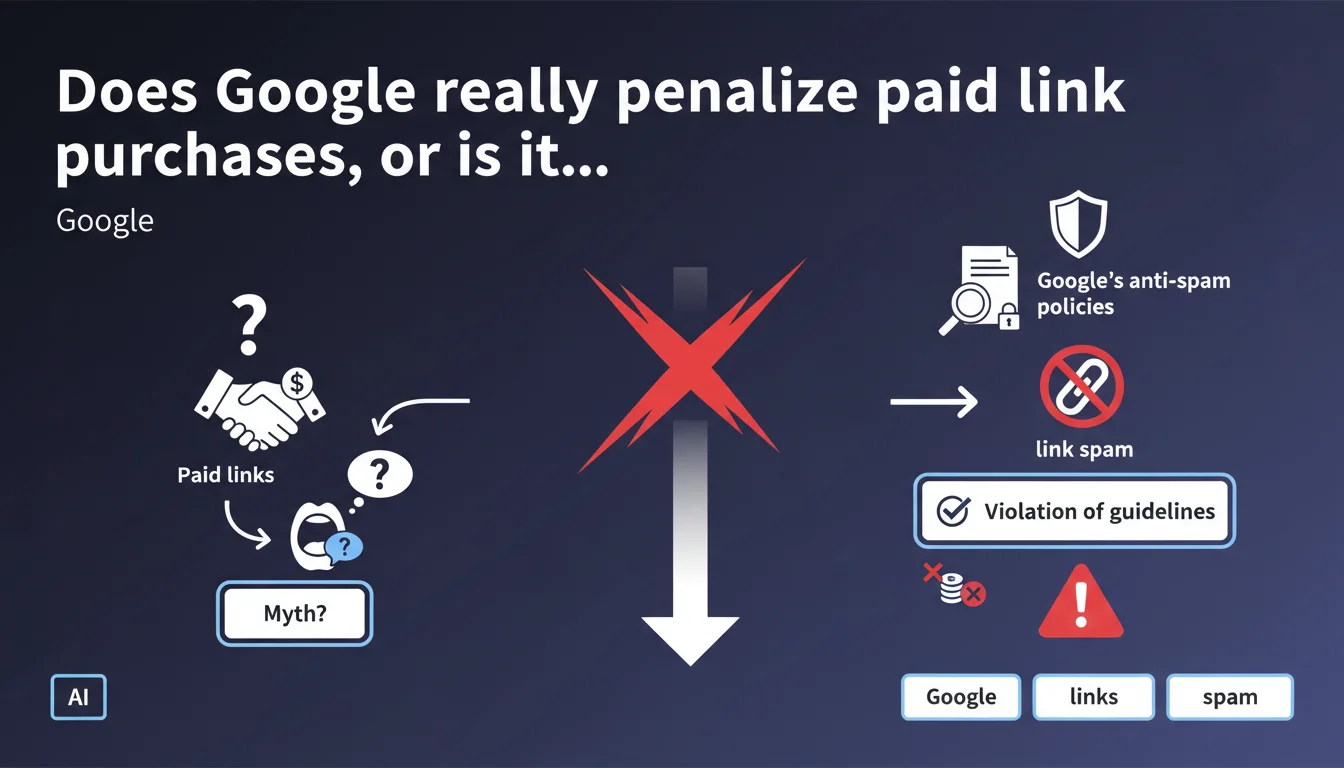
Google reaffirms that its stance on paid links has never changed: it's forbidden, plain and simple. Anti-spam policies remain identical, and any paid link without rel="sponsored" or rel="nofollow" markup violates guidelines. No evolution, no flexibility — the red line stays just as clear.
What you need to understand
Why is Google reaffirming this position now?
This statement brings nothing new to the table. Google is simply reminding everyone that buying links without appropriate markup remains a blatant violation of its guidelines. No softening, no officially recognized gray area.
Google's anti-spam policy on links has existed for years. It targets any link scheme designed to manipulate PageRank: direct purchases, massive exchanges, private blog networks… The message remains identical.
What exactly constitutes a paid link?
A paid link is any transfer of value in exchange for a link. Cash obviously, but also free products, services rendered, visibility exchanges… If consideration exists and the link passes PageRank, you're in the danger zone.
The critical nuance: Google tolerates paid links provided they're marked with rel="sponsored" or rel="nofollow". These attributes cancel out the PageRank transfer. Without them, it's a violation.
What are the concrete consequences for a website?
Penalties range from outright link disavowal (Google neutralizes them algorithmically) to heavier manual penalties. In severe cases, the entire relevant section of a site can lose its authority, or even the entire domain if spam is systemic.
Google has significantly refined its automatic detection. The SpamBrain algorithm now identifies most schemes without human intervention. Manual actions are reserved for massive or repeat offenses.
- Buying links remains a violation of Google's guidelines from day one
- Only links marked rel="sponsored" or rel="nofollow" are tolerated
- Penalties range from algorithmic neutralization to manual actions
- SpamBrain automatically detects most artificial link schemes
- Any consideration (money, product, service) constitutes a commercial exchange
SEO Expert opinion
Does this statement actually reflect what's really happening in the field?
Let's be honest: thousands of sites buy links every day and are never touched. Google's detection, however sophisticated, isn't foolproof. Entire networks operate without issues for years.
The gap between official doctrine and observed reality is enormous. Some hyper-competitive sectors (finance, gambling, CBD…) run almost entirely on artificial link profiles. And many do just fine — until one day they don't.
What nuances does Google fail to mention?
Google never talks about perceived intent. A bought link that looks like a natural editorial link — relevant context, authoritative site, smooth integration — has far less chance of being detected than footer links in bulk across 200 low-quality blogs.
Detection granularity also varies considerably. Large sites with established authority can absorb a few questionable links without impact. A new or fragile site often gets hammered for far less. [To verify]: Google has never clarified if a real tolerance threshold actually exists.
In what cases does this rule apply differently?
Legitimate business partnerships raise questions. If you sponsor an event and get a link, is that buying? Technically yes. Google will say it needs rel="sponsored" markup. In practice, many don't and it slides through.
Same ambiguity with well-integrated sponsored content. An in-depth article written by you, published on quality media for payment, with a contextual link… officially forbidden without markup. Realistically sanctioned? Rarely, unless it's repeated identically across 50 sites.
Practical impact and recommendations
What should you actually do to stay within the rules?
If you pay for a link — cash, product, service, whatever — mark it systematically with rel="sponsored" or rel="nofollow". It's the only official line of defense. You lose the SEO benefit, but you avoid the risk.
Regularly audit your inbound link profile. Look for suspicious patterns: identical optimized anchors, links from thematically unrelated sites, mass footers, sudden backlink spikes… If it looks like spam from the outside, Google will see it too.
What mistakes should you absolutely avoid?
Never buy in bulk from public platforms. Blog networks accessible to everyone are constantly scrutinized by Google. Same logic for low-quality paid directories or press releases distributed across 300 clone sites.
Avoid over-optimized anchors. A bought link with exact keyword anchor screams "I'm artificial". Vary it, dilute it, favor brand or generic anchors if you're taking this risk.
How can I verify that my link profile is clean?
Use Google Search Console to monitor manual actions. If you receive one for link spam, you already have a serious problem. But the absence of manual action doesn't mean everything's fine — algorithmic processing can neutralize your links without warning.
Cross-reference with third-party tools (Ahrefs, Majestic, Semrush) to identify potentially toxic links. Look at quality metrics: Trust Flow, Domain Rating, thematic relevance. A link from a DR 5 site with no traffic, stuffed with spam… disavow it.
- Mark all paid links with rel="sponsored" or rel="nofollow"
- Audit your backlink profile at least quarterly
- Monitor Search Console for any manual actions
- Avoid public link-buying platforms
- Systematically vary link anchors
- Disavow toxic links identified through third-party tools
- Focus on a long-term strategy of natural editorial links
❓ Frequently Asked Questions
Un lien issu d'un partenariat commercial doit-il être systématiquement balisé ?
Peut-on acheter des liens si on les balise correctement ?
Les échanges de liens sont-ils considérés comme des liens payants ?
Comment savoir si Google a neutralisé mes liens achetés ?
Le désaveu de liens protège-t-il vraiment des pénalités ?
🎥 From the same video 20
Other SEO insights extracted from this same Google Search Central video · published on 18/12/2023
🎥 Watch the full video on YouTube →
💬 Comments (0)
Be the first to comment.