
Official statement
What you need to understand
Why Does a Site Redesign Represent a Major Risk for SEO?
A site redesign typically involves technical, structural, and editorial modifications that can negatively impact SEO if not anticipated. Each URL change, navigation structure alteration, or content modification can result in temporary or permanent ranking losses.
Google must reindex the entire site and recalculate the authority of each page. Without rigorous planning, risks include 404 errors, PageRank dilution, crawl budget waste, and a brutal drop in organic traffic.
What Types of Changes Can Impact SEO During a Redesign?
Changes to information architecture, URL structure, internal linking, and HTML templates are the most critical. Even seemingly benign UI/UX improvements can slow loading times or modify the content hierarchy.
Modifications to title tags, meta descriptions, headings, and text content directly impact the relevance perceived by Google. Adding or removing pages requires meticulous management of 301 redirects and indexation.
What Methodology Does Google Recommend to Secure a Migration?
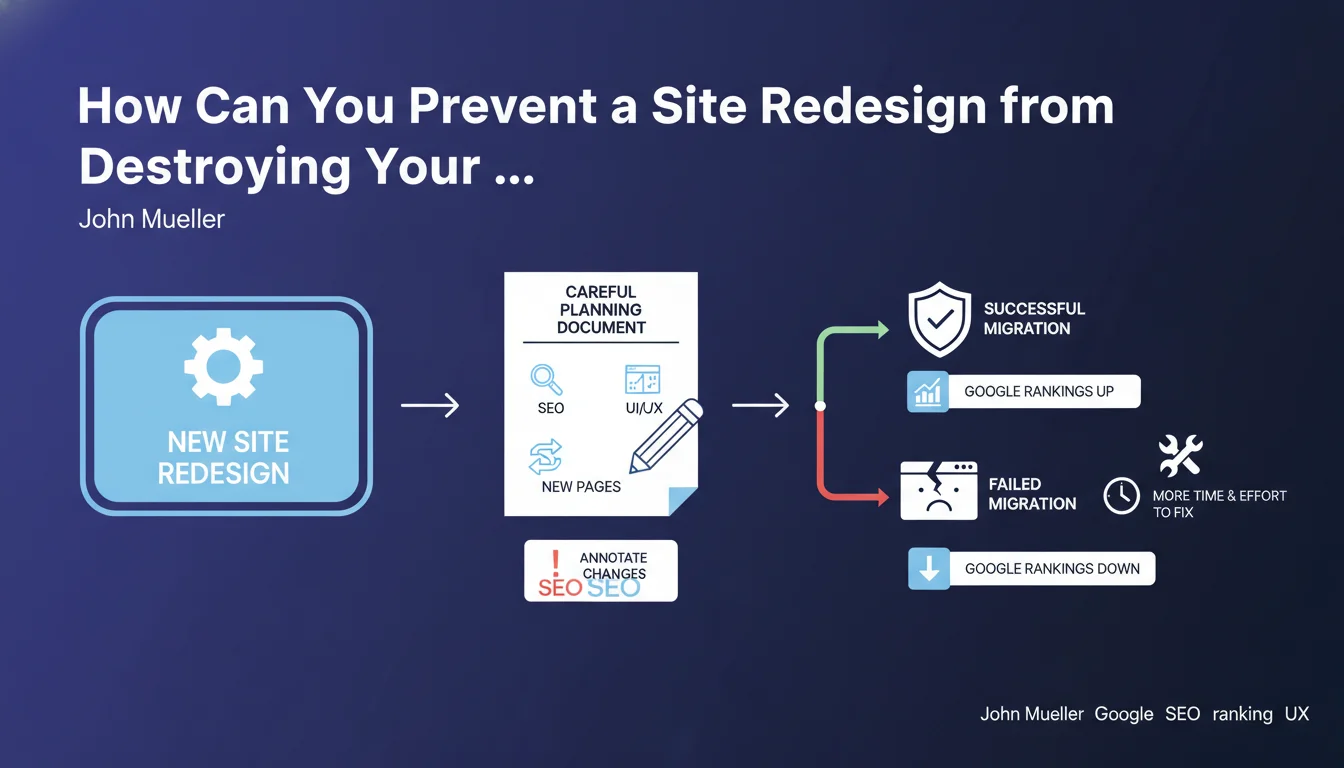
The central recommendation is to exhaustively document all planned changes in a detailed dashboard. Each modification must be evaluated according to its potential SEO impact: critical, moderate, or low.
- Create a complete inventory of all existing URLs and their mapping to new URLs
- Identify strategic pages generating organic traffic and conversions
- Plan 301 redirects to preserve link equity and avoid 404 errors
- Test in a staging environment before any production launch
- Anticipate that fixing a failed migration requires 3 to 5 times more resources than adequate preparation
SEO Expert opinion
Is This Recommendation Aligned with Best Practices Observed in the Field?
Absolutely. Experience shows that 80% of migration problems stem from a lack of documentation and coordination between technical, editorial, and SEO teams. Improvised redesigns systematically generate traffic losses between 20% and 60%.
Successful migrations all follow a methodical planning process including testing phases, progressive validation, and post-launch monitoring. Documentation becomes the common reference for all stakeholders.
What Are the Limitations and Nuances to Add to This Statement?
While planning is essential, it doesn't guarantee a complete absence of fluctuations. Google can take several weeks to several months to fully reassess a redesigned site, even with a perfectly executed migration.
Certain types of changes, such as a pure graphic redesign without URL or content modifications, present virtually no SEO risks. Planning efforts must therefore be calibrated according to the actual magnitude of structural modifications.
In Which Scenarios Is a Progressive Approach Preferable to a Complete Migration?
For large-scale sites (more than 10,000 pages), migration by sections or subdomains significantly reduces risks. This approach allows you to identify and correct problems on a limited scope before generalization.
E-commerce sites with strong seasonality must absolutely avoid high-activity periods. Progressive migration also allows maintaining a stable version during traffic peaks critical to the business.
Practical impact and recommendations
What Concrete Actions Should You Take Before a Site Redesign?
The first step is to conduct a complete SEO audit of the existing site to identify traffic-generating pages, ranked keywords, and current link structure. This data constitutes the reference baseline.
Next, create an SEO specifications document detailing each planned change with its estimated impact. This document must be validated by all stakeholders before development begins.
Set up realistic testing environments to validate the new site's behavior with crawlers, redirect consistency, and technical performance.
What Critical Mistakes Should You Absolutely Avoid During a Migration?
Never launch a redesign without having prepared and tested the complete 301 redirect file. Massive 404 errors are the primary cause of migration failures, leading to immediate and lasting traffic losses.
Avoid simultaneously modifying too many parameters: architecture, content, design, and technical infrastructure. A sequential and measured approach allows identifying the source of potential problems.
Never neglect the post-migration monitoring phase. The first 72 hours are crucial for detecting technical or indexation anomalies.
- Map all current URLs and create a complete mapping file to new URLs
- Export Analytics and Search Console data to establish a pre-migration reference
- Prepare a tested 301 redirect plan in a staging environment
- Maintain URL structure as much as possible, or create logical equivalents
- Preserve high-performing content and optimize only what requires improvement
- Test crawling and indexation with tools like Screaming Frog and Google Search Console
- Schedule the migration outside critical periods for your business
- Train teams on managing the new CMS to avoid post-launch errors
- Budget time for correcting unforeseen problems in the following weeks
How Do You Effectively Monitor a Migration and React Quickly to Problems?
Implement a centralized monitoring dashboard including key positions, organic traffic by landing page, crawl errors, indexation rate, and Core Web Vitals. Hourly monitoring during the first days is recommended.
Use automated alerts in Google Search Console to be immediately notified of 404 error spikes, crawling problems, or indexation drops. Also configure alerts in Google Analytics for abnormal traffic decreases.
💬 Comments (0)
Be the first to comment.