
Official statement
Other statements from this video 14 ▾
- □ Peut-on vraiment utiliser un sous-répertoire unique pour gérer plusieurs marchés internationaux avec hreflang ?
- □ Pourquoi Google n'indexe-t-il pas toutes les URLs de votre site ?
- □ Peut-on utiliser des avis tiers pour les résultats enrichis produits ?
- □ Comment savoir si Google vous pénalise vraiment ?
- □ Pourquoi les erreurs robots.txt unreachable sont-elles toujours de votre faute ?
- □ Faut-il vraiment rediriger vos 404 vers la homepage ?
- □ Faut-il vraiment maintenir les redirections lors d'une migration de domaine ?
- □ Faut-il s'inquiéter de millions d'URLs non indexées sur son site ?
- □ Faut-il vraiment éviter le cloaking de codes HTTP entre Googlebot et utilisateurs ?
- □ Google traite-t-il vraiment les redirections 308 et 301 de la même manière ?
- □ La qualité du contenu influence-t-elle vraiment la vitesse d'indexation par Google ?
- □ WiFi vs Wi-Fi : Google fait-il vraiment la différence pour le référencement ?
- □ Un nombre d'avis à zéro pénalise-t-il le référencement d'une page produit ?
- □ Pourquoi certains sites migrés apparaissent-ils dans Google en quelques minutes et d'autres mettent des mois ?
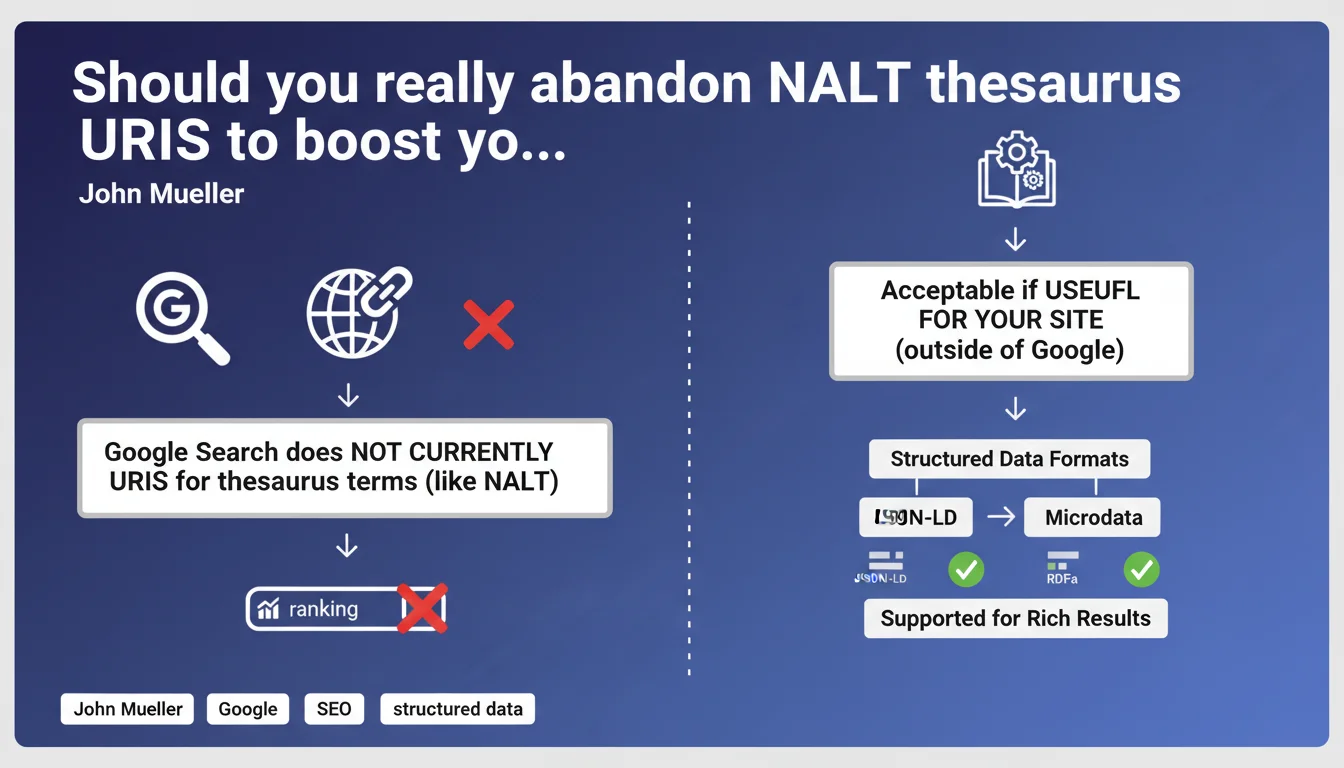
Google Search does not support thesaurus term URIs like NALT. You can use them if they serve your internal organization or other purposes, but they will bring no direct SEO benefit. Only structured data listed in the official documentation provides access to rich results.
What you need to understand
What is NALT and why does Google talk about it?
The NALT (National Agricultural Library Thesaurus) is a controlled vocabulary developed by the U.S. National Agricultural Library. It allows you to categorize and index scientific content with standardized URIs — much like Schema.org, but in a far more specialized registry.
Some websites, particularly in agriculture, environmental science, and academia, have integrated these URIs into their markup, hoping for preferential treatment from Google. Mueller sets the record straight: Google does not read these tags in its rich results logic.
Why doesn't Google support these URIs?
Google hasn't detailed its reasoning, but the answer is probably straightforward: lack of scale and mainstream relevance. Supported structured data formats (products, recipes, FAQs, articles, events...) serve massive use cases and generate rich snippets useful to the average user.
NALT, on the other hand, only applies to an infinitesimal fraction of the English-language web — essentially specialized document repositories. Integrating this standard would require engineering effort for virtually zero ROI from Google's perspective.
Can you still use NALT safely?
Yes. Mueller clarifies that it is acceptable to keep them if they serve your site — for example, to power an internal taxonomy, synchronize databases, or meet scientific documentation requirements.
Google simply ignores these tags; it does not penalize them. They won't clutter your crawl budget or trigger quality alerts — they are simply transparent to the search engine.
- Google does not support any specialized thesaurus URIs like NALT for rich results
- These tags cause no SEO harm, but provide no direct benefit to visibility
- Only structured data listed in the official documentation unlocks rich snippets
- You can retain them if they have functional value outside of Google
- Priority remains with supported formats: Product, Recipe, FAQPage, Article, etc.
SEO Expert opinion
Is this statement consistent with real-world experience?
Absolutely. We've observed for years that Google supports a limited set of vocabularies: primarily Schema.org, Open Graph for social networks, and a few proprietary tags (AMP, Twitter Cards). Anything outside this scope is ignored.
Field tests confirm that exotic tags — alternative RDF vocabularies, academic ontologies, obsolete microformats — never trigger rich snippets. Google has made strategic choices: standardize on Schema.org and refuse fragmentation.
Could Google ever support NALT in the future?
Unlikely in the near term. [To verify] Google has never expanded support to niche ontologies, even in high-value verticals (medical, legal, scientific). The search engine prefers to absorb these use cases within Schema.org — see the gradual addition of types like MedicalCondition, LegalService, Dataset.
If NALT were to be supported someday, it would likely be through integration into Schema.org, not directly. Until then, any energy invested in this markup for SEO reasons is wasted.
Should you remove these tags from an existing site?
Only if they create maintenance or performance issues. If they're there to feed an internal document system, a proprietary search engine, or an API, leave them in place.
However, if someone proposes implementing NALT « to boost SEO, » run the other way. It's either incompetence or overstated invoicing for work with no impact. Focus on proven structured data instead.
Practical impact and recommendations
What should you do if your site currently uses NALT?
First, assess why these tags exist. If they serve a business system — synchronization with a bibliographic database, export to a scientific portal, compliance with a partner standard — keep them without hesitation.
If they were added only for SEO, you can remove them safely. They've never had an impact, so deleting them won't change anything. Use the opportunity to strengthen the structured data that actually matters: Article, BreadcrumbList, Organization, etc.
Which structured data should you prioritize instead?
Focus on types listed in Google's official gallery. For a scientific or agricultural content site, priorities are:
- Article (with headline, image, datePublished, author, publisher) for all editorial content
- Dataset if you publish downloadable datasets — Google displays them in Dataset Search
- FAQPage or HowTo to structure your guides and tutorials
- Organization to strengthen your entity in the Knowledge Graph
- BreadcrumbList to clarify your architecture and improve breadcrumb display
How do you verify that your structured data is actually supported?
Use Google's Rich Results Test. It will immediately tell you whether your markup is eligible for enhanced display. If a type doesn't appear in the test results, it's not supported — end of story.
For a comprehensive audit, also use Search Console (« Enhancements » section). It lists detected types and any errors. If NALT never appears there, that's normal — it's invisible to Google.
Google does not support NALT thesaurus URIs and has no known plans to do so. If these tags serve your internal organization, keep them; otherwise, remove them and invest in structured data that actually generates rich results.
Implementing structured data compliant with Google's requirements can quickly become complex, especially if your site combines multiple content types. If you lack time or technical expertise to audit and optimize your markup, working with a specialized SEO agency will help you secure your visibility without the risk of errors.
❓ Frequently Asked Questions
Le NALT peut-il nuire au SEO si je le laisse en place ?
Existe-t-il d'autres thésaurus ou ontologies supportés par Google ?
Si Google ne supporte pas le NALT, pourquoi certains outils SEO le recommandent ?
Puis-je utiliser le NALT pour améliorer mon moteur de recherche interne ?
Google pourrait-il supporter le NALT à l'avenir ?
🎥 From the same video 14
Other SEO insights extracted from this same Google Search Central video · published on 12/04/2023
🎥 Watch the full video on YouTube →
💬 Comments (0)
Be the first to comment.