
Official statement
Other statements from this video 14 ▾
- □ Peut-on vraiment utiliser un sous-répertoire unique pour gérer plusieurs marchés internationaux avec hreflang ?
- □ Pourquoi Google n'indexe-t-il pas toutes les URLs de votre site ?
- □ Peut-on utiliser des avis tiers pour les résultats enrichis produits ?
- □ Faut-il abandonner les URI de thésaurus NALT pour optimiser son référencement ?
- □ Pourquoi les erreurs robots.txt unreachable sont-elles toujours de votre faute ?
- □ Faut-il vraiment rediriger vos 404 vers la homepage ?
- □ Faut-il vraiment maintenir les redirections lors d'une migration de domaine ?
- □ Faut-il s'inquiéter de millions d'URLs non indexées sur son site ?
- □ Faut-il vraiment éviter le cloaking de codes HTTP entre Googlebot et utilisateurs ?
- □ Google traite-t-il vraiment les redirections 308 et 301 de la même manière ?
- □ La qualité du contenu influence-t-elle vraiment la vitesse d'indexation par Google ?
- □ WiFi vs Wi-Fi : Google fait-il vraiment la différence pour le référencement ?
- □ Un nombre d'avis à zéro pénalise-t-il le référencement d'une page produit ?
- □ Pourquoi certains sites migrés apparaissent-ils dans Google en quelques minutes et d'autres mettent des mois ?
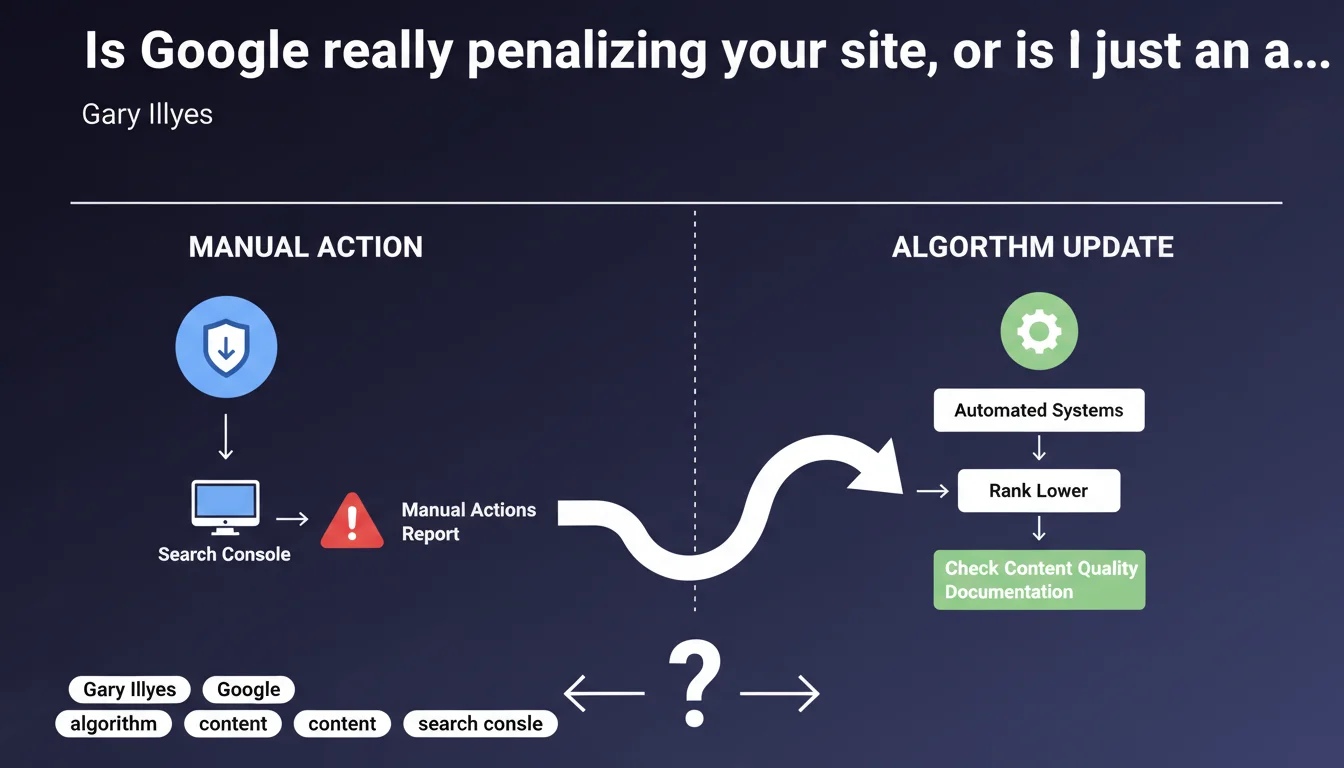
Google clarifies the difference between manual action and algorithmic demotion: manual actions always appear in Search Console. If your rankings drop without a notification, it's an automated system that has re-evaluated your content — not a penalty in the strict sense.
What you need to understand
What's the real difference between a manual action and an algorithmic demotion?
A manual action happens when a human Google reviewer detects a clear violation of guidelines: massive spam, artificial link networks, stolen content. This intervention is notified in Search Console via the dedicated report.
An algorithmic demotion, on the other hand, results from systems like Helpful Content, which continuously re-evaluate page quality. No notification is sent — your URLs simply lose positions because quality signals have changed.
Why does Google insist on making this distinction?
Because many site owners blame their traffic drops on "penalties" that don't exist. This confusion creates unnecessary reconsideration requests and unjustified frustration. If Search Console mentions nothing, you need to look elsewhere: content quality, engagement signals, increased competition.
Google wants to reframe the conversation: an algorithmic drop isn't a disciplinary sanction, it's a continuous re-evaluation of your relevance.
Where can I check if my site has a manual action?
In Search Console, go to Security and Manual Actions > Manual Actions. If this report is empty with the message "No issues detected", you don't have an active manual action.
Warning: an action may target a specific URL or your entire site. Check both tabs. Once fixed, you can request a reconsideration — but lifting it is never instantaneous.
- Manual action = explicit notification in Search Console + ability to request reconsideration
- Algorithmic demotion = no notification + requires a content strategy overhaul
- If the manual actions report is empty, your problem is algorithmic — not disciplinary
- Automated systems (Helpful Content, Core Updates) never trigger alerts in Search Console
SEO Expert opinion
Does this clarification really change anything on the ground?
Honestly? Not that much. Experienced SEOs have already made this distinction for years. What's frustrating is that Google continues to refuse any transparency on the exact criteria that trigger these algorithmic demotions.
Saying "consult the quality documentation" amounts to redirecting toward vague generalities. What thresholds? Which signals carry the most weight? [To verify] in the field, because Google will never provide a detailed scoring grid.
Are algorithmic demotions really less serious?
That's where official messaging becomes misleading. A manual action you can contest, fix, and request reconsideration for. An algorithmic demotion? You're in the dark — no recourse, no feedback, just hypotheses based on correlations.
Worse: some algorithmic drops are more devastating than targeted manual actions. A site hit by Helpful Content can lose 70-80% of its organic traffic without ever receiving a formal explanation. Calling that a "simple re-evaluation" is a euphemism.
Should you take this statement at face value?
Yes for the factual aspect: if Search Console is clean, you don't have a manual action. No for the reassuring undertone: an algorithmic demotion can be just as destructive, or even harder to diagnose.
The real problem remains algorithm opacity. Google tells you "improve quality", but never precisely defines that term. Result: you test, iterate, hope — with no guarantee whatsoever.
Practical impact and recommendations
What should you do if your rankings drop without a manual action?
First step: identify which algorithm could be responsible. Cross-reference the date of the drop with Core Updates and Helpful Content deployments. SEO forums and volatility trackers provide reliable clues.
Next, audit your content against EEAT criteria: genuine expertise, visible authorship, cited sources, real-world experience. If your articles look like generic mass-produced content — even if well-written —, that's probably your issue.
What mistakes should you avoid when diagnosing a drop?
Don't spend weeks chasing a penalty that doesn't exist. If Search Console is clean, accept that the problem is qualitative, not technical.
Also avoid overhauling everything at once. Test by segments: start with the pages that dropped the most, improve them measurably (adding expertise, rephrasing for user intent), then observe for 4-6 weeks. Algorithms don't react in 48 hours.
How can you verify your site complies with guidelines?
Re-read the Quality Rater Guidelines — not the summaries, the complete document. Compare your pages against YMYL criteria if applicable. Ask yourself: would I trust this content if I found it on a competitor's site?
Use user testing tools (Hotjar, Crazy Egg) to see where visitors disengage. A high bounce rate on informational queries often signals that your content isn't answering the intent quickly enough.
- Check the Manual Actions report in Search Console — if empty, your problem is algorithmic
- Cross-reference the drop date with Core Updates and Helpful Content System
- Audit your content against EEAT: visible expertise, sources, real-world experience
- Test improvements in small batches, not with a global overhaul
- Monitor engagement signals: time on page, bounce rate, navigation depth
- If results don't improve after 3 months of optimization, consider outside expertise
❓ Frequently Asked Questions
Si je n'ai pas d'action manuelle, pourquoi mon trafic a-t-il chuté de 60% ?
Peut-on demander un réexamen pour un déclassement algorithmique ?
Combien de temps faut-il pour qu'une action manuelle soit levée après correction ?
Un site peut-il être déclassé par un algorithme sans raison valable ?
Search Console alerte-t-il pour tous les types de problèmes de ranking ?
🎥 From the same video 14
Other SEO insights extracted from this same Google Search Central video · published on 12/04/2023
🎥 Watch the full video on YouTube →
💬 Comments (0)
Be the first to comment.