
Official statement
Other statements from this video 14 ▾
- □ Pourquoi Google n'indexe-t-il pas toutes les URLs de votre site ?
- □ Peut-on utiliser des avis tiers pour les résultats enrichis produits ?
- □ Comment savoir si Google vous pénalise vraiment ?
- □ Faut-il abandonner les URI de thésaurus NALT pour optimiser son référencement ?
- □ Pourquoi les erreurs robots.txt unreachable sont-elles toujours de votre faute ?
- □ Faut-il vraiment rediriger vos 404 vers la homepage ?
- □ Faut-il vraiment maintenir les redirections lors d'une migration de domaine ?
- □ Faut-il s'inquiéter de millions d'URLs non indexées sur son site ?
- □ Faut-il vraiment éviter le cloaking de codes HTTP entre Googlebot et utilisateurs ?
- □ Google traite-t-il vraiment les redirections 308 et 301 de la même manière ?
- □ La qualité du contenu influence-t-elle vraiment la vitesse d'indexation par Google ?
- □ WiFi vs Wi-Fi : Google fait-il vraiment la différence pour le référencement ?
- □ Un nombre d'avis à zéro pénalise-t-il le référencement d'une page produit ?
- □ Pourquoi certains sites migrés apparaissent-ils dans Google en quelques minutes et d'autres mettent des mois ?
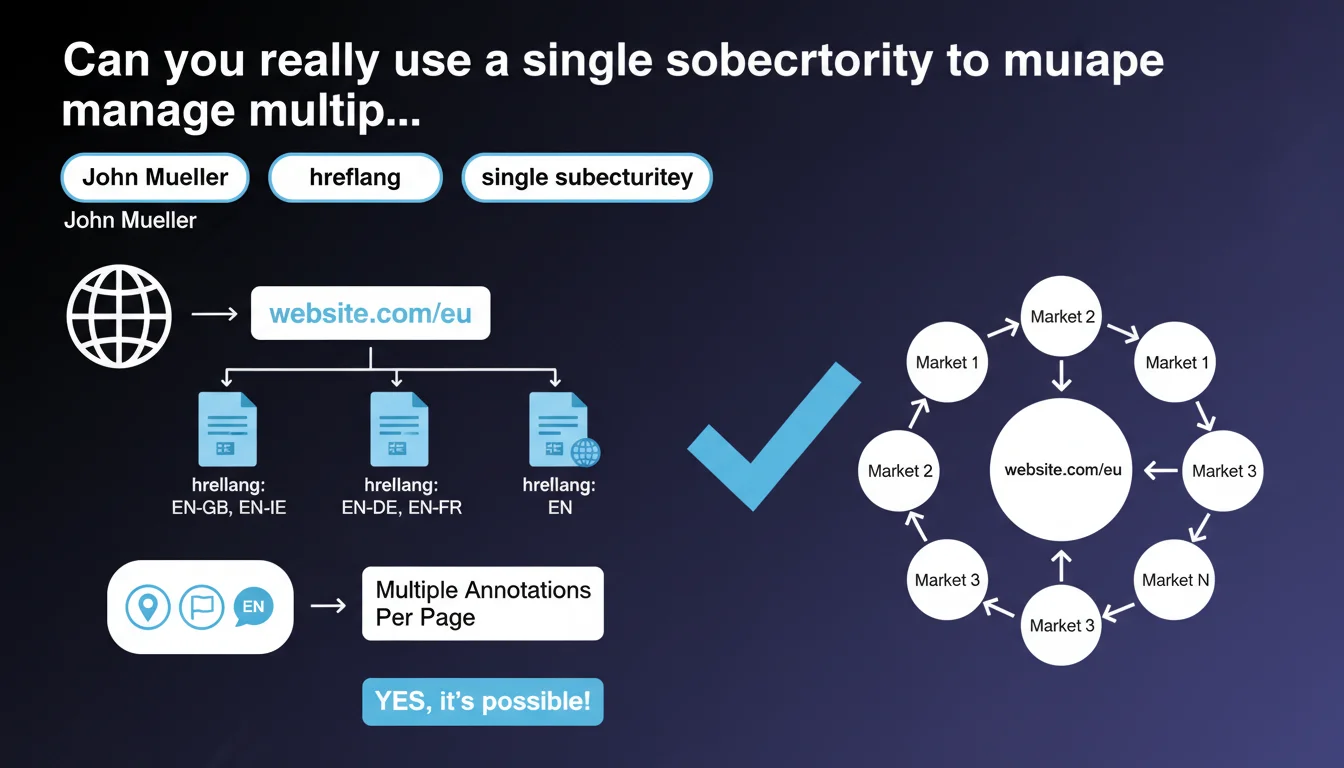
Google confirms that a subdirectory like /eu can serve as a structure for international expansion, with multiple hreflang annotations per page. It's possible to specify a list of countries sharing the same language or to use a generic EN tag without geographic targeting.
What you need to understand
Why does this Google clarification change the game for multilingual structures?
Historically, most international sites opt for subdirectories by country (/fr, /de, /es) or by language (/en-us, /en-gb). Google confirms here that a more granular approach is technically valid: a single subdirectory can serve multiple markets via multiple hreflang tags on each page.
This statement breaks the misconception that you necessarily need a separate subdirectory per market. For geographic zones sharing the same language — such as English in multiple European countries — this flexibility opens up possibilities for simplified architecture.
What does "multiple hreflang annotations on the same page" concretely mean?
A single page can carry multiple hreflang tags pointing to itself or other pages, with different language or region codes. Example: a page /eu/product can declare itself relevant for en-GB, en-IE, en-NL simultaneously.
Google also clarifies that you can use a generic EN tag (without country code) as a fallback version. This "x-default" or generic tag captures users whose browser doesn't match any specific targeting.
What are the key technical points to absolutely remember?
- Hreflang applies page by page, not at the domain or entire subdirectory level
- A single subdirectory can serve multiple markets if hreflang tags are properly configured
- It is possible to combine country targeting (en-GB, en-IE) and a generic version (EN)
- Each page must declare all language/regional variants, including itself
- Consistency between hreflang tags across all related pages is critical to avoid conflicts
SEO Expert opinion
Is this architectural flexibility really applicable in practice?
On paper, yes. Technically, nothing prevents serving multiple markets from a single subdirectory with properly configured hreflang. In reality, this approach introduces non-negligible operational complexities.
Managing identical or near-identical content for multiple countries from the same URL raises questions about Analytics measurement, ad targeting, and UX personalization. Not to mention that editorial teams often prefer clearly separated spaces by market for organizational reasons.
What are the unsaid limitations of this statement?
Google says nothing about the relative SEO performance of this approach versus a classic country-by-country architecture. Nothing either about the potential impact in terms of geographic trust signals — a .fr or a /fr can carry more local weight than a generic /eu. [To verify]
Another point not addressed: managing duplicate or near-duplicate content between markets. If /eu serves both the UK, Ireland and the Netherlands with the same English content, will Google consider there to be internal duplication if hreflang tags are misconfigured? The history of hreflang configuration errors in the field suggests yes.
In what cases is this /eu structure truly relevant?
Let's be honest: this architecture is best suited for sites in testing phase on new markets, with strictly identical content and a need to limit development costs. For mature operations with local teams, differentiated catalogs, or market-specific legal requirements, a separation by subdirectory remains more robust.
The real use case? B2B SaaS sites with a standardized English offering, seeking to capture multiple European markets without creating 15 near-identical versions. Even in this case, conversion management and tracking requires sophisticated instrumentation.
Practical impact and recommendations
What should you verify before adopting this structure?
First, assess the actual content similarity between markets. If differences are minimal (a few currency adjustments, legal notices), a shared subdirectory may be justified. If each country requires substantial adjustments, it's better to separate.
Then, audit the technical capacity to implement and maintain complex hreflang tags. Each page must point to all its variants, including itself. A configuration error creates conflicts that Google won't resolve in your favor.
What errors should you absolutely avoid?
- Don't implement an x-default tag or a generic EN version: Google won't know which page to serve to users outside your targeting
- Don't forget hreflang reciprocity: if /eu points to /fr, then /fr must point back to /eu
- Don't mix language-only codes (EN) and language-region codes (en-GB) without clear fallback logic
- Don't skip testing actual SERP rendering by geolocation: Search Console isn't enough, you need on-the-ground testing
- Don't ignore the impact on Analytics and tracking tools: how will you isolate performance by market if everything shares the same URL?
How do you structure a robust implementation?
Start by mapping all target markets and their ISO codes (language + region). Determine which page serves which market, and which generic version serves as fallback.
Implement hreflang tags in the <head> or via XML sitemap — both methods work, but the sitemap eases maintenance at scale. Validate with Search Console, then cross-check with real user tests from each geo.
In summary: This approach is technically valid but operationally demanding. It suits sites with homogeneous content across multiple markets, provided extreme rigor in hreflang implementation. For complex structures or teams without deep internal expertise, these optimizations can quickly become a source of costly errors — in that case, relying on an SEO agency specialized in international operations helps secure the rollout and avoid common configuration pitfalls.
❓ Frequently Asked Questions
Peut-on utiliser /eu pour cibler uniquement certains pays européens ou faut-il couvrir toute l'UE ?
Que se passe-t-il si j'oublie de mettre une balise hreflang vers la version générique EN ?
Les balises hreflang dans le sitemap XML sont-elles aussi efficaces que celles dans le HTML ?
Un sous-répertoire /eu peut-il nuire au référencement local dans des pays spécifiques ?
Faut-il absolument utiliser des codes pays ISO ou puis-je inventer mes propres conventions ?
🎥 From the same video 14
Other SEO insights extracted from this same Google Search Central video · published on 12/04/2023
🎥 Watch the full video on YouTube →
💬 Comments (0)
Be the first to comment.