
Official statement
Other statements from this video 14 ▾
- □ Peut-on vraiment utiliser un sous-répertoire unique pour gérer plusieurs marchés internationaux avec hreflang ?
- □ Pourquoi Google n'indexe-t-il pas toutes les URLs de votre site ?
- □ Peut-on utiliser des avis tiers pour les résultats enrichis produits ?
- □ Comment savoir si Google vous pénalise vraiment ?
- □ Faut-il abandonner les URI de thésaurus NALT pour optimiser son référencement ?
- □ Pourquoi les erreurs robots.txt unreachable sont-elles toujours de votre faute ?
- □ Faut-il vraiment rediriger vos 404 vers la homepage ?
- □ Faut-il s'inquiéter de millions d'URLs non indexées sur son site ?
- □ Faut-il vraiment éviter le cloaking de codes HTTP entre Googlebot et utilisateurs ?
- □ Google traite-t-il vraiment les redirections 308 et 301 de la même manière ?
- □ La qualité du contenu influence-t-elle vraiment la vitesse d'indexation par Google ?
- □ WiFi vs Wi-Fi : Google fait-il vraiment la différence pour le référencement ?
- □ Un nombre d'avis à zéro pénalise-t-il le référencement d'une page produit ?
- □ Pourquoi certains sites migrés apparaissent-ils dans Google en quelques minutes et d'autres mettent des mois ?
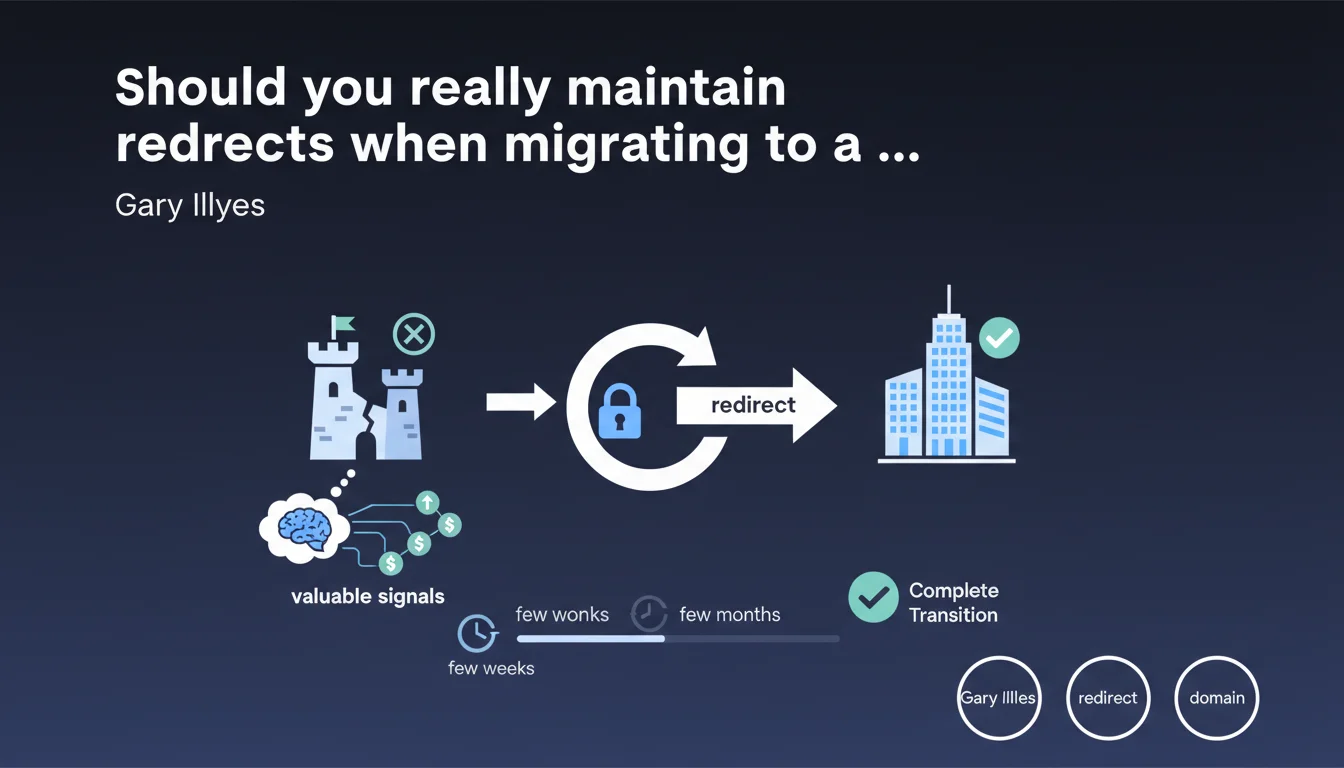
Google confirms that a domain migration absolutely requires 301 permanent redirects from the old site to the new one. Removing the old domain without redirects means abandoning years of accumulated SEO signals. The complete transfer of these signals can take anywhere from several weeks to several months depending on your site's size.
What you need to understand
Why does Google insist so much on redirects?
The old domain has accumulated trust signals over time: domain authority, backlink profile, crawl history, behavioral data. Without redirects, Google treats the new site as a completely new entity, ignoring all this history.
301 redirects allow Google to progressively transfer these signals to the new domain. It's an active process of recrawling and re-evaluation, not a simple instant copy-paste.
What actually happens during this transition period?
Google continues to crawl the old domain to detect redirects, then visits the corresponding new URLs. The ranking signals are gradually transferred: first the PageRank transmitted by backlinks, then quality and engagement metrics.
The transfer duration varies depending on the crawl frequency of the old site, the number of URLs involved, and the quality of technical implementation. A small site can stabilize in a few weeks, a large portal in several months.
What are the valuable signals mentioned by Gary Illyes?
- Backlink profile: each link pointing to the old domain must be redirected to the equivalent page on the new site
- Domain authority: the trust accumulated at the domain name level itself
- Crawl history: the frequency and priority that Googlebot assigns to the site
- Behavioral data: user engagement metrics associated with old URLs
- Freshness signals: content update history
- Trust rank: quality and reliability indicators built over time
SEO Expert opinion
Is this directive aligned with real-world observations?
Absolutely. Migrations without redirects cause systematic traffic collapses. I've seen sites lose 70-90% of their organic visibility within weeks after simply switching domains.
What's interesting is that Gary Illyes speaks of "a few weeks to a few months" — it's deliberately vague. The reality? For an average site, count on a minimum of 3 months for stabilization, often 6 months for a complete signal transfer. Large sites may require a year.
What nuances should be added to this statement?
Google doesn't specify the duration of maintaining redirects. In theory, they should remain permanent. In practice, many experts recommend a minimum of one year, or even two for high-authority sites.
Another point: Gary Illyes speaks of "valuable signals" but remains vague about their exact nature. It's difficult to objectively measure authority or trust transfer. [To verify] with controlled A/B tests on different types of sites.
In which cases might this rule not apply strictly?
If the old domain has been manually penalized or algorithmically, maintaining redirects can transfer those penalties. In that case, starting fresh might be preferable — but this is a rare and radical scenario.
For a very new site (less than 6 months, few backlinks), the impact is marginal. But even then, better to redirect on principle: you never know which signals Google values behind the scenes.
Practical impact and recommendations
What do you need to do concretely before a domain migration?
Prepare a complete URL mapping: each old URL must have a destination on the new domain. Prioritize 1:1 redirects (page to page) rather than redirecting everything to the homepage.
Configure 301 redirects at the server level (Apache .htaccess, Nginx, web server). Avoid JavaScript or meta refresh redirects — Google follows them, but it's less reliable and slower.
How do you verify that the migration is going smoothly?
Monitor Search Console: activate the new domain property, declare the address change in the dedicated tool. Monitor the evolution of impressions and clicks week by week.
Verify that redirects work with a crawler (Screaming Frog, Sitebulb). Test a sample of important URLs to confirm they return an HTTP 301 code and point to the correct destination.
What mistakes should you absolutely avoid?
- Never delete the old domain without having set up redirects first
- Don't redirect all pages to the new site's homepage — that's disguised soft 404s
- Avoid redirect chains (A → B → C) — Google may give up after 3-5 hops
- Don't forget to update the XML sitemap with new URLs
- Don't neglect backlinks: contact your main partners so they update their links
- Maintain redirects for several months minimum, ideally a year or more
- Actively monitor metrics in Search Console throughout the entire transition period
A domain migration is a critical operation that requires careful planning and rigorous monitoring. 301 redirects are non-negotiable if you want to preserve your SEO capital.
The technical complexity and associated risks mean it's often wise to work with experts to orchestrate this type of project. A specialized SEO agency can help you with pre-migration audits, redirect implementation, and post-migration monitoring to secure your positions and minimize traffic loss.
❓ Frequently Asked Questions
Combien de temps faut-il maintenir les redirections 301 après une migration ?
Peut-on transférer les signaux SEO sans redirection en faisant simplement pointer le nouveau domaine sur le même serveur ?
Les redirections 302 (temporaires) fonctionnent-elles aussi bien que les 301 pour une migration ?
Que se passe-t-il si on laisse expirer l'ancien domaine après avoir migré ?
Faut-il déclarer le changement d'adresse dans la Search Console même avec des redirections ?
🎥 From the same video 14
Other SEO insights extracted from this same Google Search Central video · published on 12/04/2023
🎥 Watch the full video on YouTube →
💬 Comments (0)
Be the first to comment.