
Official statement
Other statements from this video 14 ▾
- □ Peut-on vraiment utiliser un sous-répertoire unique pour gérer plusieurs marchés internationaux avec hreflang ?
- □ Pourquoi Google n'indexe-t-il pas toutes les URLs de votre site ?
- □ Peut-on utiliser des avis tiers pour les résultats enrichis produits ?
- □ Comment savoir si Google vous pénalise vraiment ?
- □ Faut-il abandonner les URI de thésaurus NALT pour optimiser son référencement ?
- □ Pourquoi les erreurs robots.txt unreachable sont-elles toujours de votre faute ?
- □ Faut-il vraiment rediriger vos 404 vers la homepage ?
- □ Faut-il vraiment maintenir les redirections lors d'une migration de domaine ?
- □ Faut-il s'inquiéter de millions d'URLs non indexées sur son site ?
- □ Faut-il vraiment éviter le cloaking de codes HTTP entre Googlebot et utilisateurs ?
- □ Google traite-t-il vraiment les redirections 308 et 301 de la même manière ?
- □ La qualité du contenu influence-t-elle vraiment la vitesse d'indexation par Google ?
- □ Un nombre d'avis à zéro pénalise-t-il le référencement d'une page produit ?
- □ Pourquoi certains sites migrés apparaissent-ils dans Google en quelques minutes et d'autres mettent des mois ?
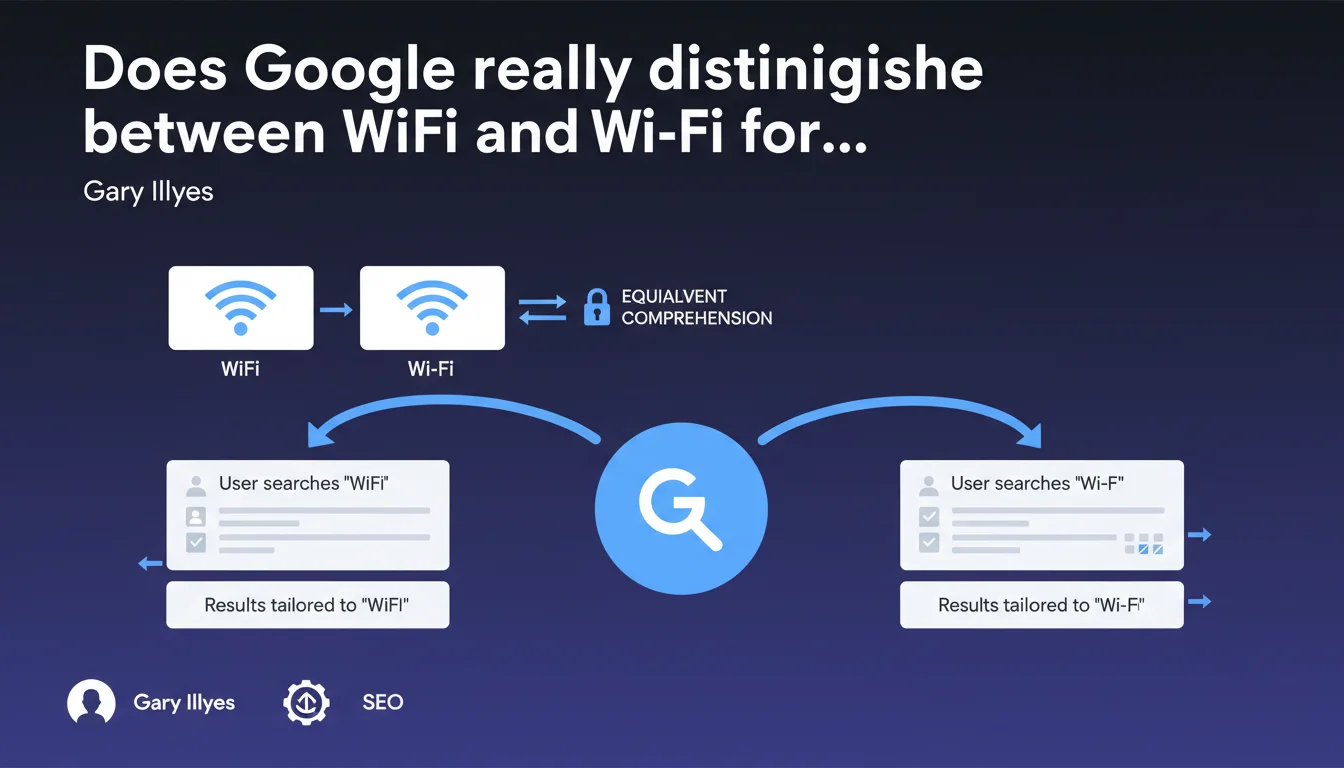
Google understands WiFi and Wi-Fi as strictly equivalent from a semantic perspective. However, in the SERPs, the algorithm subtly adjusts the order of results based on the spelling typed by the user to match their intent. Concretely: no direct SEO impact, but a micro-adjustment in display.
What you need to understand
Does Google really differentiate between these two spelling variants?
The answer is no at the comprehension level. Google's algorithm treats WiFi and Wi-Fi as perfect synonyms. Both forms point to the same concept, the same entity. The search engine does not penalize one spelling or the other, and grants no particular bonus to the hyphenated or non-hyphenated form.
But — and this is where it gets interesting — Google subtly adapts the order of results based on what the user typed. If someone searches for "Wi-Fi", pages using this hyphenated spelling may rank slightly higher. The opposite holds true for "WiFi" without a hyphen.
Why does Google then display slightly different results?
Because Google has detected that users employ both forms interchangeably, but not necessarily with the same contextual intent. Certain audiences, certain industries, certain geographic areas favor one spelling over the other.
Google therefore seeks to maximize perceived relevance by adjusting the SERPs to reflect the spelling of the query. This is not a ranking factor in the classical sense, but a micro-adjustment in display based on the user signal.
What are the concrete implications for on-page SEO?
From a purely technical standpoint, using WiFi or Wi-Fi does not impact the overall positioning of your page. Google indexes and understands both forms without distinction.
However, if your target audience overwhelmingly favors one spelling — because it's the standard in your industry or geographic area — it may be wise to align your content with this preference. Not for direct algorithmic reasons, but to optimize the coherence perceived by the user and potentially improve CTR.
- Google treats WiFi and Wi-Fi as equivalent at the semantic level and does not penalize either variant
- SERPs display slightly adjusted results based on the spelling of the user's query
- This adjustment reflects observed user behavior, not a classical ranking factor
- Aligning your content with your audience's dominant usage can improve perceived relevance and CTR
- No technical obligation: both forms are strictly interchangeable for indexing
SEO Expert opinion
Is this statement consistent with field observations?
Yes, and it confirms what we've observed for years with minor spelling variations. Google has always managed synonyms, abbreviations, and alternative spellings with a certain degree of flexibility. WiFi/Wi-Fi, email/e-mail, same story.
What's interesting here is that Gary Illyes explicitly describes the mechanism: semantic equivalence, but display adjustment. This aligns with the observation that SERPs for "email" and "e-mail" are not strictly identical, even though both queries generally return the same sites.
Where it gets a bit fuzzy — [To verify] — is on the actual magnitude of these "slightly different results". Illyes remains intentionally vague. Slightly means what exactly? A difference of 2-3 positions? A reordering of featured snippets? A variation in People Also Ask?
What nuances should be added to this statement?
First point: this logic applies to common spelling variations, not typos. If you write "Wiffi" or "Wai-Fai", Google will likely correct it, but won't treat it as a legitimate variant.
Second nuance: the adjustment of SERPs based on user queries is a dynamic and contextual mechanism. It depends on behavioral signals. If tomorrow 90% of users type "WiFi" without a hyphen, Google will probably readjust the weighting. It's not fixed.
Third point — and this is crucial — : don't over-optimize for these micro-variations. Some SEO professionals might be tempted to stuff their pages with both spellings to "cover" all queries. This is counterproductive. Google already understands the equivalence, and multiplying variations adds nothing, or even harms readability.
In what cases might this rule not apply completely?
If a registered trademark or proper name explicitly uses one of the two spellings, Google might make the distinction. For example, if a company is officially named "Wi-Fi Solutions Inc.", the query "Wi-Fi Solutions" will return this specific entity as a priority, even if someone types "WiFi Solutions".
Another edge case: highly specialized or technical queries where spelling might signal a nuance of expertise. In the context of IEEE 802.11 standards, for example, "Wi-Fi" with a hyphen is the official spelling by the Wi-Fi Alliance. Google might detect this contextual preference and adjust accordingly.
Practical impact and recommendations
Should you modify the spelling on your existing pages?
No, unless you have a clear editorial reason. If your pages already use "WiFi" or "Wi-Fi" consistently, there's no SEO benefit to rewriting everything. Google understands both forms.
However, if your site mixes both spellings haphazardly — "WiFi" in titles, "Wi-Fi" in body text — it may be wise to standardize for reasons of editorial coherence and user experience. Not for Google, but for your readers.
How do you choose the right variant for your new content?
Ask yourself three questions. First: what is the dominant spelling in your industry? If you're in B2B tech, "Wi-Fi" with a hyphen is often preferred (official spelling). In the general public, "WiFi" without a hyphen is more common.
Second question: what does your editorial style guide say? If you already have a style guide, follow it. Editorial consistency trumps hypothetical micro-optimizations.
Third point: observe your direct competitors who rank well. If they overwhelmingly use one variant, it's probably a signal that this spelling resonates better with your target audience. But again, this isn't a ranking factor — just an indicator of contextual relevance.
What mistakes should you absolutely avoid?
Don't stuff your pages with both variants to "cover" all queries. "WiFi and Wi-Fi are equivalent" written explicitly on your page is ridiculous and counterproductive. Google already knows they're equivalent.
Also avoid creating separate pages for each variant. "Our WiFi solution" and "Our Wi-Fi solution" as two separate landing pages is unnecessary duplicate content. Google will canonicalize one or dilute the signal.
- Standardize spelling across your site for reasons of editorial coherence, not for direct SEO gains
- Align yourself with the dominant spelling in your industry when creating new content
- Never create separate pages for WiFi and Wi-Fi — that's unnecessary duplication
- Don't overload your content with both variants — Google already understands the equivalence
- Ensure your title tags and H1s use spelling consistent with the rest of your content
- Monitor your backlink anchor text: natural variety is normal, no need to standardize everything
- If you have an EMD with one of the spellings, stay consistent with that one in your main content
❓ Frequently Asked Questions
Dois-je réécrire tous mes contenus pour uniformiser WiFi ou Wi-Fi ?
Est-ce que l'orthographe WiFi vs Wi-Fi impacte mon positionnement ?
Puis-je utiliser les deux variantes dans un même article ?
Faut-il créer deux pages distinctes pour cibler WiFi et Wi-Fi séparément ?
Cette logique s'applique-t-elle à d'autres variantes orthographiques comme email/e-mail ?
🎥 From the same video 14
Other SEO insights extracted from this same Google Search Central video · published on 12/04/2023
🎥 Watch the full video on YouTube →
💬 Comments (0)
Be the first to comment.