
Official statement
What you need to understand
HTTP status codes 404 and 410 have long been a source of concern for SEO professionals. Many believed that the presence of 404 errors could harm a site's search engine rankings.
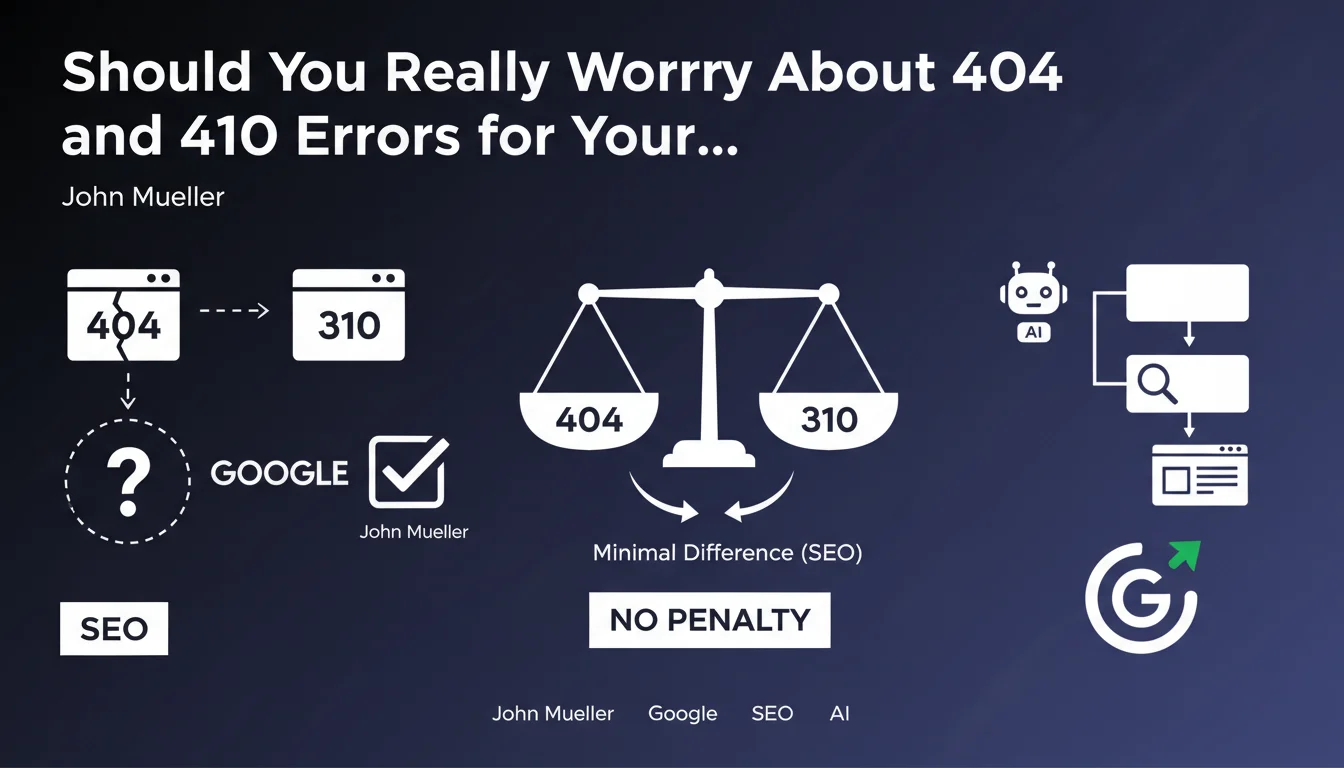
This official clarification puts an end to this confusion: Google does not penalize sites that return 404 or 410 codes. These codes simply serve to indicate that a page does not exist or no longer exists.
The technical distinction between these two codes is as follows: 404 signals a temporarily unavailable page, while 410 indicates a permanent deletion. However, from an SEO perspective, this nuance has virtually no impact on Google's handling.
- 404 and 410 errors generate no SEO penalty
- The difference in treatment between 404 and 410 by Google is negligible
- Practical considerations should take precedence over technical theory
- These codes simply allow Google to understand the status of pages
SEO Expert opinion
This statement perfectly aligns with field observations made over the years. Sites displaying 404 errors indeed experience no degradation in their overall rankings, as long as the rest of the site functions properly.
However, this statement needs nuance: while 404 errors do not directly penalize, an excessive number of errors can reveal deeper structural problems. For example, thousands of broken internal links indicate poor site architecture or a poorly managed migration.
Regarding the choice between 404 and 410, the recommendation to prioritize technical simplicity is sound. In practice, nearly all sites use only 404, which greatly simplifies management.
Practical impact and recommendations
- Don't worry about occasional 404 errors detected in Search Console
- Focus on strategic 404s: identify pages with historical traffic or quality backlinks
- Implement 301 redirects only for deleted pages that received traffic or inbound links
- Don't try to eliminate all 404s at all costs, it's neither necessary nor productive
- Simplify your technical management: use the default 404 code rather than differentiating between 404 and 410
- Regularly audit your internal links to avoid creating unnecessary 404 errors on your own site
- Create a custom 404 page with links to your main content to improve user experience
- Monitor spikes in 404 errors that may indicate a technical problem (migration, development bug)
In summary: 404 and 410 codes should no longer be a source of anxiety. Focus your efforts on errors that have a real impact on your traffic.
Strategic management of 404 errors, internal link auditing, and implementing appropriate redirects nevertheless require in-depth technical expertise. Analyzing historical traffic, identifying high-potential pages, and defining a coherent redirect strategy can prove complex at scale. For personalized support and custom optimization of your technical architecture, working with a specialized SEO agency will allow you to benefit from expert insight and advanced analytical tools.
💬 Comments (0)
Be the first to comment.