
Official statement
Other statements from this video 14 ▾
- □ Peut-on vraiment utiliser un sous-répertoire unique pour gérer plusieurs marchés internationaux avec hreflang ?
- □ Pourquoi Google n'indexe-t-il pas toutes les URLs de votre site ?
- □ Peut-on utiliser des avis tiers pour les résultats enrichis produits ?
- □ Comment savoir si Google vous pénalise vraiment ?
- □ Faut-il abandonner les URI de thésaurus NALT pour optimiser son référencement ?
- □ Pourquoi les erreurs robots.txt unreachable sont-elles toujours de votre faute ?
- □ Faut-il vraiment rediriger vos 404 vers la homepage ?
- □ Faut-il vraiment maintenir les redirections lors d'une migration de domaine ?
- □ Faut-il s'inquiéter de millions d'URLs non indexées sur son site ?
- □ Faut-il vraiment éviter le cloaking de codes HTTP entre Googlebot et utilisateurs ?
- □ La qualité du contenu influence-t-elle vraiment la vitesse d'indexation par Google ?
- □ WiFi vs Wi-Fi : Google fait-il vraiment la différence pour le référencement ?
- □ Un nombre d'avis à zéro pénalise-t-il le référencement d'une page produit ?
- □ Pourquoi certains sites migrés apparaissent-ils dans Google en quelques minutes et d'autres mettent des mois ?
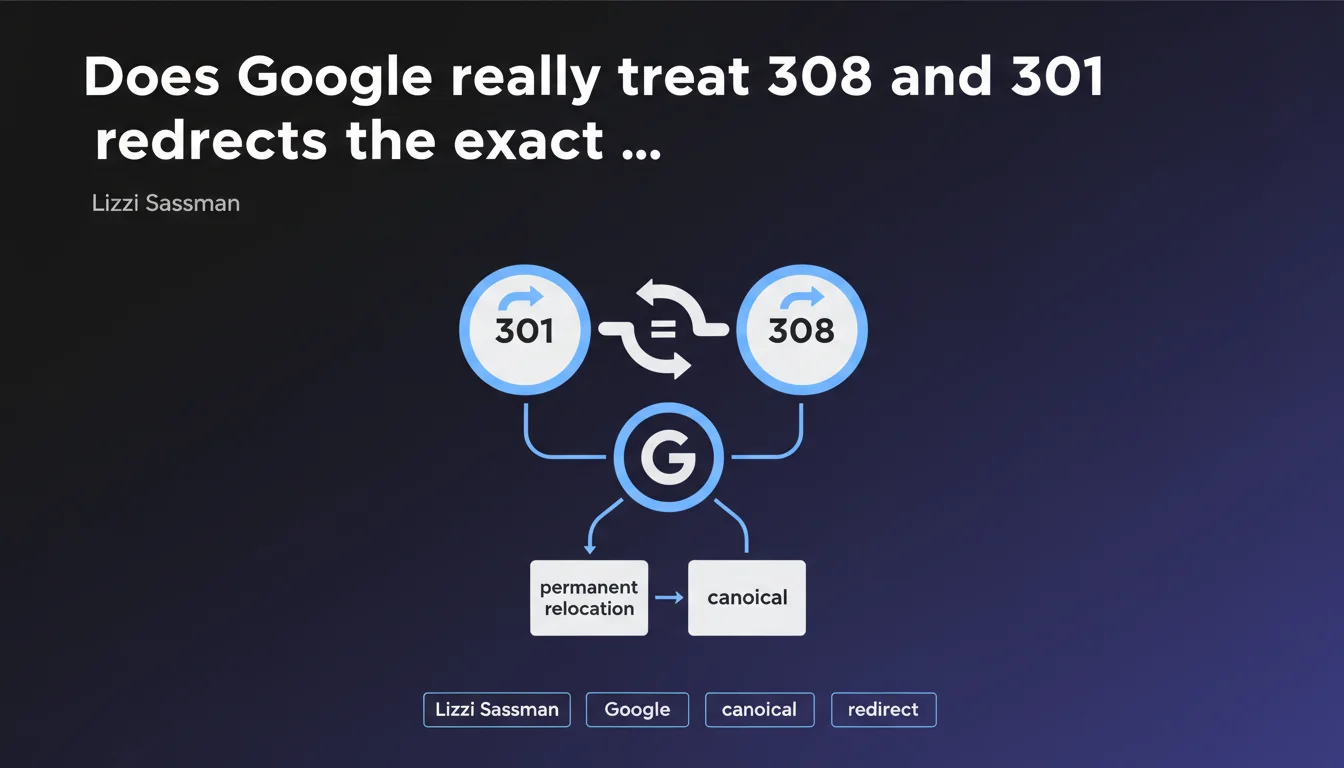
Google confirms that Googlebot treats 308 and 301 status codes as strictly equivalent: both indicate permanent relocation and serve as strong canonicalization signals. In practice, choosing one over the other has zero impact on SEO performance.
What you need to understand
What is the technical difference between a 301 and a 308?
The 301 Moved Permanently is the historical permanent redirect code in the HTTP protocol. It indicates that a resource has changed its address permanently. Key quirk: during redirection, the HTTP method can theoretically change — a POST can become a GET.
The 308 Permanent Redirect was introduced later under RFC 7538 specification. Key difference: it guarantees that the HTTP method remains unchanged during redirection. A POST stays a POST, a GET stays a GET. It's a stricter version of 301 on this aspect.
Why is Google clarifying this equivalence now?
Historically, 301 was the absolute reference for SEOs — 308 remained poorly documented in Google's official documentation. This clarification ends a gray zone: some practitioners hesitated to use 308 out of fear of different treatment by Googlebot.
Google simplifies the message: no difference in treatment between the two codes. They carry equal weight as canonicalization signals. No added SEO value in favoring one over the other.
What does "strong canonicalization signal" mean in concrete terms?
When Googlebot encounters a 301 or 308 redirect, it interprets this as clear instruction: "this URL no longer exists, the target URL is the definitive version". This is a strong signal for determining which URL should appear in the index.
Unlike a canonical tag (which remains a suggestion), permanent redirects impose a more directive choice. Google typically transfers ranking signals (backlinks, authority) to the destination URL — though this transfer is never guaranteed at 100%.
- 301 and 308 are treated identically by Googlebot for SEO purposes
- Both codes signal permanent relocation of the resource
- They serve as strong signals for canonicalization, more constraining than a canonical tag
- The technical difference (preservation of HTTP method) has no observable SEO impact
- PageRank and signal transfer operates the same way with both codes
SEO Expert opinion
Was this equivalence already observed in the field?
Yes. Practitioners using 308 — particularly on modern architectures or CDNs that favor it — never reported different behavior compared to 301. Empirical tests already showed identical index consolidation.
This official statement simply formalizes already-known practice. It's mainly reassuring: no hidden penalties, no second-tier treatment for 308. Useful for technical teams preferring 308 for its protocol rigor.
Are there scenarios where choosing between 301 and 308 could matter?
In pure theory, if a bot or browser sends a POST request to a URL that redirects, 308 guarantees the POST remains a POST. With 301, some browsers convert it to GET. But for Googlebot, which uses primarily GET, this distinction is irrelevant.
In reality, for 99.9% of SEO scenarios, the choice is cosmetic. Except in very specific configurations involving crawled APIs or forms — an extremely rare scenario in standard SEO.
Does this statement change anything for SEOs already using 301 everywhere?
No, there's no reason to modify existing configuration. If your permanent redirects are 301 and working correctly, leave them alone. The equivalence works both directions.
However, if your technical infrastructure favors 308 (servers configured that way by default, modern frameworks), you can now use it without SEO concerns. No need to force a 301 "for Google".
Practical impact and recommendations
What should you actually do with this information?
If you're in a site redesign or migration phase, you can freely choose between 301 and 308 based on your technical constraints. Both codes will produce identical results in terms of canonicalization and signal transfer.
For existing sites with 301 redirects already in place: change nothing. No gains from switching to 308. Conversely, if your tech stack generates 308 by default, don't worry — it's perfectly valid.
What errors should you avoid when implementing permanent redirects?
The classic mistake: redirect chains. Whether 301 or 308, avoid redirecting A → B → C. Googlebot follows redirects, but each hop lengthens crawling and potentially dilutes signals. Always redirect directly to the final destination.
Another trap: using a permanent redirect for a temporary test. If the change isn't permanent, use 302 or 307 (temporary equivalents of 308). Once a URL is deindexed in favor of another via 301/308, reverting is complex.
- Verify that your redirects point directly to the final destination, without intermediate chains
- Use 301 or 308 only for permanent moves
- Test your redirects with a tool like cURL or Screaming Frog to confirm the returned status code
- Monitor Search Console after migration: old URLs should gradually disappear from the index
- Don't mix permanent redirect with contradictory canonical tag on the destination page
- Document your technical choices (301 vs 308) to prevent confusion during future audits
How can you verify your redirects are correctly configured?
Standard technical audit: crawl your site with Screaming Frog or equivalent tool in "follow redirects" mode. Filter for 301 and 308 codes, verify there are no chains, loops, or redirects to 404s.
On Google's side, use the URL inspection tool in Search Console. If a redirected URL still appears in the index, request reindexing — or wait, consolidation takes time. Also monitor coverage reports to detect any error URLs.
❓ Frequently Asked Questions
Dois-je remplacer mes redirections 301 par des 308 après cette annonce ?
Le 308 transfère-t-il plus de PageRank que le 301 ?
Dans quels cas utiliser un 308 plutôt qu'un 301 ?
Une redirection 301 ou 308 transfère-t-elle 100% du PageRank ?
Peut-on utiliser un 308 pour une redirection temporaire ?
🎥 From the same video 14
Other SEO insights extracted from this same Google Search Central video · published on 12/04/2023
🎥 Watch the full video on YouTube →
💬 Comments (0)
Be the first to comment.