
Official statement
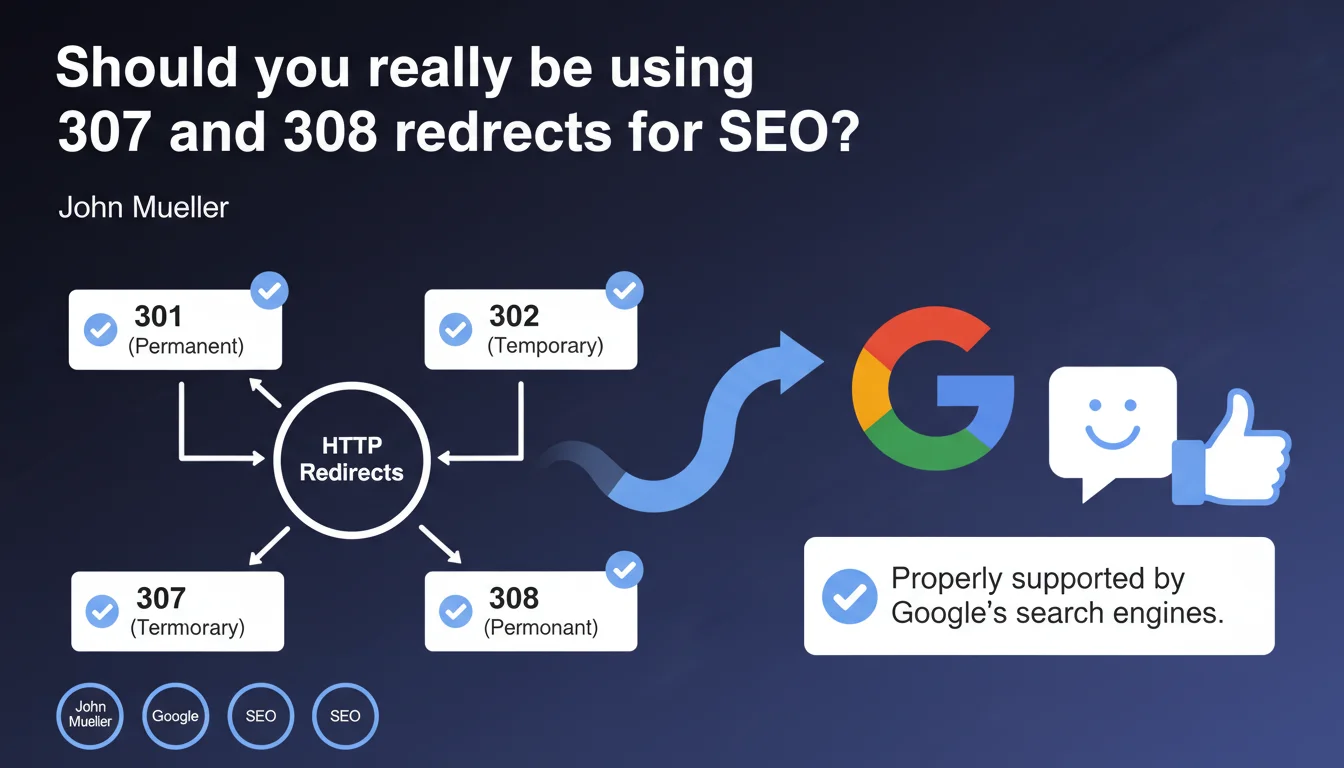
Google confirms that 307 and 308 redirects are treated the same way as 301 and 302 redirects by its search engine. All these types of HTTP redirects are officially supported. The choice between these options now depends on your specific technical needs, not SEO constraints.
What you need to understand
What's the difference between these four types of redirects?
The 301 and 302 redirects belong to the HTTP/1.0 protocol, while 307 and 308 are their HTTP/1.1 equivalents. The main distinction lies in how they handle HTTP methods: a 301 or 302 can transform a POST request into a GET request during the redirect, whereas 307 and 308 strictly preserve the original method.
In practice, 301 is permanent, 302 is temporary. The 307 and 308 follow this same logic — 308 for permanent, 307 for temporary — but with more predictable behavior on non-GET requests.
Why is Mueller clarifying this now?
For years, SEO discourse has been fixated on the 301/302 pair. The 307 and 308 remained shrouded in mystery — did they even work? Did they pass PageRank? This statement ends the ambiguity: all standard redirects are treated fairly by Googlebot.
The search engine has adapted to the evolution of the HTTP protocol. What mattered yesterday (absolutely choosing a 301) becomes less dogmatic today.
What's the key takeaway from this announcement?
- All four redirect types (301, 302, 307, 308) are correctly interpreted by Google
- Your choice should be based on technical constraints, not fear of negative SEO impact
- 307/308 guarantee stricter behavior with HTTP methods, useful for modern applications
- No penalties or signal loss to worry about with HTTP/1.1 versions
SEO Expert opinion
Is this statement consistent with real-world observations?
Yes, and it's quite reassuring. For several years now, sites using 308 redirects have shown no difference in behavior compared to classic 301 redirects. PageRank transfer occurred normally, indexing followed without issues.
What was missing was clear official confirmation. Mueller provides it here unambiguously. That said, many CMS platforms and CDNs continue to favor 301/302 by default — out of habit rather than technical necessity.
When should you favor a 307 or 308 over a 301 or 302?
If your site handles POST requests — forms, APIs, complex web applications — 307 and 308 prevent unpredictable behavior. A 301 can silently convert a POST to a GET, which breaks certain user interactions.
For a standard website with GET-only pages, the difference is negligible. But for an e-commerce platform or SaaS where HTTP methods vary, the HTTP/1.1 versions bring welcome rigor. [To verify]: Google doesn't detail whether processing speed differs between these types — empirically, no measurable gap has been observed.
Are there pitfalls to avoid despite this validation?
One critical point: configuration consistency. Mixing 301 and 308 for similar redirects makes no logical sense and complicates debugging. Choose a convention and stick with it.
Another common pitfall: believing a 307 temporary redirect can replace a page indefinitely. Temporary means temporary — if the redirect lasts for months, opt for a 308 or 301 permanent redirect. Google eventually interprets permanence signals even with an inappropriate HTTP code, but you might as well be explicit from the start.
Practical impact and recommendations
What do you need to change on an existing site?
Honestly? Probably nothing if your current redirects are working. No need to convert everything to 308 in an optimization frenzy — Google treats all four codes equivalently.
However, if you're overhauling your infrastructure or migrating to a new server, that's the time to adopt HTTP/1.1 standards. Modern CDNs (Cloudflare, Fastly, etc.) support them natively and provide interfaces to choose the exact redirect type.
How do you verify the redirect type in place?
Several quick methods:
- Use your browser's DevTools (Network tab) to inspect the HTTP status code returned
- Query directly via cURL from the command line:
curl -I https://yoursite.com/old-page - Use tools like Screaming Frog or OnCrawl to audit all site redirects in bulk
- Test via Google Search Console's URL inspection tool to see how Googlebot interprets the redirect
What common mistakes should you avoid when implementing?
Don't confuse temporary with permanent based on your actual needs. A 307 or 302 signals to Google that the original URL may return — ranking signals remain attached to that source URL. A 308 or 301 permanently transfers these signals to the destination.
Avoid redirect chains: A → B → C slows down crawling and dilutes signals. Google follows up to 5 hops but recommends pointing directly to the final destination.
In summary: Integrate 307 and 308 into your technical arsenal without overhauling everything. Audit your existing redirects, fix inconsistencies (chains, inappropriate codes), and prioritize HTTP/1.1 standards for your new projects.
While these optimizations are technical, they can be tricky to deploy without introducing errors — especially on high-volume sites or complex architectures. Working with a specialized SEO agency allows you to benefit from tailored support to audit, plan, and execute these adjustments safely.
❓ Frequently Asked Questions
Une redirection 308 transfère-t-elle le PageRank comme une 301 ?
Puis-je mélanger 301 et 308 sur un même site ?
Les 307 et 308 sont-elles plus rapides que les 301 et 302 ?
Dois-je convertir toutes mes 301 en 308 maintenant ?
Les anciens navigateurs supportent-ils les redirections 307 et 308 ?
🎥 From the same video 4
Other SEO insights extracted from this same Google Search Central video · published on 31/08/2023
🎥 Watch the full video on YouTube →
💬 Comments (0)
Be the first to comment.