
Official statement
Other statements from this video 4 ▾
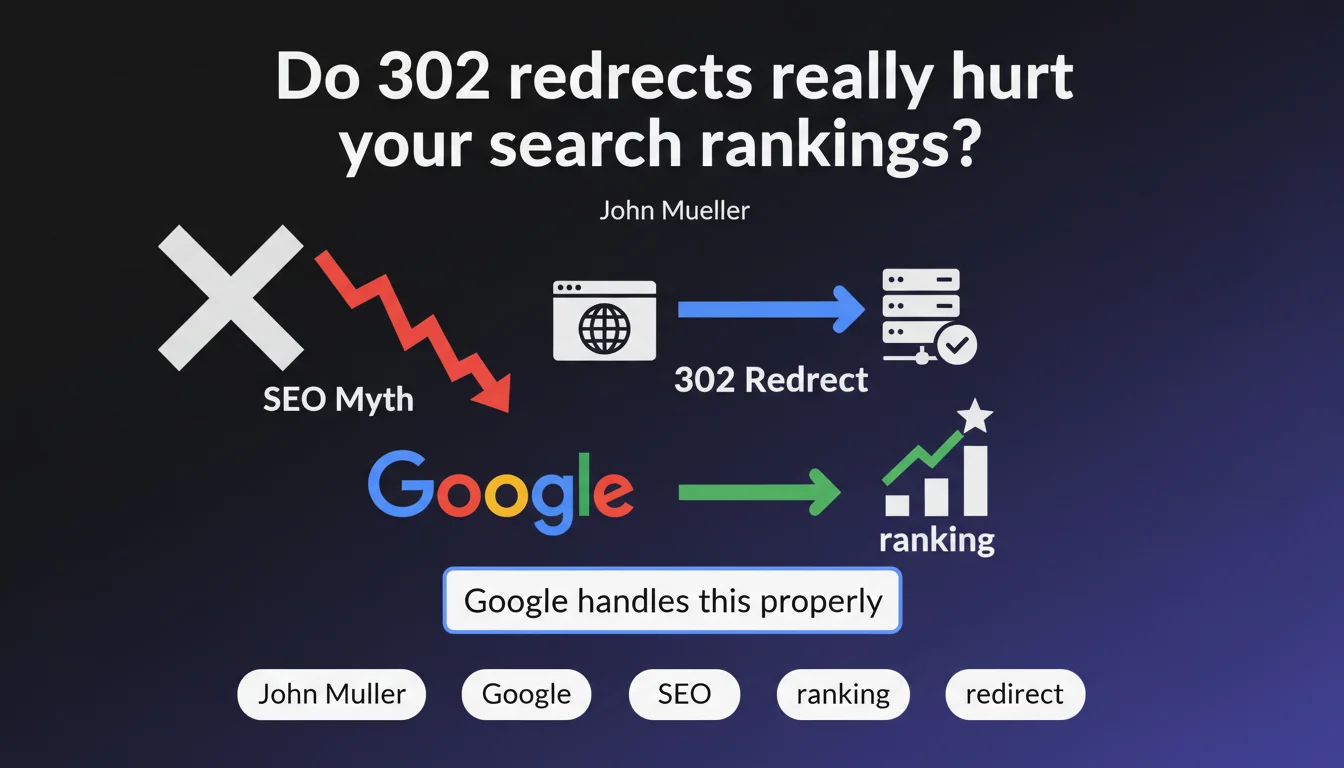
Google states that 302 redirects do not penalize SEO, contrary to widespread belief in the industry. The search engine handles this type of redirect correctly and without negative impact on rankings. The distinction between 301/302 would therefore be more a matter of semantic signal than performance.
What you need to understand
Why has there been so much confusion around 302 redirects?
For years, SEO doctrine has hammered home a simple principle: 301 for permanent redirects, 302 for temporary ones. This distinction seemed logical since the 301 is supposed to pass "SEO juice" while the 302, being temporary in nature, would not.
The problem? This oversimplification has created an irrational fear of 302s. Many professionals systematically avoid them, even in contexts where they would be technically more appropriate. Google is setting the record straight here by reminding us that 302s are not toxic for SEO.
How does Google actually treat 302 redirects?
The technical reality is more nuanced than the myth. Google analyzes the context of the redirect rather than blindly relying on the HTTP code. If a 302 remains in place for months, the search engine understands that it functions de facto as a permanent one.
In practical terms, this means Google will gradually transfer signals (PageRank, link anchors, etc.) to the destination URL, even with a 302. The delay may be longer than with a 301, but the final impact on rankings is negligible in most cases.
When should you still prefer a 301 redirect?
Let's be honest: just because 302s "are not bad" doesn't mean they're always the right choice. If your intention is clearly permanent — redesign, domain migration, content consolidation — the 301 remains the cleanest signal.
Why? Because it accelerates the process of transferring signals and clarifies the intent for search engines. A poorly used 302 creates ambiguity that can slow indexing of the new URL. It's mainly a matter of efficiency, not a penalty.
- 302 redirects do not penalize SEO according to Google
- The search engine analyzes the actual behavior of the redirect, not just the HTTP code
- A 302 maintained for a long time will be treated as a 301 progressively
- 301 remains preferable for permanent intentions because it accelerates signal transfer
- Avoiding 302s out of fear is a tactical mistake stemming from an SEO myth
SEO Expert opinion
Is this statement consistent with real-world observations?
Yes and no. On paper, Mueller's assertion is technically correct: we do observe that 302s maintained over time eventually transmit signals. But the delay in signal transfer remains a gray area.
On urgent migrations or redesigns where every week counts, I've found that 301s trigger faster reindexing. 302s sometimes create a waiting phase where Google hesitates between keeping the old URL in the index or switching to the new one. It's not a penalty, it's inertia — and in SEO, inertia is costly.
What nuances should be added to this statement?
Mueller's statement overlooks a crucial point: context of use. A 302 for a geotargeted A/B test? Perfectly logical. A 302 to permanently redirect 500 pages after a redesign? Poor strategic choice, even if technically "not bad."
And that's where it gets tricky. The message "302s are not bad" can be misinterpreted by technical teams who might think "so it doesn't matter then." Except it does, it matters for the speed of signal transfer. [To verify]: Google never communicates about the comparative timelines for 301 vs 302 consolidation.
When does a 302 redirect become problematic?
When it creates redirect chains or adds to an already complex architecture. A 302 to a 301 to another 302? You've just created an obstacle course for Googlebot, with signal loss at each hop.
Another tricky scenario: domain migrations. Technically, a 302 will eventually work. But why take the risk of a prolonged delay when a 301 sends an unambiguous signal? The 302 in this context is a matter of technical negligence, not strategy.
Practical impact and recommendations
What should you do concretely with your current redirects?
First step: audit your existing 302 redirects. Use Screaming Frog or your preferred crawler to list all 302 redirects on your site. Ask yourself for each one: is it really temporary, or is it leftover from a poorly completed migration?
If the 302 has been in place for more than 3 months and the intention was permanent, switch to 301. No need to panic though: you've probably not lost major SEO juice, but you'll gain clarity and faster consolidation speed.
What mistakes should you absolutely avoid?
Never create redirect chains involving 302s, especially to important URLs. If you need to redirect A to B then B to C, point A directly to C with a 301.
Another classic pitfall: using a 302 to "test" a domain migration. The testing happens before production deployment, not with a faulty redirect in production. A migration is done with a 301 or not at all.
- List all active 302 redirects on your site
- Identify those in place for more than 3-6 months without valid temporary reason
- Switch to 301 the redirects with permanent intent
- Check for the absence of redirect chains involving 302s
- Document the intention of each maintained 302 to justify the technical choice
- Monitor consolidation timelines in Search Console after corrections
How can you verify the impact of your redirects?
In Google Search Console, Coverage section, monitor URLs that disappear from the index after redirect. If an old URL remains indexed several weeks after a 302 supposedly permanent, it's a signal that Google is hesitant — switch to 301.
Also track the positions and traffic of destination URLs. A sudden drop could indicate signal loss due to poorly managed redirect chains.
❓ Frequently Asked Questions
Une redirection 302 fait-elle perdre du PageRank ?
Faut-il remplacer toutes mes 302 par des 301 ?
Combien de temps Google met-il à consolider une 302 ?
Une 302 peut-elle causer une désindexation de l'URL source ?
Les chaînes de 302 sont-elles dangereuses pour le SEO ?
🎥 From the same video 4
Other SEO insights extracted from this same Google Search Central video · published on 31/08/2023
🎥 Watch the full video on YouTube →
💬 Comments (0)
Be the first to comment.