
Official statement
Other statements from this video 4 ▾
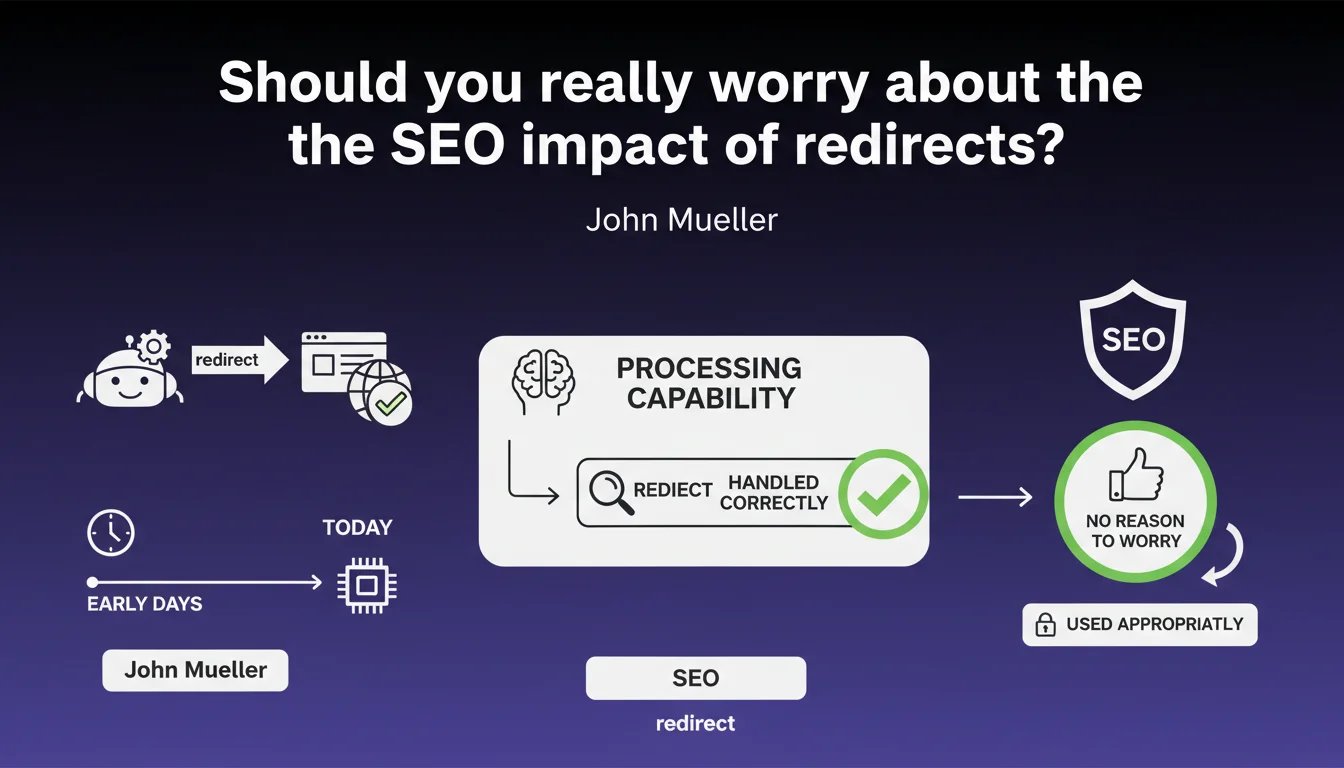
Google has mastered redirects since its inception and manages them without any problem if they are used correctly. No need to panic: a clean redirect is not a roadblock to SEO. The real question is understanding what "used appropriately" actually means in practice.
What you need to understand
Why does Google insist on technical mastery of redirects?
Since their creation, search engines have had to deal with HTTP redirects. A site migrates, a page changes URL, a domain merges — all situations where redirecting is essential. Google wants to reassure you: its crawler won't choke on a 301 or 302.
The algorithm follows redirect chains, consolidates signals (PageRank, backlinks) toward the target URL, and indexes the correct version. It's a well-oiled process, optimized over decades. As long as the redirect is clear and technical, Google knows what to do.
What does "used appropriately" really mean according to Google?
This is where things get fuzzy. Google doesn't detail its precise criteria. We can infer a few obvious points: favor permanent 301 redirects for definitive migrations, avoid overly long chains (A → B → C → D…), don't create multiple back-and-forth redirects.
But how many redirects in a chain is "too many"? What's the maximum tolerated latency? What's the impact on crawl budget if a site has 10,000 active redirects? Google remains deliberately vague on these thresholds.
Do redirects have a cost in PageRank or indexing speed?
Historically, Google has stated that 301 redirects don't lose PageRank — an evolution from earlier positions. On the indexing side, a redirect adds an extra step: the crawler must follow the link, fetch the new URL, then process it.
If the redirect is fast (low latency), the impact is minimal. But a redirect to a slow page or an overwhelmed server can slow down the process. It's an indirect effect, not an algorithmic penalty.
- Search engines have handled redirects since the beginning — nothing new technically here.
- A properly configured 301 redirect transfers ranking signals without loss.
- The real risk: overly long chains or redirects to non-existent pages.
- Google provides no specific thresholds to define "appropriate".
SEO Expert opinion
Is this statement consistent with real-world observations?
Overall, yes. 301 redirects work — we verify this every day during migrations. Backlinks follow, ranking transfers (sometimes with a delay of a few weeks), and Google eventually indexes the new URL.
But saying "there's no reason to worry" oversimplifies things. A poorly managed migration — 302 redirects instead of 301, complex chains, temporary redirects never cleaned up — can cost you significantly in visibility. [To verify]: Google never specifies how long it takes for signals to be completely consolidated after a migration.
What nuances should be added to this claim?
First nuance: speed matters. A redirect that adds 500 ms of latency slows down crawling and degrades user experience. Google can technically follow the redirect, but if the target page is slow, it impacts your site.
Second nuance: JavaScript redirects or meta refresh are not handled the same way as an HTTP 301. Google can follow them, but with a delay and fewer guarantees of PageRank transfer. [To verify]: the exact impact of a meta refresh on authority transfer remains unclear in official documentation.
In what cases does this rule not apply?
When redirects are abusive or deceptive. For example: massively redirecting to an unrelated page to capture traffic, or chaining redirects to manipulate crawling. Google can then ignore the redirect or even apply a manual action.
Another problematic case: temporary redirects (302, 307) used incorrectly long-term. Google may end up indexing the source URL instead of the target, or hesitate between both — resulting in signal dilution.
Practical impact and recommendations
What should you do concretely for SEO-friendly redirects?
First rule: use permanent 301 redirects whenever a page permanently changes URL. It's the standard for transferring authority and clearly signaling to Google the new destination.
Second rule: avoid redirect chains. If A redirects to B which redirects to C, simplify by redirecting A directly to C. Each hop adds latency and risks losing signal.
Third rule: monitor response times. A redirect that takes 2 seconds to respond penalizes the crawler as much as the user. Optimize your servers and test with tools like GTmetrix or WebPageTest.
What mistakes should you absolutely avoid?
Never mix 302 and 301 without valid reason. A 302 says "temporary", so Google may keep the old URL in its index. If it's permanent, use a 301.
Never redirect to a 404 page or an unrelated page. It breaks signal consolidation and degrades user experience. Google may even treat it as a soft 404 and deindex it.
Never leave obsolete redirects lying around after a migration. Clean up: remove redirects that are no longer useful, eliminate chains accumulated over the years.
How can you verify your site follows these best practices?
Crawl your site with Screaming Frog, Oncrawl, or Botify. Identify all redirects, spot chains, verify HTTP codes (301 vs 302), measure response times.
Check Google Search Console to detect crawl errors related to redirects. Review server logs to see how often Googlebot follows a redirect and whether it abandons partway.
If your site has gone through multiple migrations or restructurings, a complete technical audit is essential. These projects can quickly become complex, especially on sites with thousands of pages. Partnering with a specialized SEO agency can save you time and prevent costly mistakes — customized support allows you to optimize every redirect and track signal consolidation over time.
- Use permanent 301 redirects for any permanent migration
- Avoid redirect chains (more than 2 hops = risk)
- Monitor redirect response times (ideally < 200 ms)
- Crawl regularly to detect chains and errors
- Clean up obsolete redirects after each migration
- Check server logs to see how Googlebot follows redirects
❓ Frequently Asked Questions
Une redirection 301 fait-elle perdre du PageRank ?
Combien de redirections dans une chaîne sont tolérées par Google ?
Dois-je utiliser une 301 ou une 302 pour une page temporairement indisponible ?
Les redirections JavaScript sont-elles aussi efficaces qu'une 301 HTTP ?
Combien de temps après une migration Google consolide-t-il les signaux ?
🎥 From the same video 4
Other SEO insights extracted from this same Google Search Central video · published on 31/08/2023
🎥 Watch the full video on YouTube →
💬 Comments (0)
Be the first to comment.