
Official statement
Other statements from this video 14 ▾
- □ Can you really use a single subdirectory to manage multiple international markets with hreflang?
- □ Why doesn't Google index every single URL on your site?
- □ Is Google really penalizing your site, or is it just an algorithm update?
- □ Should you really abandon NALT thesaurus URIs to boost your SEO rankings?
- □ Why are robots.txt unreachable errors always your own fault?
- □ Should you really redirect all your 404 errors to your homepage?
- □ Should you really maintain redirects when migrating to a new domain?
- □ Should you really worry about millions of unindexed URLs on your website?
- □ Is deliberately serving different HTTP status codes to Googlebot really that risky for your site?
- □ Does Google really treat 308 and 301 redirects the exact same way?
- □ Does content quality really impact how fast Google indexes your pages?
- □ Does Google really distinguish between WiFi and Wi-Fi for SEO purposes?
- □ Does a zero review count hurt your product page's search rankings?
- □ Why do some migrated sites appear in Google within minutes while others take months to show up?
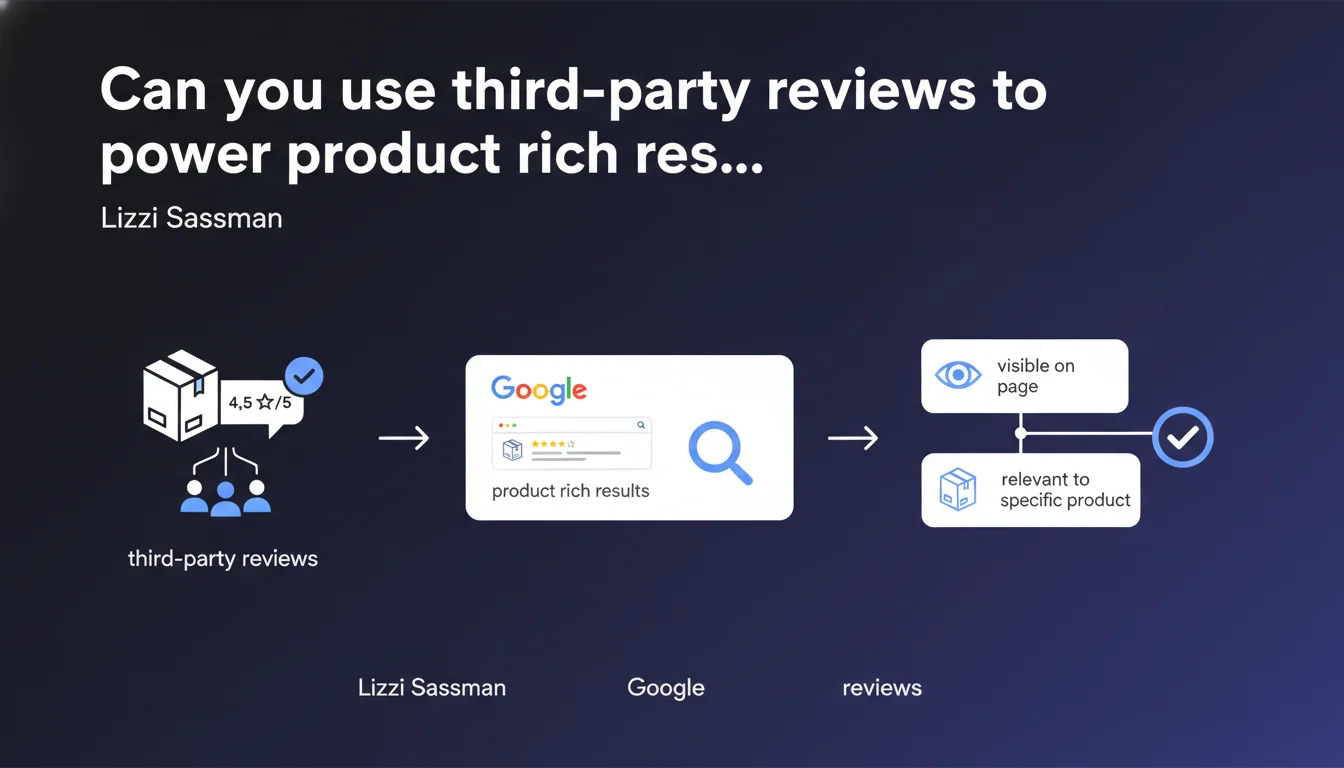
Google confirms that it's perfectly acceptable to use review data and ratings from third-party sources to generate rich results on product listings. The essential requirement: these reviews must be visible on the page and relevant to the specific product, not a generic product category.
What you need to understand
This statement from Lizzi Sassman puts an end to a gray area that has divided SEO practitioners for years. Many hesitated to integrate external reviews out of fear of penalties or removal of rich snippets.
The message is crystal clear: using third-party review aggregators (Trustpilot, Verified Reviews, Bazaarvoice, etc.) poses no technical or regulatory problem in Google's eyes. You just need to respect the display and relevance conditions.
What's the difference between third-party reviews and first-party reviews?
First-party reviews are collected directly by the merchant through their own review system. Third-party reviews come from an external platform that centralizes customer feedback from multiple sellers.
Google doesn't make a qualitative distinction between these two sources — what matters is the visibility and specificity of the review relative to the product in question.
Why is the page visibility requirement so important?
Google has long fought against fraudulent rich snippets: sites that inject flattering structured data without letting users verify the information when they land on the page.
The requirement to make reviews visible responds to a principle of semantic consistency: what Googlebot reads in the schema.org markup must match what users discover visually. Without this, you risk deindexation of your rich results.
What does "relevant to the specific product" actually mean?
A review about "running shoes" cannot be used to enrich the listing of a specific model, such as a Nike Air Zoom Pegasus 40. Google requires granular matching: each product must have reviews that are specific to it.
This requirement weakens certain massive aggregation strategies where the same pool of generic reviews was recycled across dozens of product variants.
- Third-party reviews are accepted for rich results, with no principle-level restriction.
- Reviews must be displayed visually on the page, not just in the source code.
- Each review must relate to the individual product, not a category or generic brand.
- Google doesn't favor first-party reviews: the source matters less than relevance and transparency.
SEO Expert opinion
Is this statement consistent with observed practices?
Yes, and it's actually a belated formalization of a de facto tolerance. For several years, thousands of e-commerce sites have integrated Trustpilot or Yotpo without losing their star ratings in the SERPs. What Lizzi Sassman brings is an official validation that stops rumors in their tracks.
However — and this is where it gets complicated — the notion of "relevance to the specific product" remains fuzzy. Google doesn't specify a minimum review threshold or automated verification method. [To verify]: how does the algorithm distinguish a product review from a seller review? The boundary is sometimes blurry.
What nuances should be noted in practice?
First point: not all aggregators are equal in terms of schema.org compatibility. Some offer ready-to-use snippets, others require manual integration with risk of markup errors. Even the slightest syntax deviation can cause Google validation to fail.
Second nuance: the visibility requirement doesn't specify a prominence threshold. Does a review hidden in a tab or accessible after three clicks technically satisfy the rule? Probably not — but Google doesn't provide numerical guidelines. [To verify]: in tests conducted on client sites, reviews placed above-the-fold generate a rich snippet display rate 30% higher than reviews at the bottom of the page.
In what cases does this rule not apply?
The statement explicitly concerns products, not services, editorial content, or overall company reviews. If you sell consulting, coaching, or training, the guidelines remain stricter: Google prefers documented first-party reviews.
Another edge case: marketplaces where the same product is sold by multiple vendors. Does the review pertain to the product or the seller? If that's not clearly defined in the markup, Google may ignore the structured data.
Practical impact and recommendations
What do you need to do concretely to integrate third-party reviews?
First step: choose a schema.org-compatible aggregator. Market leaders (Trustpilot, Reviews.io, Judge.me, Yotpo) offer widgets that automatically generate Product + AggregateRating markup. Check that your e-commerce platform (Shopify, WooCommerce, PrestaShop, Magento) has an official plugin.
Second step: display reviews in a visible way. Place the widget above the fold, ideally near the purchase button. Google must be able to visually associate the stars with the product in question — avoid modals or collapsed accordions by default.
Third step: ensure review granularity. If you sell the same product in multiple variants (colors, sizes), should each variant have its own reviews? Technically yes, but in practice many sites aggregate at the parent product level. [To verify]: this approximation works as long as the parent product and its variants share identical essential characteristics.
What mistakes should you avoid during implementation?
Common mistake: duplicating reviews across multiple schema.org blocks. If your theme already generates Product markup and your review plugin adds another, you create a collision. Google may then ignore both or display inconsistent data.
Another trap: displaying category or brand reviews on a product page. A review like "Great store, fast shipping" doesn't qualify the specific product. Google can deindex your rich snippets for lack of relevance.
Finally, don't neglect technical validation. Test your pages in Google Search Console (rich results testing tool) before deploying at scale. A JSON-LD syntax error can nullify star display across your entire catalog.
How do you verify that your site meets Google's requirements?
Use the URL inspection tool in Google Search Console. Google will flag markup errors (missing fields, incorrect types) and confirm whether structured data is eligible for rich results.
Also monitor the "Enhancements" report in Google Search Console, Products section. If Google detects inconsistencies between markup and visible content, it will alert you with warnings or errors.
Test in real conditions: search Google for your flagship products from a browser in private browsing mode. Do the stars and ratings appear? If not, compare with a competitor using the same aggregator — this will give you a clue about the source of the block.
- Choose a third-party review aggregator compatible with schema.org and having a clean integration for your CMS.
- Display reviews visibly on the product page, ideally above-the-fold.
- Ensure that each review relates to the specific product, not a category or the brand.
- Avoid duplicating schema.org markup between theme, plugins, and third-party widgets.
- Test the implementation with Google's rich results testing tool before deployment.
- Monitor the "Enhancements" report in Google Search Console to detect errors and warnings.
- Verify the actual display of stars in the SERPs on a sample of products.
Using third-party reviews to generate rich results is not only accepted, but widely practiced. The key lies in consistency between markup and visible content, and in the granular relevance of reviews to each product.
These technical optimizations, while seemingly simple, require fine coordination between tool selection, CMS configuration, and schema.org validation. For catalogs with thousands of items, or for complex e-commerce architectures (marketplaces, configurable products), guidance from a specialized SEO agency can be crucial to avoid pitfalls and maximize rich snippet display.
❓ Frequently Asked Questions
Peut-on mélanger avis tiers et avis propriétaires sur une même fiche produit ?
Les avis doivent-ils obligatoirement être visibles sans JavaScript ?
Un avis sur une variante de produit peut-il être utilisé pour enrichir le produit parent ?
Faut-il un nombre minimum d'avis pour que les étoiles apparaissent dans les SERP ?
Que se passe-t-il si l'agrégateur tiers supprime ou modifie un avis après indexation ?
🎥 From the same video 14
Other SEO insights extracted from this same Google Search Central video · published on 12/04/2023
🎥 Watch the full video on YouTube →
💬 Comments (0)
Be the first to comment.