
Official statement
Other statements from this video 20 ▾
- □ Why can't Google ever guarantee that your users will land on the right language version of your site?
- □ Are automatic redirects really killing your international SEO rankings?
- □ Should you really block JavaScript execution for SPAs with server-side rendering?
- □ Should you really tag foreign words with the lang attribute for SEO purposes?
- □ Does duplicate content really trigger a Google penalty?
- □ Does Google really respect rel=canonical or is it just a suggestion that gets ignored?
- □ Is hreflang really essential for managing a successful international website?
- □ Does Google's web cache actually affect your search rankings?
- □ How does Google really customize search results based on location and language? Here's what actually happens behind the scenes
- □ Does noindex really help you save crawl budget, or is it the wrong tool for the job?
- □ Do you really need to stick to just one topic on your site to rank well?
- □ How many links can you really put on a page without triggering a Google penalty?
- □ Does the referrer URL in Search Console really affect your search rankings?
- □ Does word count really matter for SEO ranking?
- □ Should you worry about reusing the same text blocks across multiple pages?
- □ Does Google really accept machine-translated content on multilingual websites?
- □ Does blocking URLs with robots.txt but leaving them indexed really hurt your SEO?
- □ Do you really need to duplicate the Organization schema on every page of your website?
- □ Can self-hosted reviews display star ratings in Google search results for local businesses?
- □ Why do website mergers produce unpredictable results in Google's eyes?
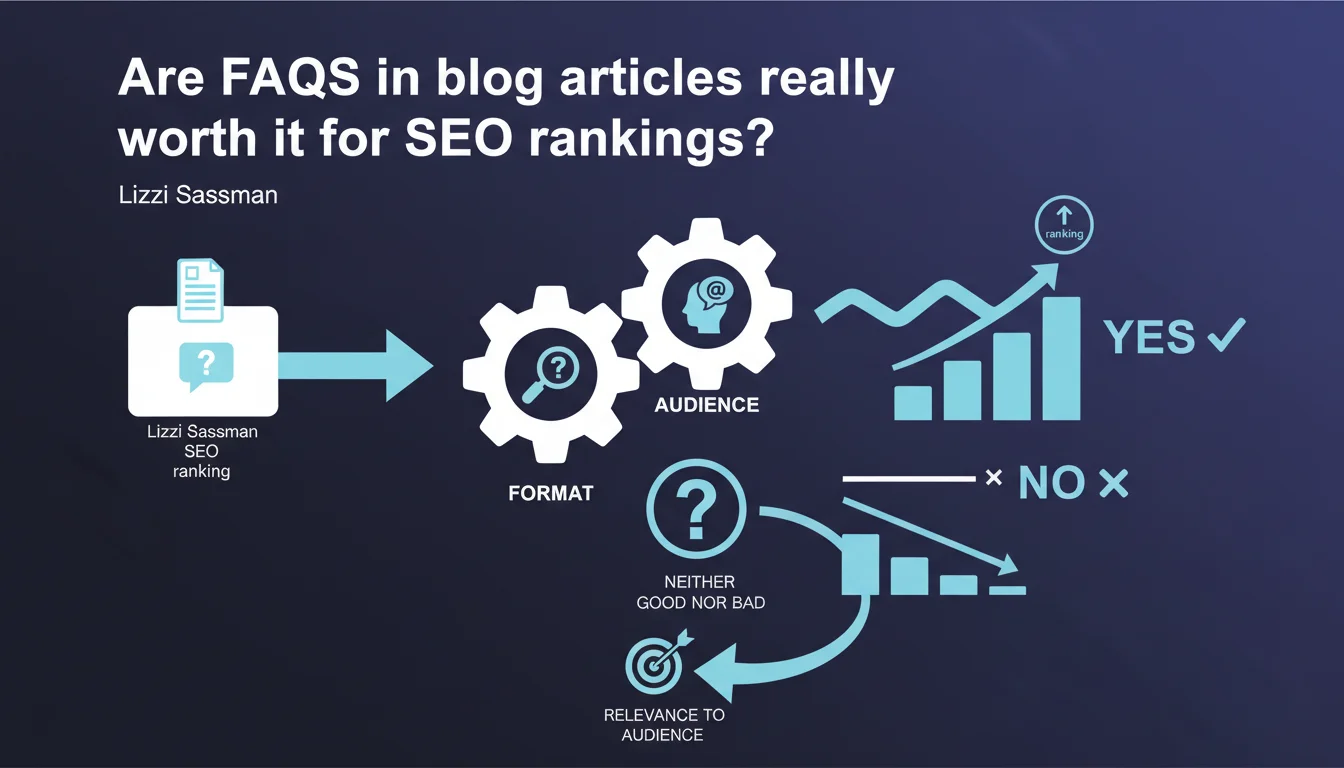
Adding a FAQ to an article doesn't directly impact search rankings. Google doesn't consider this format inherently good or bad — what matters is the quality of answers and their relevance to your audience. Format is secondary, substance is what counts.
What you need to understand
Why does Google claim the FAQ format is neutral?
Lizzi Sassman is pushing back here on a persistent misconception: the idea that structuring content as FAQs guarantees an SEO advantage. Google doesn't reward a format for being a format. What counts is whether the questions actually match what users are really searching for.
Many SEOs tack FAQs onto the end of articles on autopilot, thinking it'll trigger featured snippets or rich results. But if the questions are generic, off-topic, or forced, they add nothing—neither for users nor for rankings.
What does "thinking about your audience" actually mean in practice?
This phrase keeps showing up in Google's communications, and it's not accidental. Thinking about your audience means anticipating the real questions your readers will have after digesting the main content. Not the questions you wish they'd ask.
Say your article covers a technical topic—like implementing hreflang. If your FAQ lists "What is SEO?" or "Why is SEO important?", you've missed the mark. Your target audience for that piece wants "How do I verify hreflang is working?" or "Can I use hreflang with machine-translated content?" instead.
Does Google favor certain types of FAQs over others?
Officially, no. But in practice, FAQs that generate rich results—meaning those marked up with Schema.org FAQPage—get extra visibility in the SERPs. It's not a direct ranking signal, but it does help with CTR.
Fair warning though: Google can choose not to show your FAQs as rich results even if the markup is correct. The eligibility criteria stay murky, and display varies by query, context, and competition.
- FAQ format isn't good or bad—the content is what matters.
- Only add FAQs if they answer real questions from your target audience.
- Schema.org FAQPage markup can help, but it doesn't guarantee rich result display.
- Generic or forced FAQs deliver zero advantage and can actually dilute your content's relevance.
SEO Expert opinion
Does this official line match what we're seeing in the real world?
Mostly yes. A/B tests we've run show that a well-targeted FAQ can boost time-on-page and lower bounce rate—two signals Google does pick up on. But we haven't seen a direct correlation with ranking gains if the FAQ feels artificially bolted on.
What does work: FAQs that tackle questions with clear search intent—especially lower-funnel stuff—can capture long-tail traffic through people also ask. That's a win. But if you're stuffing your article with off-topic questions just to pad the word count, forget it.
What nuances should we add to Google's official position?
Google says "it's just a format," which is true—but certain formats fit certain search intents better. FAQs work well for informational content where users want quick, targeted answers. On transactional pages, they're usually noise.
Another nuance: [Needs verification] the real impact of FAQPage markup on CTR. Google has scaled back certain rich result displays in recent months, and FAQs aren't being rolled out as systematically. Hard to measure the precise impact without Google's internal data.
When does this rule break down?
If you're in a highly competitive space where the SERP is packed with featured snippets and PAA boxes, a well-optimized FAQ can give you a tactical edge. Here, format becomes a lever—but only if your content is rock-solid.
Another scenario: pillar pages in topic clusters. A well-structured FAQ can act as an internal linking hub, strengthening your site structure and clarifying thematic hierarchy. In this case, format becomes strategic.
Practical impact and recommendations
What should you do right now with your existing FAQs?
Step one: audit your current FAQs. Go through them and ask yourself: does each question reflect something my audience actually wonders about? If the answer is no, delete it or rewrite it.
Step two: cross-reference your FAQs with Search Console data. Look for impressions coming through people also ask. If you're getting them, double down on those answers. If not, dig into why—either the question isn't being searched or your answer isn't clear enough.
What mistakes should you avoid at all costs?
Don't create FAQs just because "it looks good." Generic FAQs like "What is X?" about topics your audience already understands are just clutter. They dilute relevance and add scroll time without delivering value.
Another trap: repeating content that's already in your main article. If you've already explained something thoroughly in the body text, don't regurgitate it word-for-word in your FAQ. Summarize, rephrase, or move to a different question.
How do you know if your FAQs are actually adding value?
Use tools like AnswerThePublic, AlsoAsked, or People Also Ask to uncover questions real users are asking. Compare against your FAQ. If there's a gap, fix it.
Then monitor your metrics: time-on-page, bounce rate, clicks from PAA. If your FAQs hit the mark, you should see engagement lift. If not, that's a signal they're not working.
- Audit your existing FAQs and remove those that don't answer real questions.
- Cross-check your FAQs against Search Console data and people also ask boxes.
- Never duplicate content that's already covered in your main article.
- Use AnswerThePublic or AlsoAsked to surface what users are actually asking.
- Only apply Schema.org FAQPage markup if the questions are truly relevant.
- Track engagement metrics (time-on-page, bounce rate) to measure real impact.
❓ Frequently Asked Questions
Faut-il obligatoirement baliser les FAQ en Schema.org FAQPage ?
Combien de questions faut-il inclure dans une FAQ ?
Les FAQ peuvent-elles nuire au SEO si elles sont mal faites ?
Les FAQ aident-elles à capter du trafic longue traîne ?
Google affiche-t-il toutes les FAQ balisées en rich result ?
🎥 From the same video 20
Other SEO insights extracted from this same Google Search Central video · published on 21/10/2022
🎥 Watch the full video on YouTube →
💬 Comments (0)
Be the first to comment.