
Official statement
Other statements from this video 20 ▾
- □ Why can't Google ever guarantee that your users will land on the right language version of your site?
- □ Are automatic redirects really killing your international SEO rankings?
- □ Should you really block JavaScript execution for SPAs with server-side rendering?
- □ Should you really tag foreign words with the lang attribute for SEO purposes?
- □ Does duplicate content really trigger a Google penalty?
- □ Does Google really respect rel=canonical or is it just a suggestion that gets ignored?
- □ Are FAQs in blog articles really worth it for SEO rankings?
- □ Is hreflang really essential for managing a successful international website?
- □ Does Google's web cache actually affect your search rankings?
- □ How does Google really customize search results based on location and language? Here's what actually happens behind the scenes
- □ Does noindex really help you save crawl budget, or is it the wrong tool for the job?
- □ Do you really need to stick to just one topic on your site to rank well?
- □ How many links can you really put on a page without triggering a Google penalty?
- □ Does the referrer URL in Search Console really affect your search rankings?
- □ Does word count really matter for SEO ranking?
- □ Should you worry about reusing the same text blocks across multiple pages?
- □ Does Google really accept machine-translated content on multilingual websites?
- □ Does blocking URLs with robots.txt but leaving them indexed really hurt your SEO?
- □ Do you really need to duplicate the Organization schema on every page of your website?
- □ Why do website mergers produce unpredictable results in Google's eyes?
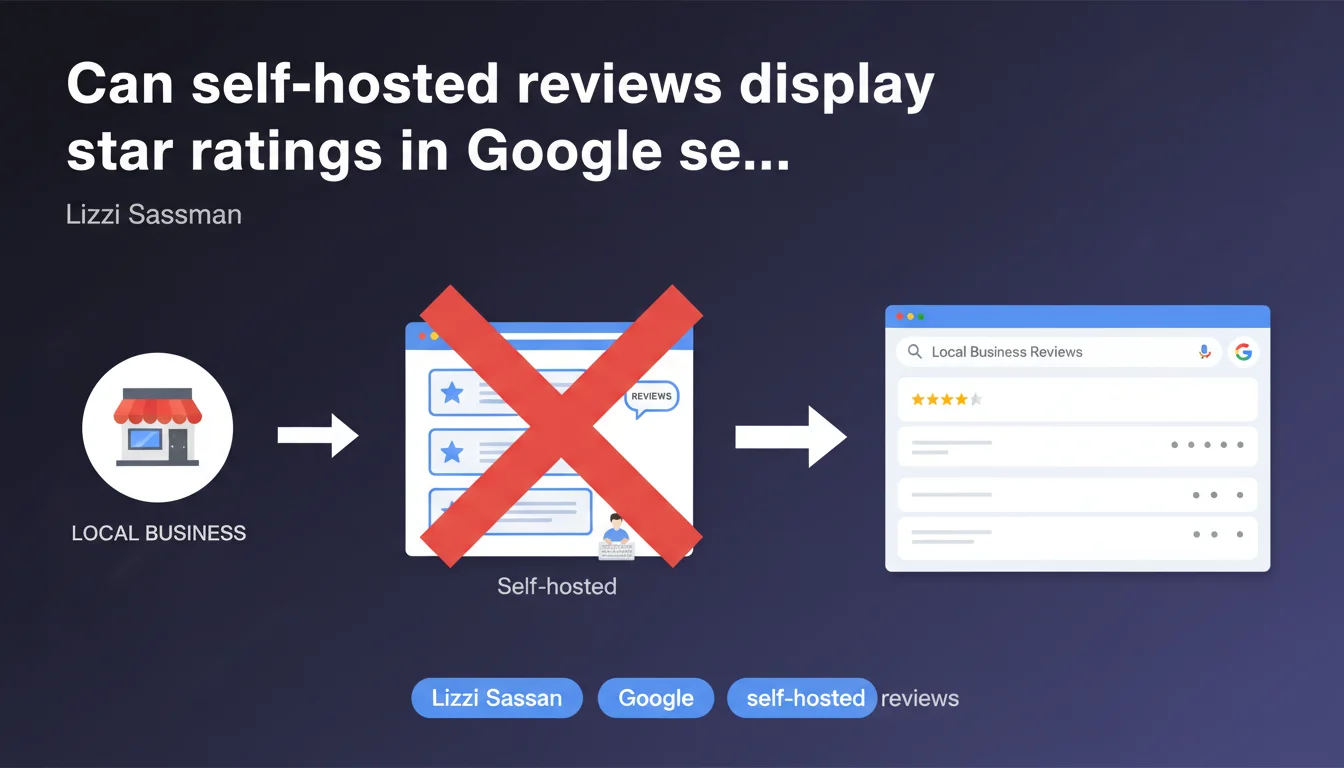
Google now refuses to display review star ratings in SERPs for local businesses that host their own reviews (self-hosted). Only reviews from independent third-party platforms remain eligible for rich snippets with stars. This rule specifically targets local organizations that control both the hosting and content of their reviews.
What you need to understand
What exactly is a "self-hosted" review?
A self-hosted review is a system where the business controls both the hosting platform and the displayed reviews. Concretely: you create a "Customer Testimonials" section on your own website, you collect feedback, you publish it. You manage the entire chain.
Google now considers this mechanism as insufficiently reliable to justify enriched display in search results. The search engine favors independent third-party sources — platforms where the rated business has no control over moderation or publication.
Why is Google tightening its stance now?
Review manipulation, let's be honest, is a national sport in certain sectors. Golden stars catch the eye, boost CTR, and some have figured out that displaying only 5-star reviews while hiding others is effective. Too effective.
By restricting eligibility to verifiable third-party platforms (Google Business Profile, Trustpilot, Yelp, etc.), Google is attempting to maintain minimum credibility in its rich snippets. This is consistent with its fight against spam from self-generated content and deceptive practices.
Which entities are affected by this restriction?
The statement explicitly targets "local businesses or organizations". Not traditional e-commerce sites, not marketplaces, not review aggregators. Local shops, service providers, professional offices — all those that fall under the LocalBusiness markup in Schema.org.
If you manage a restaurant, medical practice, physical shop, forget about stars in SERPs via your own hosted reviews. Only external recognized sources will remain displayed.
- Self-hosted reviews (your site): no more stars in Google results
- Independent third-party reviews (GBP, Trustpilot, etc.): always eligible for rich snippets
- Primary target: local businesses and organizations, not global e-commerce
- Google's objective: limit manipulation and guarantee reliability of rating signals
SEO Expert opinion
Is this rule truly new or just a clarification?
Google has never been lenient with self-hosted reviews, but the wording here is more definitive and explicit. Before, it was vague — some sites still managed to display stars via homemade AggregateRating markup. Now, the message is unambiguous: if you control the review, no stars.
In the field, we've already observed for several months a decline in rich snippet display for "homemade" reviews. This statement formalizes a practice already underway algorithmically. So no, not a revolution — rather a public confirmation of a shift initiated quietly.
What nuances should be applied to this ban?
First point: the rule concerns star display in organic SERPs, not the validity of Schema markup itself. You can still structure your reviews with Review or AggregateRating — technically, it's correct. Simply, Google won't display them as golden stars.
Second nuance: [To be verified] — the exact definition of "self-hosted" remains unclear in some edge cases. For example, if you use a third-party widget (Trustpilot embed, Avis Vérifiés integrated) that displays reviews collected by them but visually hosted on your site, is this considered self-hosted? Google doesn't clarify. Caution dictates favoring 100% external sources.
Third point: e-commerce sites with product reviews don't appear directly targeted by this statement. The focus is on "local businesses," so business listings. A Shopify shop with customer reviews should theoretically continue to display product stars — as long as the markup respects standard Review snippet guidelines.
In what cases does this rule not apply?
If you're a media outlet, news site, editorial platform that publishes argued reviews (films, books, restaurants), you're not concerned. Review snippets for editorial content remain eligible, even hosted on your own domain — provided you meet quality and transparency criteria.
Same for recognized third-party review aggregators (Yelp, TripAdvisor, etc.): they publish reviews on their own domains, but Google considers them independent sources because they don't rate their own services. The logic is the separation between evaluator and evaluated.
Practical impact and recommendations
What should you do concretely to keep your stars in SERPs?
Top priority: focus on Google Business Profile (formerly Google My Business). It's the number one source for local business reviews, and it directly feeds the Knowledge Panel and local results. Encourage your customers to leave reviews directly on your GBP listing.
Next, identify relevant third-party platforms for your sector. Lawyer? Invest in Avvo. Restaurant? Focus on TripAdvisor or TheFork. Tradesperson? Pages Jaunes, Trustpilot. The idea: diversify sources of external reviews recognized by Google and your audience.
Technically, you can keep your Schema.org markup for self-hosted reviews — it structures data, it's clean for engines, it can serve other purposes (voice assistants, APIs, etc.). But don't count on it anymore to generate stars in organic SERPs. Separate technical structuring from visual display.
What mistakes must you avoid absolutely?
First mistake: brutally removing all customer reviews from your site. Testimonials hosted on your site remain useful for conversion, social proof, indirect SEO (fresh content, natural keywords). What changes is just Google star display — not the intrinsic value of the content.
Second trap: buying fake reviews on third-party platforms to compensate. Google detects suspicious patterns better and better (rapid creation, fake profiles, generic text). If you get caught, the consequences go far beyond losing stars: manual penalty, GBP listing removal, reputational damage.
Third blunder: neglecting responses to negative reviews on third-party platforms. Now that these sources become your only lever for SERP stars, each review counts twice. A 1-star review without response weighs heavily. Implement a systematic monitoring and response process.
How do you verify that your site is compliant?
Use the Google Rich Results Test tool to analyze your pages with review markup. If the test validates the markup but you still don't see stars in production after a few weeks, Google likely classifies your reviews as self-hosted.
Check in Google Search Console, "Enhancements" section, the status of your Review rich snippets. If you observe a sudden drop in the number of impressions with stars, it's a strong signal. Cross-reference with Google Analytics: drop in organic CTR on local searches? Possible side effect of losing stars.
Also audit your direct local competitors. If they still display stars and you don't, two scenarios: either they rely on GBP/third-party platforms, or they're still in grace period (Google rolls out changes gradually). Either way, draw tactical lessons from it.
- Prioritize optimizing and encouraging reviews on Google Business Profile
- Identify 2-3 relevant sector-specific third-party platforms and develop active presence there
- Keep internally hosted reviews for conversion, but don't expect SERP stars
- Set up automated monitoring of third-party reviews and a fast response process
- Regularly test your pages with Rich Results Test to anticipate changes
- Monitor organic CTR evolution on local queries via Search Console
- Train front-office teams to request reviews post-purchase on the right platforms
❓ Frequently Asked Questions
Peut-on encore utiliser le markup Schema.org Review sur son propre site ?
Les avis produits e-commerce sont-ils concernés par cette restriction ?
Qu'est-ce qu'une plateforme tierce reconnue par Google pour les avis ?
Si j'intègre un widget Trustpilot sur mon site, suis-je considéré comme auto-servi ?
Combien de temps avant que mes étoiles disparaissent si j'utilise des avis auto-hébergés ?
🎥 From the same video 20
Other SEO insights extracted from this same Google Search Central video · published on 21/10/2022
🎥 Watch the full video on YouTube →
💬 Comments (0)
Be the first to comment.