
Official statement
Other statements from this video 20 ▾
- □ Why can't Google ever guarantee that your users will land on the right language version of your site?
- □ Are automatic redirects really killing your international SEO rankings?
- □ Should you really block JavaScript execution for SPAs with server-side rendering?
- □ Should you really tag foreign words with the lang attribute for SEO purposes?
- □ Does duplicate content really trigger a Google penalty?
- □ Does Google really respect rel=canonical or is it just a suggestion that gets ignored?
- □ Are FAQs in blog articles really worth it for SEO rankings?
- □ Is hreflang really essential for managing a successful international website?
- □ Does Google's web cache actually affect your search rankings?
- □ How does Google really customize search results based on location and language? Here's what actually happens behind the scenes
- □ Does noindex really help you save crawl budget, or is it the wrong tool for the job?
- □ Do you really need to stick to just one topic on your site to rank well?
- □ How many links can you really put on a page without triggering a Google penalty?
- □ Does the referrer URL in Search Console really affect your search rankings?
- □ Should you worry about reusing the same text blocks across multiple pages?
- □ Does Google really accept machine-translated content on multilingual websites?
- □ Does blocking URLs with robots.txt but leaving them indexed really hurt your SEO?
- □ Do you really need to duplicate the Organization schema on every page of your website?
- □ Can self-hosted reviews display star ratings in Google search results for local businesses?
- □ Why do website mergers produce unpredictable results in Google's eyes?
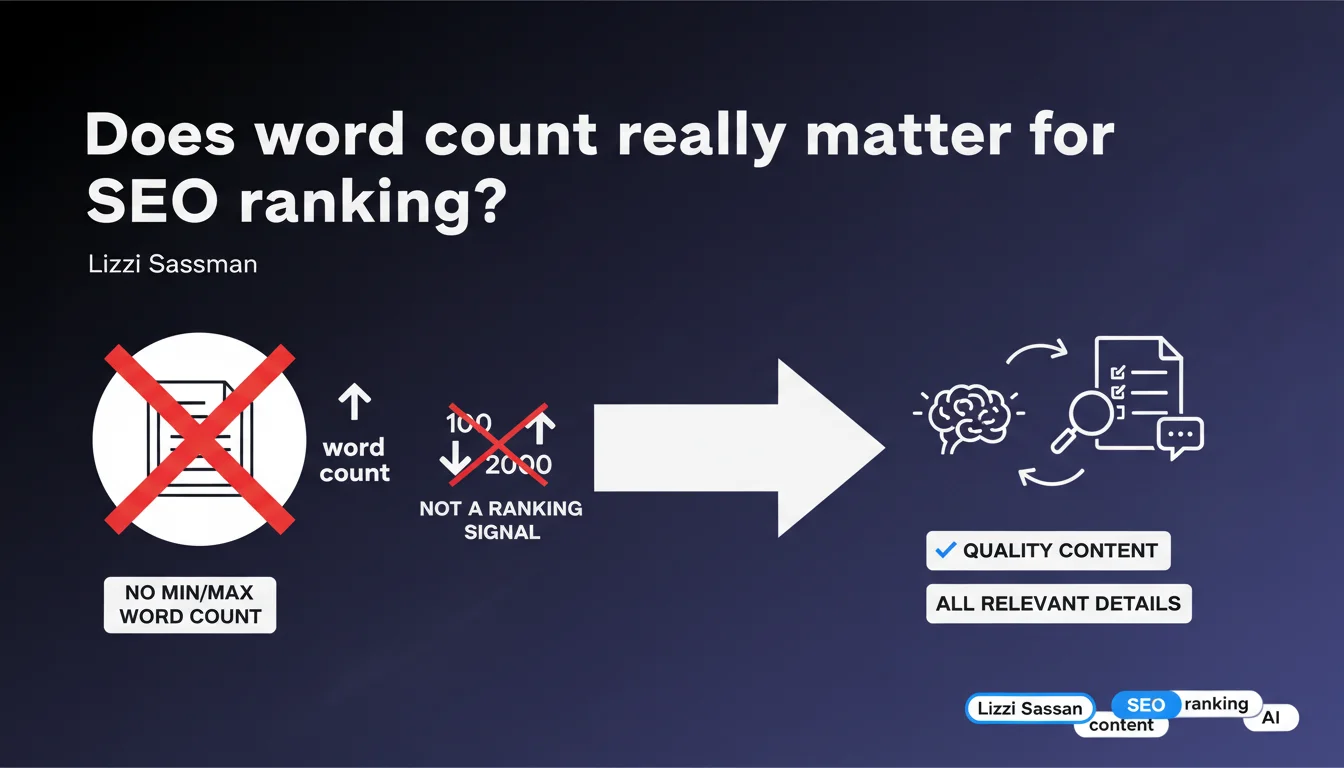
Google states that word count is not a direct ranking signal. There is no minimum or maximum word requirement — only the ability to thoroughly cover the subject matters to meet audience expectations. This statement aims to discourage the race for 2000+ word articles without real substance.
What you need to understand
What does "not a ranking signal" actually mean?
Google says its algorithm does not measure word volume to determine a page's position in the SERPs. In other words, a 500-word article can theoretically outrank a competitor's 3,000-word article if the former better answers the search intent.
This statement targets mechanical practices: writing to hit an arbitrary quota ("we need at least 1,500 words") rather than writing to satisfy the user. Google wants to push toward a logic of topic completeness, not padding.
Why this clarification now?
Because word count obsession has poisoned SEO strategies for years. SEO audits are full of recommendations like "expand shorter content". SEO tools display average length benchmarks for top 10 results.
By clarifying its position, Google is trying to reset expectations: it's not quantity that matters, but relevance and thoroughness. A technical guide might need 4,000 words; a precise definition, 200.
What really counts then?
The phrasing "cover all relevant details for your audience" is intentionally vague. In practice, it refers to content's ability to satisfy search intent without critical gaps.
Google likely evaluates this completeness through behavioral signals (bounce rate, time on page, pogo-sticking) and semantic content analysis. Text that's too short and leaves unanswered questions will be penalized indirectly — not because of its length, but because of its factual insufficiency.
- Word count is not a direct ranking factor
- Thorough topic coverage takes precedence over volume
- Short content can outrank long content if better targeted
- The notion of "quality" remains deliberately subjective and contextual
- Indirect signals (user engagement) remain decisive
SEO Expert opinion
Is this statement really new?
No. Google has been repeating this in various forms for years. John Mueller already hammered home that there's "no magic length". What's different is the context: with the explosion of AI-generated content — often verbose and hollow — Google is intensifying this message.
Let's be honest: this statement also serves to absolve Google of responsibility. By rejecting any mechanical correlation between length and ranking, they avoid being blamed for results that favor one format over another. It's a rhetorical escape hatch.
Do on-the-ground data contradict this discourse?
Partially. Correlation studies (Backlinko, SEMrush, etc.) consistently show that long-form content dominates SERPs for competitive queries. Average length of top 3 results hovers around 1,800-2,500 words for informational queries.
[To verify] Google says "not a direct signal", but the correlation remains strong. Why? Because a complex topic naturally requires more words to be properly covered. Length becomes a proxy for completeness, even if it's not the causal factor.
The problem: this nuance escapes many people. We confuse correlation with causation. Writing long guarantees nothing if the content is diluted. But thoroughly covering a complex topic mechanically results in longer content.
Where does this rule not apply?
On queries where the optimal answer is short: definitions, unit conversions, direct factual answers. Google can place a Featured Snippet of 40 words in position zero.
On transactional queries too: an effective product page doesn't need 2,000 words. Clear descriptions, technical specs, customer reviews — all that fits in 300-500 words. Artificially extending it degrades UX and conversion rates.
Practical impact and recommendations
What should you do concretely?
Abandon arbitrary word quotas in your editorial briefs. Replace "1,500 word minimum" with "thoroughly cover X, Y, Z" backed by a list of mandatory questions/subtopics.
Analyze the current top 10 for your target query: what aspects do they cover? Are there unexploited angles? The goal is to produce the most complete and useful content, whatever length naturally results from it.
Invest in semantic analysis tools (Clearscope, Surfer SEO, etc.) that identify concepts and entities to cover — not just word counting. Semantic richness matters more than raw volume.
What errors must you absolutely avoid?
Don't artificially lengthen a performing piece of content just because a competitor is longer. If your 800-word page perfectly answers the intent and performs well, leave it alone. The risk: diluting your message and losing clarity.
Avoid fluff — those endless introductory paragraphs that say nothing, generic padding, disguised repetitions. Google (and especially your readers) spot this emptiness. Better 600 dense words than 2,000 watered-down ones.
Don't neglect UX signals: a 3,000-word wall with no clear structure will drive readers away. Headings, lists, short paragraphs, visuals — all matter as much as the text itself. Long content poorly formatted underperforms short, well-organized content.
How do you verify content completeness?
Compare your pages to People Also Ask and related searches on Google for your target query. If recurring questions aren't addressed in your article, there's a gap to fill — regardless of word count.
Use content audits based on intent: for each page, define the primary intent (informational, navigational, transactional) and verify that format and depth match. A verbose transactional page is self-defeating.
- Remove fixed word quotas from your editorial processes
- Audit your existing content to detect unnecessary fluff
- Structure long content rigorously (H2, H3, ToC)
- Analyze PAA and related searches for each target query
- Test real readability: can a colleague quickly find the answer?
- Invest in semantic analysis tools, not just word counters
- Train your writers on completeness vs. volume
❓ Frequently Asked Questions
Un article de 500 mots peut-il vraiment ranker en première page ?
Faut-il raccourcir mes contenus longs existants ?
Les outils SEO qui recommandent une longueur cible sont-ils obsolètes ?
Comment mesurer la complétude d'un contenu sans compter les mots ?
Cette déclaration change-t-elle quelque chose pour le contenu IA ?
🎥 From the same video 20
Other SEO insights extracted from this same Google Search Central video · published on 21/10/2022
🎥 Watch the full video on YouTube →
💬 Comments (0)
Be the first to comment.