
Official statement
Other statements from this video 20 ▾
- □ Pourquoi Google ne peut-il jamais garantir que vos utilisateurs atterriront sur la bonne version linguistique de votre site ?
- □ Faut-il bannir les redirections automatiques pour les sites multilingues ?
- □ Faut-il bloquer l'exécution JavaScript pour les SPA avec SSR ?
- □ Faut-il baliser les mots étrangers avec l'attribut lang pour le SEO ?
- □ Le contenu dupliqué entraîne-t-il vraiment une pénalité Google ?
- □ Le rel=canonical est-il vraiment pris en compte par Google ou juste une suggestion ignorée ?
- □ Les FAQ dans les articles de blog sont-elles vraiment utiles pour le SEO ?
- □ Hreflang est-il vraiment obligatoire pour gérer un site international ?
- □ Le cache Google a-t-il un impact sur votre référencement ?
- □ Le noindex est-il vraiment inutile pour gérer le budget de crawl ?
- □ Faut-il vraiment se limiter à une seule thématique sur son site pour bien ranker ?
- □ Combien de liens peut-on vraiment mettre sur une page sans pénalité Google ?
- □ L'URL référente dans Search Console impacte-t-elle vraiment votre classement ?
- □ Le nombre de mots est-il vraiment inutile pour le référencement ?
- □ Faut-il s'inquiéter de réutiliser les mêmes blocs de texte sur plusieurs pages ?
- □ Google valide-t-il vraiment la traduction automatique sur les sites multilingues ?
- □ Les URLs bloquées par robots.txt mais indexées posent-elles vraiment problème ?
- □ Faut-il vraiment dupliquer le schema Organisation sur toutes les pages du site ?
- □ Les avis auto-hébergés peuvent-ils afficher des étoiles dans les résultats de recherche Google ?
- □ Pourquoi les fusions de sites Web génèrent-elles des résultats imprévisibles aux yeux de Google ?
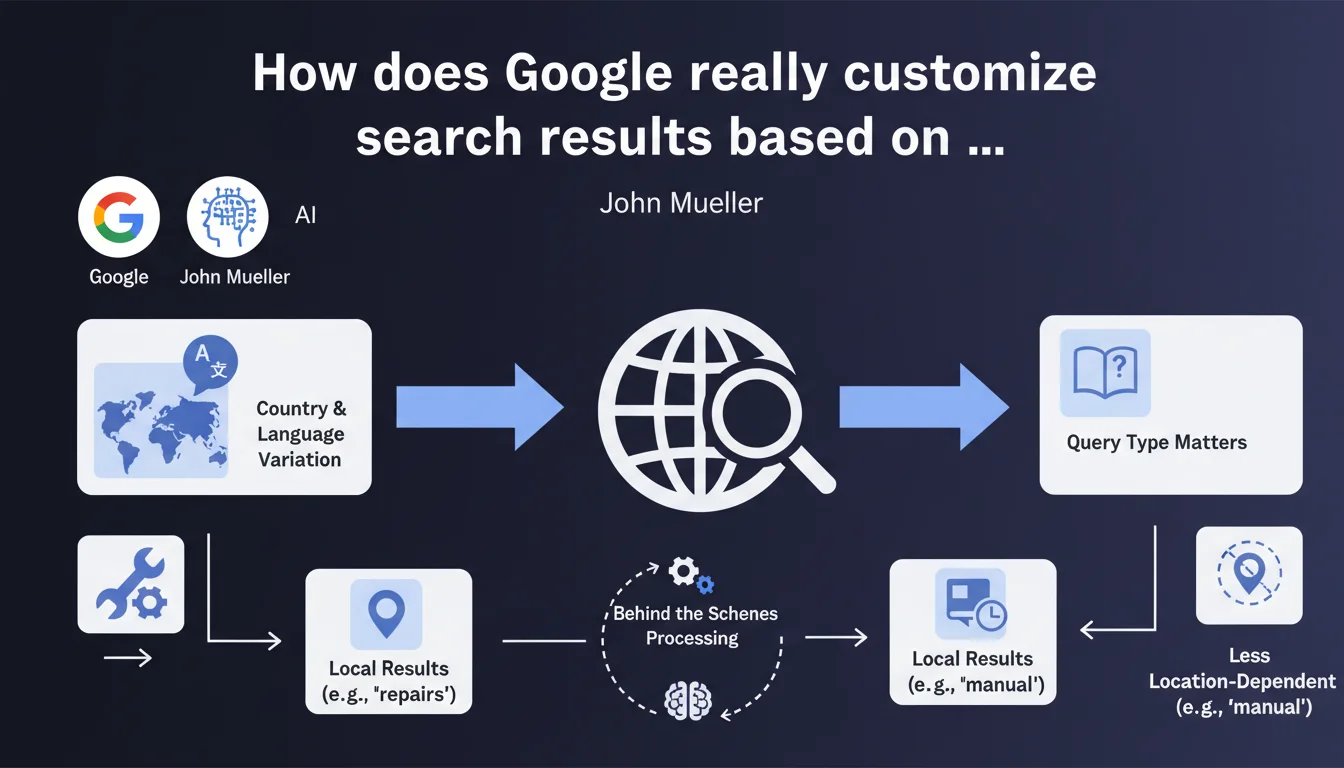
Google confirms that search results intentionally vary based on the user's country and language. For certain queries with local intent (repairs, services), geolocation heavily influences rankings, while for others (documentation, manuals), it becomes almost negligible. This is algorithmic differentiation by design, not a bug.
What you need to understand
Why does Google adapt its results based on location?
Google's algorithm integrates geographic relevance as a ranking signal that varies depending on the nature of the query. This approach is based on analyzing user intent: is the user looking for something physically nearby or information that's universally relevant?
For a query like "iPhone repair," Google assumes a local intent—the user wants a technician nearby. The algorithm therefore boosts geographically localized results. Conversely, "iPhone manual PDF" triggers an informational search where the location of the result matters little.
Is this variation the same for all types of websites?
No. Websites with a Google Business profile and a strong local footprint benefit from preferential treatment on local queries. Purely informational or international e-commerce sites experience fewer geographic fluctuations, unless their content explicitly targets a specific national market.
Language also plays a distinct role from geolocation. A French-language website from Belgium can outrank a generic French website if Google detects specific cultural or linguistic relevance to the Belgian market.
What signals does Google use for this differentiation?
Google cross-references multiple indicators: the user's IP address, browser language settings, geolocated search history, and especially geographic mentions in the content (NAP, LocalBusiness schema, local links).
But—and this is crucial—Google doesn't reveal the exact weight of each signal. We know they exist, not how they balance across different sectors.
- Results vary by design, not as an algorithmic malfunction
- Query intent determines how much geolocation weighs in rankings
- Local signals (GMB, NAP, local backlinks) only matter if the query justifies it
- Language and country are two distinct dimensions: a site can be linguistically relevant without being geographically relevant
SEO Expert opinion
Is this statement consistent with real-world observations?
Yes, overall. Multi-country ranking tests confirm that certain queries (services, local commerce) show radically different SERPs depending on geolocation, while others (generic informational queries) remain stable.
But the boundary between "local query" and "universal query" remains blurry. Google publishes no exhaustive list. For example, we observe that "best restaurant" is clearly local, but "best CRM software" is much less so—yet in practice, SERPs often prioritize sites from the user's country even on the second query. [To verify] systematically through geolocated ranking tests.
What nuances should be added to this statement?
Mueller oversimplifies. He contrasts "repair" (local) with "manual" (universal), but between these two extremes lies a huge gray spectrum. Queries like "SEO training," "accounting software," or "marketing agency" fluctuate by market, local competition, and available content quality.
Another point: the statement says nothing about the impact of hreflang. Technically, this signal is meant to help Google differentiate between language/geographic versions of a site. But its real effectiveness varies enormously based on implementation and site structure.
Finally, Google doesn't clarify how it handles VPNs or mobile users traveling. IP address doesn't always reflect true localization intent. This is a major area of uncertainty for international e-commerce sites.
In what cases does this rule not apply completely?
International authority sites (Wikipedia, government sites, major global brands) partially escape this logic. Their global authority often compensates for a lack of local signals, except on hyper-local queries where even Wikipedia loses to a well-optimized GMB listing.
Brand queries also show different behavior: searching "Nike" from France returns nike.com/fr, but the mechanics rely more on hreflang and geo-targeted redirects than on pure ranking logic.
Practical impact and recommendations
What should you concretely do for a locally-focused website?
Optimize proximity signals: complete and up-to-date Google Business listing, consistent NAP across all platforms (website, directories, social media), and high-quality backlinks from local websites. This is the basic three-part formula for capturing local queries.
Integrate geolocated content: dedicated pages by city or region, neighborhood mentions, local events, local partners. Google detects these text markers to refine geographic relevance.
Structure your data with schema.org LocalBusiness (or its variants depending on your sector). This is a direct signal to Google that your business has a local dimension.
How do you optimize a multi-country or multilingual site?
Implement hreflang correctly: each language/geographic version should point to its alternatives with appropriate tags. Common mistake: forgetting the self-reference or mixing language and country (fr vs fr-FR).
Create distinct URLs per market: subdomains (fr.example.com), subdirectories (example.com/fr/), or ccTLD domains (example.fr). Avoid language selectors in JavaScript that hide content from Google.
Adapt content beyond simple translation: cultural relevance, local currencies, customer testimonials from the target country, mentions of local regulations. Google detects these signals to refine geographic relevance.
What mistakes should you absolutely avoid?
Don't duplicate the same content while merely changing the language without real adaptation. Google detects machine translations or generic content slapped across multiple markets. Result: cannibalization between your own versions.
Don't block access to certain versions based on IP without properly implementing hreflang. This creates algorithmic confusion: Google crawls from the USA and sees one version, but your French users see another.
Don't neglect local backlinks under the pretense that your site is "international." Even a global site benefits from having links from each target market to strengthen its local relevance on hybrid queries.
- Audit SERPs from each target country to identify ranking variations
- Check NAP consistency across all directories and platforms (Yext, Yellow Pages, social media)
- Test hreflang implementation with Google Search Console and third-party tools (Screaming Frog, OnCrawl)
- Create market-specific content, not just translated but culturally adapted
- Acquire backlinks from quality local websites in each geographic zone
- Implement LocalBusiness or Organization schemas with complete addresses
- Track rankings from local IPs, not from a single centralized country
Results localization isn't a marginal phenomenon—it's a core logic of Google's algorithm. Your SEO strategy must adapt depending on whether you're targeting a local, national, or international market.
For multi-country sites, this technical complexity (hreflang, URL architecture, localized content, geographic link building) can quickly become headache-inducing. If you notice significant performance gaps across countries or if your hreflang implementation generates Search Console errors, working with an international SEO-specialized agency can make the difference between a strategy that stalls and sustainable organic growth across each market.
❓ Frequently Asked Questions
Comment Google détermine-t-il si une requête est locale ou universelle ?
Le hreflang garantit-il que Google affiche la bonne version selon le pays ?
Un site .fr peut-il ranker en Belgique ou en Suisse francophone ?
Les utilisateurs avec VPN faussent-ils les SERPs locaux ?
Faut-il créer des pages locales même pour un service 100% en ligne ?
🎥 From the same video 20
Other SEO insights extracted from this same Google Search Central video · published on 21/10/2022
🎥 Watch the full video on YouTube →
💬 Comments (0)
Be the first to comment.