
Official statement
Other statements from this video 20 ▾
- □ Faut-il bannir les redirections automatiques pour les sites multilingues ?
- □ Faut-il bloquer l'exécution JavaScript pour les SPA avec SSR ?
- □ Faut-il baliser les mots étrangers avec l'attribut lang pour le SEO ?
- □ Le contenu dupliqué entraîne-t-il vraiment une pénalité Google ?
- □ Le rel=canonical est-il vraiment pris en compte par Google ou juste une suggestion ignorée ?
- □ Les FAQ dans les articles de blog sont-elles vraiment utiles pour le SEO ?
- □ Hreflang est-il vraiment obligatoire pour gérer un site international ?
- □ Le cache Google a-t-il un impact sur votre référencement ?
- □ Les résultats de recherche localisés : comment Google adapte-t-il vraiment son algorithme selon les pays et les langues ?
- □ Le noindex est-il vraiment inutile pour gérer le budget de crawl ?
- □ Faut-il vraiment se limiter à une seule thématique sur son site pour bien ranker ?
- □ Combien de liens peut-on vraiment mettre sur une page sans pénalité Google ?
- □ L'URL référente dans Search Console impacte-t-elle vraiment votre classement ?
- □ Le nombre de mots est-il vraiment inutile pour le référencement ?
- □ Faut-il s'inquiéter de réutiliser les mêmes blocs de texte sur plusieurs pages ?
- □ Google valide-t-il vraiment la traduction automatique sur les sites multilingues ?
- □ Les URLs bloquées par robots.txt mais indexées posent-elles vraiment problème ?
- □ Faut-il vraiment dupliquer le schema Organisation sur toutes les pages du site ?
- □ Les avis auto-hébergés peuvent-ils afficher des étoiles dans les résultats de recherche Google ?
- □ Pourquoi les fusions de sites Web génèrent-elles des résultats imprévisibles aux yeux de Google ?
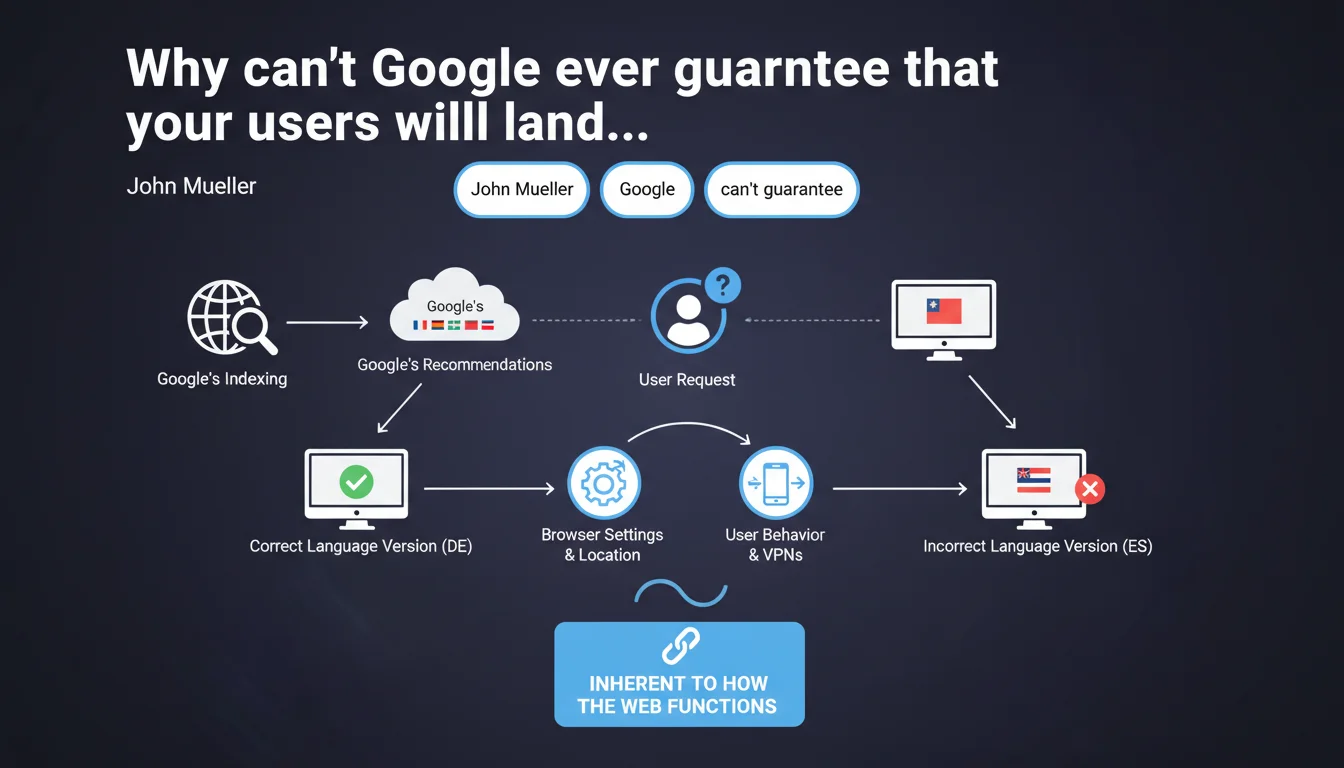
Google acknowledges that it's impossible to guarantee a user will always access the appropriate language or geographic version of a site, even with perfect targeting. This limitation is structural: it stems from how the web itself works, not from a technical failure on Google's part. SEO professionals must therefore integrate this imperfection into their international targeting strategy.
What you need to understand
When you deploy a multilingual or multi-country site, you often assume that Google will direct each user to the correct version. Wrong approach. Mueller cuts through any illusion of absolute precision: even if you do everything right (hreflang, server geolocation, clear signals), French users will land on the English version, and vice versa.
The reason? The web doesn't function as a closed system where Google controls every variable. Users travel, use VPNs, share direct links, and have atypical language configurations. Google detects and interprets signals; it doesn't decree a universal truth.
What signals does Google use to determine the appropriate version?
Google combines several indicators: the user's IP address, browser language preferences, browsing history, the site's hreflang tags, and sometimes the content itself. None of these signals is infallible on its own.
A French user traveling to Tokyo with a browser configured in English will likely receive the English or Japanese version, even if Google knows they're French. The signals contradict each other, and Google makes a probabilistic choice, not a definitive one.
Does this imperfection affect all international sites equally?
No. Sites with versions clearly separated by domain (.fr, .de, .co.uk) generally fare better than those using subdirectories (/fr/, /de/) or subdomains. But even in the best case scenario, perfection remains out of reach.
Sites targeting geographically dispersed audiences (expatriates, travelers, multilinguals) face even more uncertainty. Google can't guess that a user in Spain prefers to read in German because they're Austrian.
- Google never guarantees perfect targeting, even with flawless technical configuration
- The signals used (IP, browser language, hreflang) often contradict each other
- This limitation is structural, tied to how the web works, not a lack of sophistication on Google's part
- Multi-country sites must implement user-side switching mechanisms
Why does Mueller insist that this is "inherent to the web"?
Because too many SEO professionals still believe that perfect technical implementation is enough. Mueller reframes the issue: it's not a bug, it's a feature of the system. The web is decentralized, users are mobile, and access contexts vary.
This statement also serves to absolve Google of responsibility. By saying "it's the web, not us," Mueller preempts complaints like "my hreflang is perfect but Google sends the wrong users." Message received: Google does its best, but promises nothing.
SEO Expert opinion
Is this statement consistent with real-world observations?
Absolutely. Any SEO who has managed an international site has observed recurring routing errors. American users land on the British version, Swiss Francophones on the German version. It's commonplace, everyday, and Mueller confirms it officially.
What's new is that Google acknowledges it publicly instead of deferring to hreflang documentation. It changes the conversation: we stop looking for the magic configuration and design the site by integrating this imperfection from the start.
What nuances should be added to this statement?
Mueller says "impossible to guarantee," but that doesn't mean all cases are equal. A site with coherent hreflang, clear geographic signals, and well-differentiated content will have fewer routing errors than a poorly configured site. Perfection doesn't exist, but degrees of imperfection vary.
There's also a difference between "Google can't guarantee" and "Google makes frequent mistakes." In the majority of cases, Google sends the user to the right place. The uncertainty applies to edge cases — expatriates, VPN users, multilingual users, direct link shares. [To verify]: Google doesn't publish any metrics on its language targeting success rate.
What should you do with this information?
Stop optimizing for perfect targeting and implement fallback mechanisms. A visible language selector, intelligent redirects (but not automatic ones), contextual suggestions when Google gets it wrong. Think UX, not just SEO.
This also affects how you measure international performance. If 5% of French users land on the English version, is that a technical failure or a structural consequence of the web? Mueller tells us it's the latter, so we adjust our KPIs accordingly.
Practical impact and recommendations
What should you do concretely to limit routing errors?
Start by implementing hreflang correctly. It's the strongest signal you can send Google about your site's language structure. Verify tag reciprocity: if the FR page points to EN, EN must point back to FR.
Add a visible language selector in the header or footer. Google gets it wrong? The user corrects it themselves. It's basic, but it's the most effective safety net. Never rely solely on Google's ability to guess.
Use distinct domains by country (.fr, .de, .co.uk) if your budget allows. It's heavier to manage, but it sends much clearer geographic signals than a generic subdirectory. Google makes fewer errors when boundaries are clear.
What mistakes must you absolutely avoid?
Never automatically redirect a user based on their IP address. This is the worst practice possible. Google itself can get blocked on one version, VPN users are trapped, and you break the accessibility of direct links.
Don't use aggressive pop-ups to suggest a language change. A discreet banner, fine. An overlay that blocks content, no. You solve an SEO problem while creating a UX problem, and Google penalizes degraded user experience.
Don't rely solely on Google's automatic detection. Even with perfect hreflang, provide user-side mechanisms to easily switch between versions. It's defensive design: you assume Google will sometimes get it wrong.
How do you verify that your site handles this uncertainty correctly?
Test your site with varied configurations: VPN, browsers in different languages, foreign IP addresses. Verify that the language selector remains accessible and functional in all cases. If Google gets it wrong, the user must be able to correct it in a maximum of two clicks.
Analyze your server logs to identify recurring error patterns. If 15% of your American visitors land on the British version and bounce, that's a clear signal. Adjust your contextual messages or redirect suggestions.
- Implement hreflang correctly with complete reciprocity
- Add a visible, permanent language selector in the interface
- Prioritize distinct domains by country if budget allows
- Never automatically redirect based on IP or browser language
- Test the site with different geographic and linguistic configurations
- Analyze logs to identify frequent routing errors
- Provide non-intrusive contextual suggestions when Google gets it wrong
Perfect language and geographic targeting is an illusion. Google does its best with available signals, but the web is too variable to guarantee absolute precision. The winning strategy combines rigorous technical implementation (hreflang, geographic signals) and user-side fallback mechanisms (language selector, contextual suggestions).
Designing a high-performing international site requires pointed technical expertise and a deep understanding of multi-geographic user behaviors. If your organization lacks internal resources to orchestrate this complexity, working with an SEO agency specialized in international search engine optimization can significantly accelerate the implementation of a solid and resilient architecture, resistant to the structural imperfections of automatic targeting.
❓ Frequently Asked Questions
Hreflang suffit-il à garantir un ciblage linguistique parfait ?
Faut-il rediriger automatiquement les utilisateurs vers leur version linguistique supposée ?
Un domaine par pays est-il plus efficace qu'un sous-répertoire par langue ?
Comment mesurer les erreurs de ciblage linguistique sur mon site ?
Cette limitation concerne-t-elle aussi les sites avec un seul pays mais plusieurs langues ?
🎥 From the same video 20
Other SEO insights extracted from this same Google Search Central video · published on 21/10/2022
🎥 Watch the full video on YouTube →
💬 Comments (0)
Be the first to comment.