
Official statement
Other statements from this video 10 ▾
- □ Should you remove HowTo structured data from your pages now that Google has stopped displaying rich results?
- □ Should you abandon FAQ schema markup on your website after Google's restriction?
- □ Should you really let your CMS handle your structured data?
- □ How often does Google really roll out its core updates?
- □ Does Google's Helpful Content System really measure quality at the entire site level?
- □ Should you block third-party content from indexation to avoid Helpful Content penalties?
- □ Why does Google direct you to its documentation when your rankings drop?
- □ Should you subscribe to Google's Search Status Dashboard RSS feed to stay ahead of ranking updates?
- □ Does Google automatically display multilingual site names correctly in search results?
- □ Is Google really indexing your CSV files and should you be concerned about it?
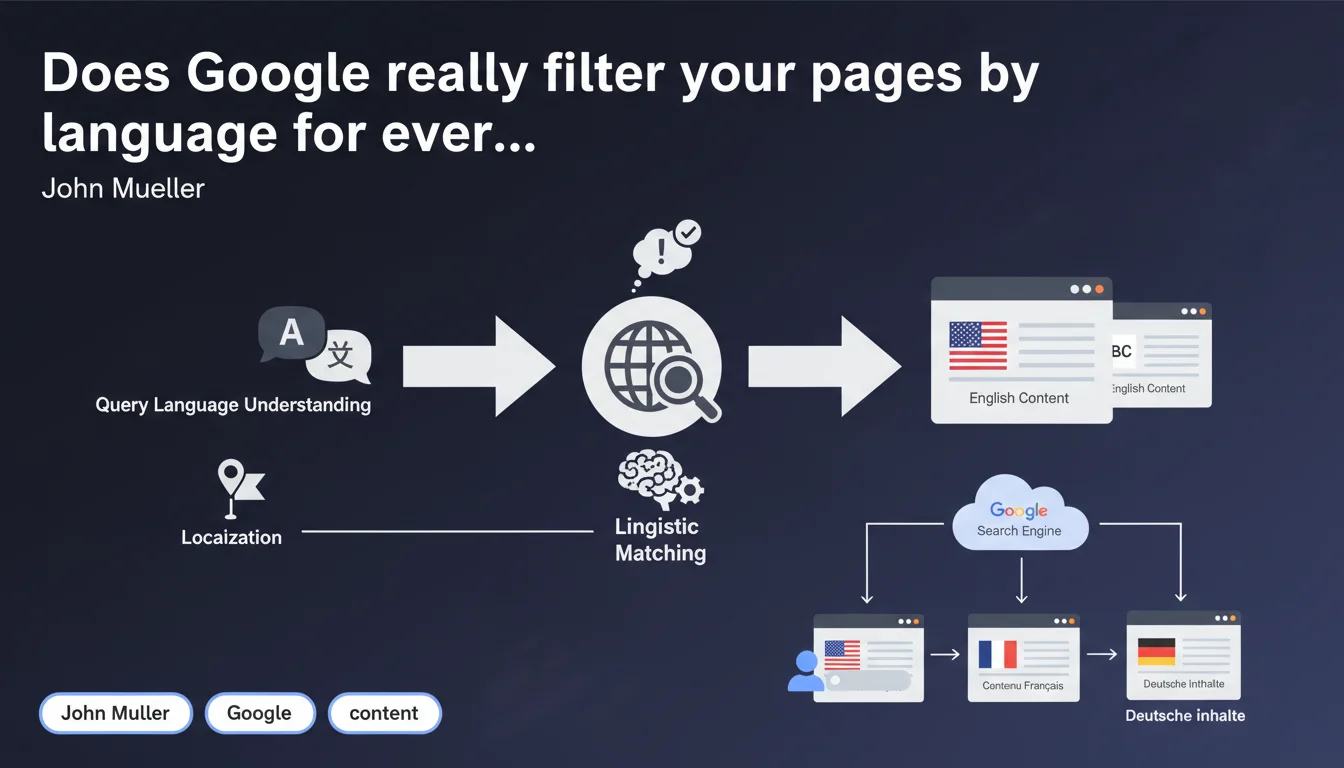
Google now adjusts linguistic matching between user queries and search results by cross-referencing user language parameters, geographic location, and language detected in the query. In practice, a poorly structured multilingual site risks having certain language versions become invisible depending on the search context. The key challenge: ensuring each language version is technically identifiable and consistent with its target audience.
What you need to understand
What does Google mean by "improved linguistic matching"?
Google no longer simply compares keywords and content. It evaluates the language of the query, compares this information against linguistic preferences declared by the user (browser settings, Google account) and their geographic location.
Result: if you search for "plumber brussels" from a browser configured in French, Google will prioritize French-language pages, even if Dutch or English versions exist for the same website.
How does this evolution differ from previous behavior?
Previously, Google relied mainly on hreflang tags and automatic language detection in content. The current system weights user context more heavily: their declared preferences and physical location become decisive criteria.
In other words, a perfectly optimized English page can be excluded if Google determines the user expects French — even if that page would be technically relevant.
What signals does Google use to determine the "appropriate" language?
Mueller mentions three pillars: language parameters (browser, Google account), localization (IP, GPS data on mobile) and understanding of query language (automatic detection based on words used).
The problem is that Google remains vague about the hierarchy between these signals. Will a French-speaking user searching in English from Paris see English or French results? The statement doesn't clarify this.
- Google crosses three types of signals: user parameters, geolocation, language detected in the query
- hreflang tags remain essential to indicate alternative versions, but no longer guarantee display
- A multilingual site must clearly segment its content by language (subdomains, subdirectories, separate domains)
- Consistency between declared language (HTML tags, hreflang) and actual content language becomes critical
- Sites targeting multiple language markets within the same geographic area (Belgium, Switzerland, Canada) are particularly exposed
SEO Expert opinion
Does this statement match real-world observations?
Yes and no. Tests show that Google does favor the language of the user interface in results. A Google account configured in Spanish will see more Spanish-language pages, even for ambiguous queries.
But — and this is where it gets tricky — this logic is not systematic. On highly specific or technical queries, Google regularly displays English results even for French-speaking users. The "appropriate language" remains a fuzzy concept, likely adjusted by machine learning without fixed rules. [Verify] this in your own SERPs based on your sectors.
What gray areas remain in this announcement?
Mueller says nothing about poorly structured bilingual or multilingual sites. What happens if a site mixes French and English on the same page? Does Google arbitrarily choose a dominant language, or does it penalize the page outright?
Another unclear point: interaction with mixed queries. Will a French-speaking user searching "best CRM software" (French-English mix) see French or English results? The statement remains silent.
In what cases can this logic penalize a well-optimized site?
A technical B2B site in English targeting French speakers (documentation, SaaS) can lose visibility if Google systematically prioritizes French content for French users — even if English is the reference language for the sector.
Another problematic scenario: multilingual geographic areas (Switzerland, Belgium, Luxembourg). If Google prioritizes the region's majority language (German in Switzerland), French or Italian versions can be underrepresented for users actually concerned.
Practical impact and recommendations
How can you verify that your multilingual architecture is compatible with this evolution?
First step: audit your hreflang tags in Search Console. Google must correctly detect all your language versions without reciprocity errors or incorrect language codes.
Next, test your key pages in private browsing mode with different language parameters (browser in FR, EN, DE…) from different locations (VPN). Note whether Google displays the expected language version or if some disappear from SERPs.
What mistakes should you absolutely avoid on a multilingual site?
Never mix multiple languages on the same URL without clear structure (e.g., EN navigation, FR content). Google must identify a dominant language without ambiguity.
Avoid automatic redirects based on IP that prevent Googlebot from crawling all versions. Provide a visible manual language selector and allow Googlebot free access to each language version.
- Audit hreflang tags in Search Console and fix any reported errors
- Clearly segment URLs by language (subdirectories
/fr/,/en/or subdomains) - Declare language in
<html lang="...">on each page - Test results display from different linguistic contexts (browser, location)
- Verify that each language version has unique content, not just word-for-word translation
- Implement a visible language selector, without forced redirection
- Monitor organic performance by language version in Analytics (custom segments by subdirectory)
- For multilingual areas (Belgium, Switzerland), create dedicated pages by region AND language if relevant
❓ Frequently Asked Questions
Les balises hreflang sont-elles encore utiles après cette mise à jour ?
Mon site est uniquement en anglais mais cible des francophones — vais-je perdre du trafic ?
Comment tester si mes versions linguistiques sont bien prises en compte par Google ?
Faut-il créer une version linguistique par pays ou par langue ?
Que faire si Google affiche la mauvaise version linguistique malgré un balisage hreflang correct ?
🎥 From the same video 10
Other SEO insights extracted from this same Google Search Central video · published on 05/10/2023
🎥 Watch the full video on YouTube →
💬 Comments (0)
Be the first to comment.