
Official statement
Other statements from this video 10 ▾
- □ Faut-il supprimer les données structurées HowTo de vos pages après l'arrêt des résultats enrichis ?
- □ Faut-il abandonner le balisage FAQ sur votre site après la restriction de Google ?
- □ Faut-il vraiment laisser votre CMS gérer vos données structurées ?
- □ Combien de fois Google déploie-t-il vraiment ses core updates ?
- □ Le système de contenu utile mesure-t-il vraiment la qualité à l'échelle du site ?
- □ Faut-il bloquer le contenu tiers de l'indexation pour éviter les pénalités du Helpful Content ?
- □ Faut-il s'abonner au Search Status Dashboard de Google pour anticiper les mises à jour ?
- □ Les noms de sites multilingues s'affichent-ils automatiquement dans Google ?
- □ Google filtre-t-il vraiment vos pages par langue pour chaque requête ?
- □ Google indexe-t-il vraiment vos fichiers CSV et faut-il s'en préoccuper ?
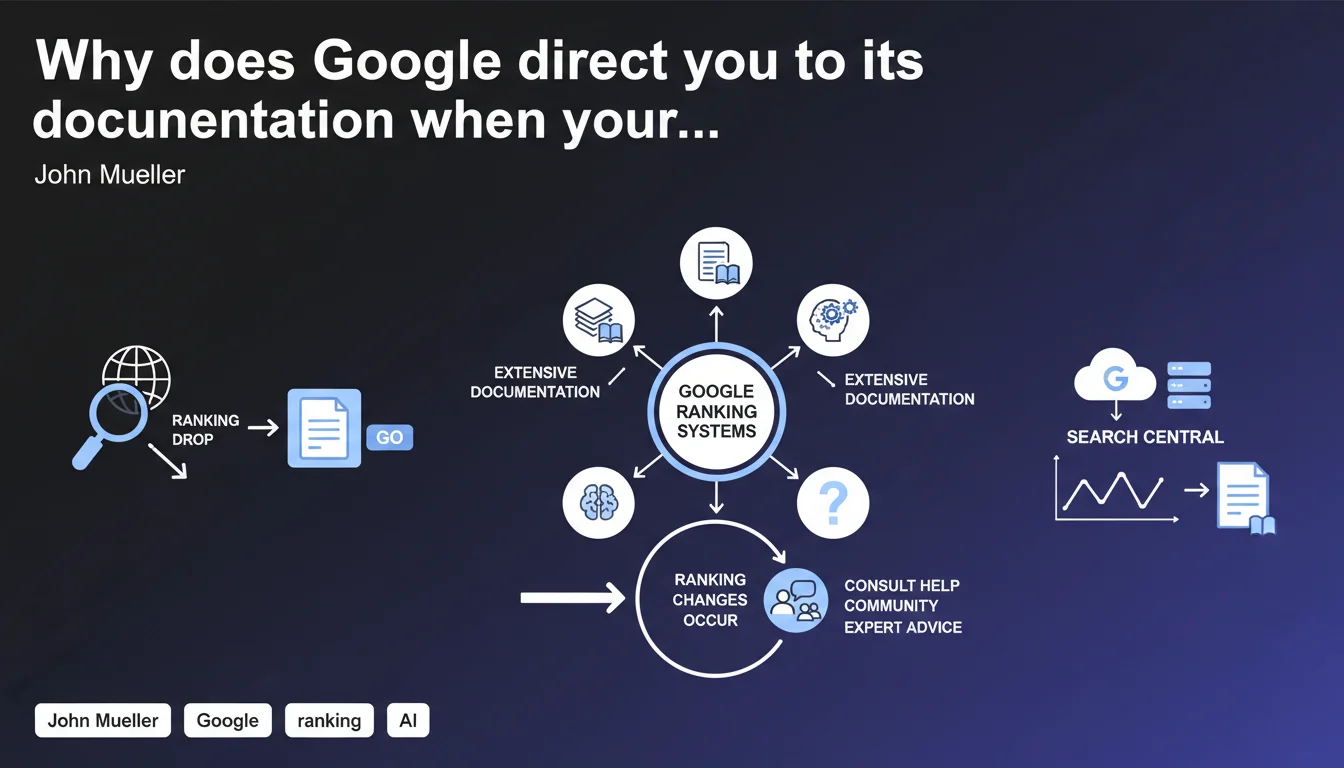
John Mueller confirms that Google centralizes explanations about its ranking systems in its developer documentation. When facing fluctuations, the official recommendation is to consult these resources and seek advice from the Search Central Help community rather than waiting for personalized responses.
What you need to understand
What does Google's statement actually say?
Google claims to have compiled extensive information about the logic of its ranking systems in its technical documentation. The idea? Everything is already written down somewhere.
When your site loses positions, Mueller suggests consulting the Search Central Help community to get advice. This is a redirect toward community support rather than direct Google assistance.
Why is Google taking this approach?
Google handles billions of queries daily. Responding individually to every webmaster who notices a drop would be physically impossible.
The documentation serves as a official reference — theoretically comprehensive — meant to cover all relevant ranking factors. The problem: this documentation remains generic and doesn't always explain why a specific site drops.
What resources does Google provide?
The developer documentation covers ranking systems, quality criteria, and technical best practices. It notably includes E-E-A-T guidelines, Core Web Vitals, and spam-related guidelines.
The Search Central Help community brings together Product Experts — experienced contributors — who can offer analytical leads. Be aware: they have no privileged access to your site's data.
- Google centralizes its explanations in publicly accessible technical documentation
- In case of fluctuation, the official recommendation is to consult these resources and the community
- No personalized assistance is offered to understand ranking declines
- The documentation remains generic and does not provide site-specific analysis
SEO Expert opinion
Is this response truly satisfactory for an SEO practitioner?
Let's be honest: no. Google's documentation does compile hundreds of pages, but it deliberately remains vague about actual weightings and critical thresholds. You'll find general principles there, rarely precise answers about why your site dropped 40% after an update.
Typical advice like "create quality content" or "improve user experience" is theoretically correct, but hardly actionable when you're trying to identify the specific factor that triggered a decline. It's like telling a patient to "eat a balanced diet" without diagnosing their condition.
Can the Search Central community really help?
Product Experts in the community have genuine expertise and can spot obvious technical errors — misconfigured canonicals, indexation issues, broken redirects. Their value is undeniable for first-level diagnostics.
But — and this is where it gets tricky — they have no access to algorithm-specific data about your site. They cannot see which signals triggered the drop. Their advice therefore remains hypotheses based on their experience, not factual diagnoses. [To be verified]: to what extent do their recommendations actually reflect the current algorithm's priorities?
Why does Google maintain this opacity?
Officially? To prevent algorithm manipulation. If Google published exact weightings, bad actors could game the system more easily.
In practice, this opacity creates a frustrating information asymmetry. You must guess what's wrong by crossing dozens of potential signals, with no guarantee your diagnosis is correct. And meanwhile, your competitors may perform well without respecting certain official "best practices".
Practical impact and recommendations
What should you do concretely after a ranking drop?
First, consult the documentation — yes, as Mueller suggests — but target sections relevant to your situation. No need to re-read 500 pages. Focus on recent updates (Helpful Content, Product Reviews, Core Updates) and technical criteria (indexation, crawl, Core Web Vitals).
Next, cross-reference with real data: Search Console, server logs, analytics. Identify which pages dropped, for which queries, and look for patterns. A widespread drop suggests a trust or overall quality problem. A targeted drop may indicate a technical issue or loss of relevance on certain keywords.
What mistakes should you avoid in this analysis phase?
Don't fall into the "change for change's sake" trap. Making massive changes to your content or structure without precise diagnosis can make things worse. Google values stability — sudden changes trigger re-evaluations that can work against you.
Also avoid over-interpreting official statements. When Mueller says "consult the documentation", it doesn't mean the answer is spelled out in black and white. It's often a starting point, not a ready-made solution.
How should you structure your action plan?
Prioritize measurable signals: loading time, bounce rate, session depth, lost backlinks. These metrics provide concrete clues about what might displease the algorithm or users.
If your analysis reveals multiple improvement areas — content, technical, authority — test them sequentially if possible. This allows you to identify what really works, rather than fixing 10 things at once without knowing which one made the difference.
- Audit impacted pages via Search Console and identify drop patterns
- Check server logs to detect potential crawl or indexation issues
- Control Core Web Vitals and fix any recent technical regressions
- Analyze lost or devalued backlinks using third-party tools (Ahrefs, Majestic)
- Compare your content with that of competitors ranking better on your target queries
- Post on Search Central Help with precise data if you can't find an obvious cause
- Avoid major modifications without a clear hypothesis — stability matters
❓ Frequently Asked Questions
La documentation Google suffit-elle vraiment à diagnostiquer une baisse de classement ?
Les Product Experts de Search Central ont-ils accès à des informations privilégiées sur mon site ?
Faut-il systématiquement modifier son contenu après une mise à jour algorithmique ?
Combien de temps faut-il attendre après une correction pour voir un impact sur le classement ?
Peut-on contacter directement Google pour obtenir des explications sur une baisse ?
🎥 From the same video 10
Other SEO insights extracted from this same Google Search Central video · published on 05/10/2023
🎥 Watch the full video on YouTube →
💬 Comments (0)
Be the first to comment.