
Official statement
Other statements from this video 10 ▾
- □ Faut-il supprimer les données structurées HowTo de vos pages après l'arrêt des résultats enrichis ?
- □ Faut-il abandonner le balisage FAQ sur votre site après la restriction de Google ?
- □ Faut-il vraiment laisser votre CMS gérer vos données structurées ?
- □ Combien de fois Google déploie-t-il vraiment ses core updates ?
- □ Le système de contenu utile mesure-t-il vraiment la qualité à l'échelle du site ?
- □ Pourquoi Google vous renvoie-t-il vers sa documentation après une chute de classement ?
- □ Faut-il s'abonner au Search Status Dashboard de Google pour anticiper les mises à jour ?
- □ Les noms de sites multilingues s'affichent-ils automatiquement dans Google ?
- □ Google filtre-t-il vraiment vos pages par langue pour chaque requête ?
- □ Google indexe-t-il vraiment vos fichiers CSV et faut-il s'en préoccuper ?
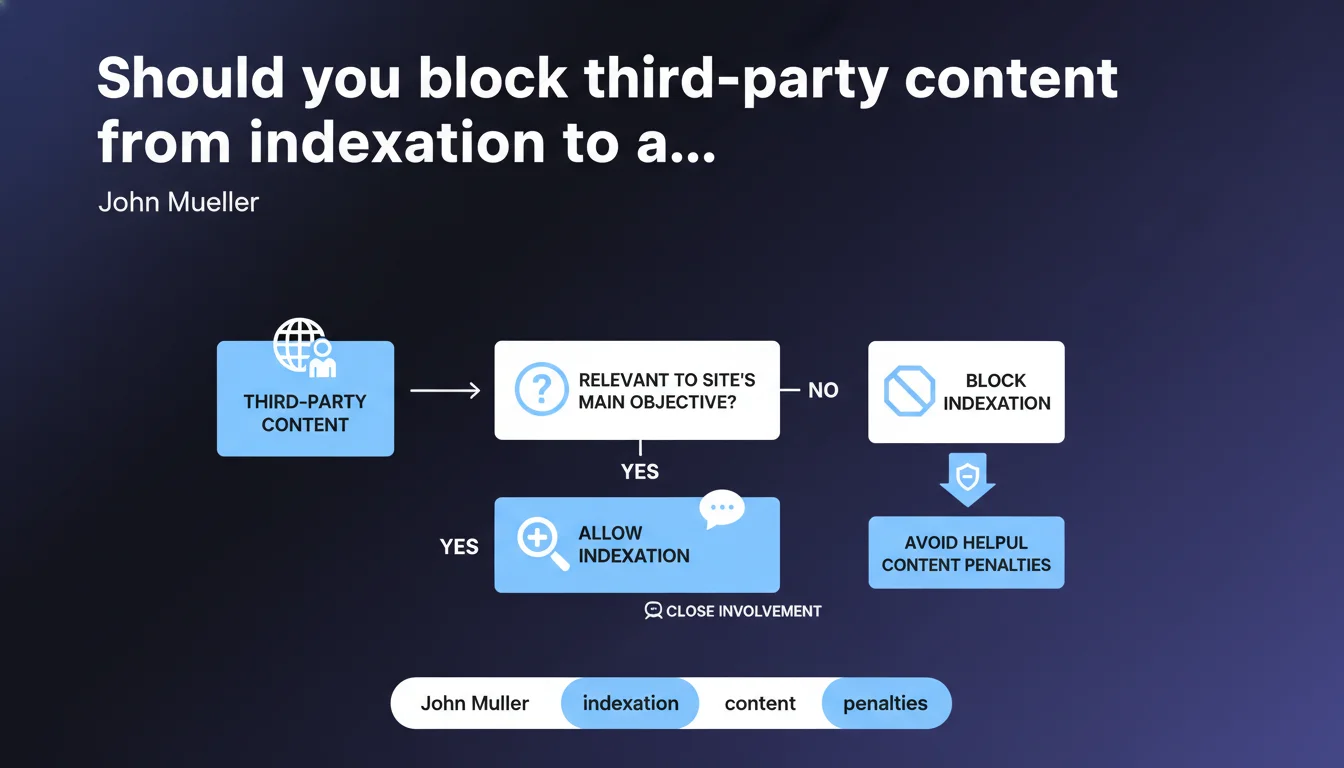
Google recommends blocking the indexation of third-party content unrelated to a site's main objective, because the Helpful Content system analyzes signals at the entire domain level. Poorly supervised third-party content can contaminate the site's overall reputation and trigger a ranking decline. This statement confirms that Google does not segment its evaluation by section, but judges the site as a whole.
What you need to understand
Mueller delivers here a technical directive that confirms a hypothesis debated since the launch of the Helpful Content Update. The system does not discriminate between different sections of a site — it aggregates signals to produce a global score.
What exactly is unrelated third-party content?
We're talking about content hosted on your domain but with no direct connection to your main topic: general forums on a specialized e-commerce site, off-topic guest blogs, unsupervised classified ad sections, UGC (User Generated Content) platforms open to all topics.
The problem? These areas often generate poor quality content, spam, or indexed pages with no added value. Google sees this as a signal of thematic dilution.
Why does the Helpful Content system evaluate the entire site?
Unlike Panda, which could target specific sections, Helpful Content operates on global behavioral and qualitative signals. If 30% of your indexed pages are noise, this impacts the trust given to the remaining 70%.
Google uses aggregated engagement metrics: average bounce rate, session duration, recurring navigation. A block of weak pages pulls the entire site down.
- Helpful Content does not segment: it judges the domain as a single entity
- Third-party content = contamination risk: an unsupervised area can pollute overall reputation
- Block indexation via robots.txt or noindex to protect the rest of the site
- Close involvement required: if you host third-party content, it must be moderated and thematically aligned
What does "close involvement" mean in this directive?
Google opposes two models: the site that passively hosts external content versus the one that actively moderates, edits, and selects. Close involvement implies actual editorial control.
If you cannot guarantee quality and thematic relevance, blocking becomes the only safe option. It's a binary choice: rigorous supervision or complete deindexation.
SEO Expert opinion
Is this recommendation consistent with real-world observations?
Absolutely. Since the September 2022 Helpful Content Update, we've observed massive ranking declines on domains hosting poorly moderated forums or UGC sections unrelated to the core business.
Authority sites lost 40-60% of organic traffic because a minor portion of the site (guest blogs, forums) generated weak content massively indexed. The signal: Google makes no distinction between your premium content and noise hosted on the same domain.
What gray areas remain in this directive?
Mueller remains deliberately vague on the tolerance threshold. At what percentage of weak pages does the system trigger a global penalty? [To be verified] — no official data.
Another issue: the notion of "close involvement" has no technical definition. Do you need to moderate every publication? Is it enough to approve contributors? Google provides no measurable criteria.
When can you ignore this recommendation?
If your third-party content is thematically aligned and actively supervised, blocking is unnecessary. Example: a recipe site that hosts user-submitted recipes that are moderated and verified.
The risk is zero if the volume remains marginal (less than 10% of indexed pages) and quality is controlled. But once the ratio reverses or moderation becomes impossible, blocking becomes imperative.
Practical impact and recommendations
How do you identify at-risk third-party content on your site?
Start with a segmented indexation audit. Use Google Search Console to isolate site sections: forums, contributor blogs, UGC, classified ads. Analyze impressions and clicks per segment.
If a section represents 20% of indexed pages but generates less than 2% of organic traffic, that's a signal of low relevance. Cross-reference with Analytics data: session duration, bounce rate, pages per session.
- List all sections hosting external or user-generated content
- Calculate the indexed pages / organic traffic ratio for each section
- Identify areas with high indexation volume and low engagement
- Verify thematic consistency: is the topic related to core business?
- Audit editorial quality: is there moderation, review, validation?
Which blocking method to prioritize: robots.txt or noindex?
It depends on your goal. robots.txt blocks crawling but doesn't guarantee deindexation of already-known URLs. If pages are already indexed, use the noindex tag as a priority.
For an entire section, combine both: noindex to gradually deindex, then robots.txt to conserve crawl budget once deindexation is confirmed. Monitor the indexation decline via Search Console.
What errors should you avoid during implementation?
Don't block a section without analyzing the incoming backlinks. If third-party content captures quality links, removing it from the index can impact internal PageRank. First evaluate the link profile via Ahrefs or Majestic.
Another error: blocking user content that generates qualified long-tail traffic. Some well-moderated niche forums or Q&A bring valuable traffic. Mueller's criterion isn't binary — it's the quality-to-volume ratio that matters.
- Don't block without auditing the backlink profile of the section in question
- Verify that third-party content doesn't generate indirect conversions
- Test first on a limited subsection before massive blocking
- Monitor overall traffic evolution for 30 days post-blocking
- Keep a record of blocked URLs for reindexation if needed
This Mueller directive imposes a strategic tradeoff: either you assume strict editorial supervision of third-party content, or you deindex it to protect the rest of the domain. There is no acceptable middle ground in the eyes of Helpful Content.
Implementation requires fine technical analysis — indexation segmentation, backlink audit, progressive testing — and continuous monitoring of impacts. If this complexity exceeds your internal resources or if you manage a large-scale site with multiple at-risk areas, partnering with a specialized SEO agency can help you avoid costly mistakes and accelerate the return to a healthy situation.
❓ Frequently Asked Questions
Le blocage d'une section entière via noindex impacte-t-il le crawl budget ?
Un blog de contributeurs externes est-il considéré comme du contenu tiers à risque ?
Combien de temps faut-il pour observer un impact positif après blocage ?
Peut-on héberger du contenu tiers sur un sous-domaine pour isoler le risque ?
Le Helpful Content pénalise-t-il uniquement le contenu faible ou aussi le hors-sujet de qualité ?
🎥 From the same video 10
Other SEO insights extracted from this same Google Search Central video · published on 05/10/2023
🎥 Watch the full video on YouTube →
💬 Comments (0)
Be the first to comment.