
Official statement
Other statements from this video 10 ▾
- □ Should you abandon FAQ schema markup on your website after Google's restriction?
- □ Should you really let your CMS handle your structured data?
- □ How often does Google really roll out its core updates?
- □ Does Google's Helpful Content System really measure quality at the entire site level?
- □ Should you block third-party content from indexation to avoid Helpful Content penalties?
- □ Why does Google direct you to its documentation when your rankings drop?
- □ Should you subscribe to Google's Search Status Dashboard RSS feed to stay ahead of ranking updates?
- □ Does Google automatically display multilingual site names correctly in search results?
- □ Does Google really filter your pages by language for every search query?
- □ Is Google really indexing your CSV files and should you be concerned about it?
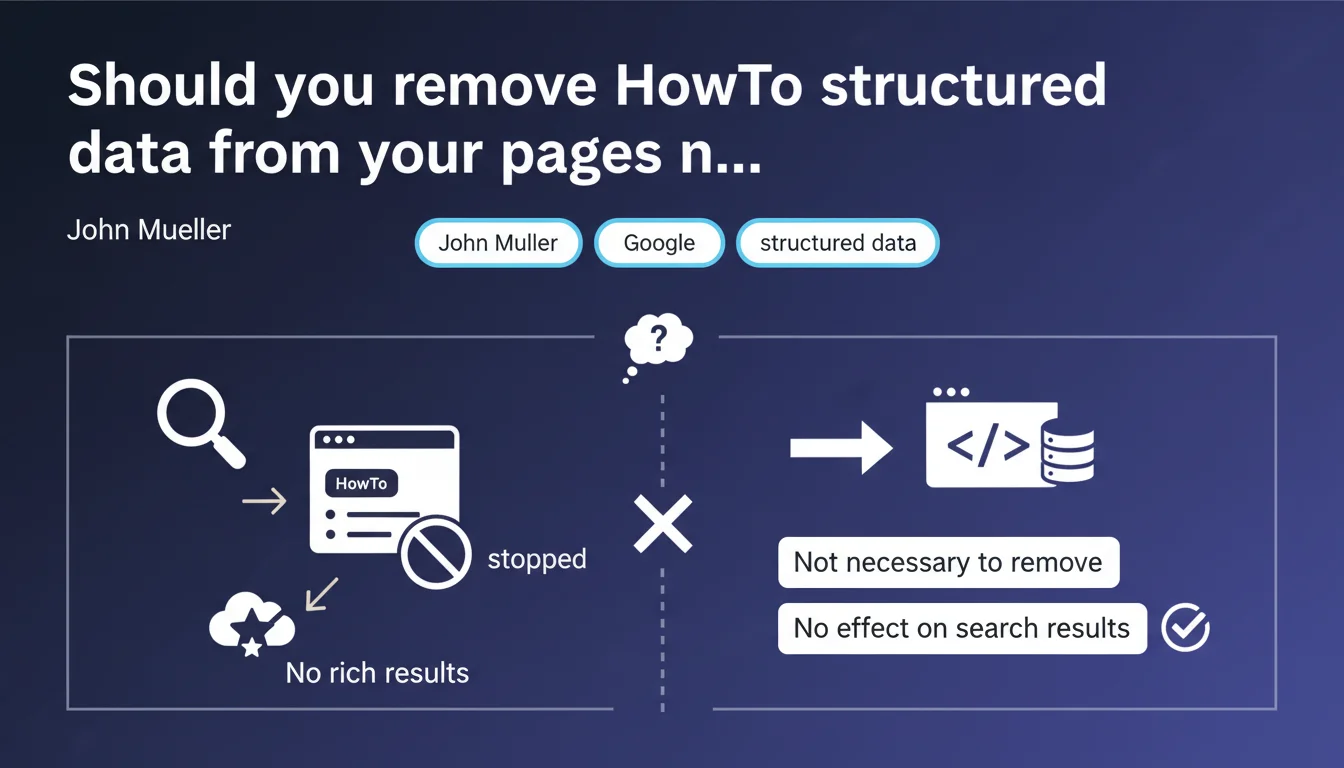
Google has stopped displaying rich results based on HowTo structured data. The markup can remain in place without negative effects, but it no longer generates any visible advantage in the SERPs. This decision marks another step back by Google on certain rich snippet formats.
What you need to understand
Why is Google abandoning HowTo rich results?
Google provides no detailed explanation for this decision. Officially, the search engine continues to explore and understand this structured data, but it simply no longer uses it to generate rich displays in search results.
This evolution reflects a trend observed over several months: Google is gradually simplifying SERP display and reducing certain rich snippet formats that are perhaps deemed less effective in terms of user satisfaction or click-through rates. HowTo rich results were designed to display tutorial steps directly, but their real impact on CTR remained difficult to measure.
Do these structured data still have any value?
From a strictly SERP perspective, no. They no longer generate any special display. However, they can theoretically facilitate semantic understanding of content by Google's crawlers, even though the concrete impact of this "improved understanding" remains unclear.
Third-party tools (aggregators, voice assistants, alternative search engines) may still use this data. But let's be honest: the overwhelming majority of organic traffic comes from Google Search, and that's where the markup loses its main value.
What exactly does John Mueller say about the course of action?
Mueller is clear: no need to remove existing markup. There is no negative effect to keeping it. Google simply ignores it for display purposes, but the code remains valid and generates neither errors nor penalties.
This pragmatic stance avoids massive cleanup work for sites that had invested in this markup. However, it becomes pointless to add HowTo structured data to new pages if the only objective was to obtain a rich result.
- HowTo rich results no longer appear in Google SERPs since this announcement
- The markup can remain in place without negative consequences
- Google continues to crawl this data but no longer uses it for display
- No direct SERP benefit to adding this markup to new pages
- The impact on "semantic understanding" remains theoretical and unverifiable
SEO Expert opinion
Is this decision consistent with practices observed in the field?
Absolutely. Over the past several months, we have observed a progressive reduction in rich snippets displayed by Google. HowTo results were already not systematically triggered, even with perfectly implemented markup. Their disappearance confirms a trend: Google now favors formats that generate direct engagement (classic featured snippets, videos, People Also Ask).
HowTo results suffered from a structural problem: they provided too much information directly in the SERP. Users got their answer without clicking. For a search engine that lives on advertising, this model was never optimal. [To verify] but it is likely that the CTR of these results was lower than Google's expectations.
What nuances should be applied to this announcement?
First point: Mueller is speaking only about display in rich results. He says nothing about possible use of this data for ranking itself. Some could argue that the markup helps Google better understand a tutorial's structure, which would indirectly influence ranking. But this is an interpretation — nothing in the official statement confirms it.
Second nuance: Google is not blocking this data, it is ignoring it for display purposes. This means that future reactivation is not impossible, even if it seems unlikely in the short term. HowTo structured data remains in the official Schema.org vocabulary, and other actors besides Google can use it.
In what cases does this markup still retain residual value?
If your content is syndicated or picked up by third-party platforms (recipe aggregators, tutorials, voice assistants), HowTo markup can still be used. But this remains marginal. Most of the ROI from structured data came from Google.
Concretely? If you've already implemented this markup, leave it in place for pragmatic reasons — removing it costs time for zero gain. But if you're planning new implementations, focus your resources elsewhere: structured FAQs, articles, products, reviews… formats that still generate active rich snippets.
Practical impact and recommendations
What should you concretely do with existing HowTo markups?
Nothing. Leave them in place. Their presence does not harm the site, generates no errors in Search Console, and does not consume significant crawl budget. Removing them represents technical effort for zero gain.
However, if you used a WordPress plugin or a module dedicated solely to HowTo structured data, and that module slows your site or adds superfluous code, then you can consider cleanup. But this is a decision about general technical optimization, not an SEO emergency.
Should you still implement HowTo structured data on new pages?
No, except in very specific cases where you're targeting third-party channels. For Google Search, it's finished. Focus your efforts on Schema.org formats that still trigger rich results:
- FAQ — still displayed, very effective for capturing long-tail traffic
- Article with date, author, image — important for Google Discover and Top Stories
- Product and Review — critical for e-commerce
- BreadcrumbList — improves SERP readability and internal UX
- VideoObject — essential if you publish video content
How can you verify that this change has no negative impact on your site?
Monitor Search Console, "Enhancements" section. Google continues to report detected HowTo structured data, but you will see that no rich results are generated. This is normal. If you notice sudden HowTo errors, fix them for cleanliness' sake, but they no longer affect your visibility.
Traffic-wise: compare the performance of affected pages before and after the announcement. If you were observing a boost linked to HowTo rich results (CTR increase on certain queries), you will likely see a slight decline. But for the majority of sites, the impact will be invisible — these results were already not being triggered much.
Summary of practical actions:
- Keep existing HowTo structured data, no reason to remove it
- Stop spending time implementing new ones for Google Search
- Redirect your efforts to FAQ, Product, Review, Article, and Breadcrumb
- Monitor Search Console to detect any errors, without panic
- Analyze post-announcement traffic to measure real impact on your tutorial pages
These adjustments may seem simple, but their rigorous implementation — auditing existing pages, prioritizing new formats, monitoring performance — requires technical and strategic expertise. If you manage a substantial site or if SEO represents a major business lever, consulting with a specialized agency can help you avoid costly mistakes and maximize the ROI of your structured data.
❓ Frequently Asked Questions
Est-ce que supprimer les données structurées HowTo peut améliorer le SEO ?
Les données HowTo peuvent-elles encore servir en dehors de Google ?
Google peut-il réactiver les résultats enrichis HowTo à l'avenir ?
Quels formats de données structurées prioriser maintenant ?
Cette annonce signale-t-elle la fin progressive de toutes les données structurées ?
🎥 From the same video 10
Other SEO insights extracted from this same Google Search Central video · published on 05/10/2023
🎥 Watch the full video on YouTube →
💬 Comments (0)
Be the first to comment.