
Official statement
Other statements from this video 10 ▾
- □ Should you remove HowTo structured data from your pages now that Google has stopped displaying rich results?
- □ Should you abandon FAQ schema markup on your website after Google's restriction?
- □ Should you really let your CMS handle your structured data?
- □ Does Google's Helpful Content System really measure quality at the entire site level?
- □ Should you block third-party content from indexation to avoid Helpful Content penalties?
- □ Why does Google direct you to its documentation when your rankings drop?
- □ Should you subscribe to Google's Search Status Dashboard RSS feed to stay ahead of ranking updates?
- □ Does Google automatically display multilingual site names correctly in search results?
- □ Does Google really filter your pages by language for every search query?
- □ Is Google really indexing your CSV files and should you be concerned about it?
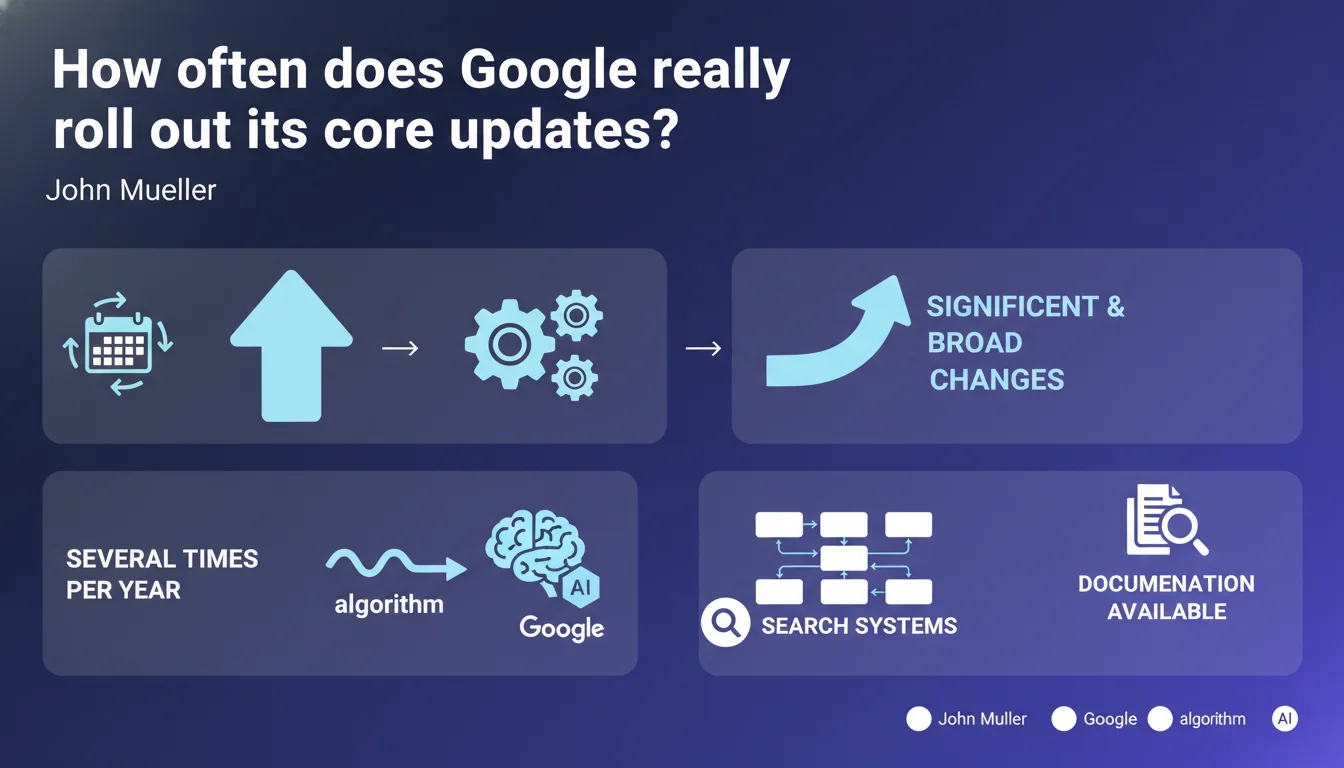
Google deploys several core updates per year — major and broad changes to its search algorithms. These updates are not minor or inconsequential: they massively impact the ranking of millions of sites. Google's official communication emphasizes the existence of detailed documentation to understand these upheavals.
What you need to understand
What exactly is a core update?
A core update refers to a significant overhaul of Google's algorithms, simultaneously affecting numerous ranking signals. Unlike minor daily adjustments, these updates cause visible fluctuations in the SERPs.
Google announces them publicly via its SearchLiaison Twitter (or X), specifies their name (ex: "March 2023 Core Update"), and documents their general objectives. But — let's be honest — the documentation often remains vague about the exact criteria being modified.
Why multiple times per year and not continuously?
Google constantly tests hundreds of algorithmic modifications. Core updates group those that have been validated and deemed sufficiently mature for global deployment.
The "several times per year" pace reflects a balance: frequent enough to improve relevance quickly, spaced out enough to let sites adapt. In practice, we observe 3 to 5 major core updates annually.
What documentation does Google actually provide?
Google centralizes its advice in the Search Central Blog and its "What webmasters should know about Google's core updates" guidelines. These resources emphasize content quality, E-E-A-T, and user experience.
Concretely? They repeat the same mantras: "create useful content", "put users first". No specific KPIs, no precise metrics. It's frustrating but consistent with Google's desire not to reveal its exact criteria.
- Core updates = broad and significant changes, not minor adjustments
- Frequency: several times per year, typically 3 to 5 major deployments
- Systematic public announcements with an official name for each update
- Documentation focused on general principles (E-E-A-T, quality), not precise metrics
- Visible impact in the SERPs, sometimes for several weeks (gradual rollout)
SEO Expert opinion
Is this communication really transparent?
Google insists on the existence of "detailed documentation", but on-the-ground reality nuances this claim. Official resources remain deliberately vague about actionable levers.
Example: Google hammers "improve your content", but never specifies if an optimal text/image ratio exists, if length matters, or how to quantify the "usefulness" of an article. [To verify]: Google's internal benchmarks on these criteria are never shared publicly.
Does the "several times per year" pace hide something?
The phrase "several times per year" is cautious. In practice, some years have 2 core updates, others 6. Google commits to no specific regularity.
And that's where it gets tricky: this unpredictability complicates any medium-term SEO strategy. Impossible to anticipate when your sector will be targeted, or whether a major refresh will occur before your technical migration. Observations also show that some updates are partially rolled back — Google never officially communicates this.
Should you really wait for the next update to recover lost traffic?
Google repeats that a site penalized by a core update can recover at the next one if it improves its quality. That's true… in theory.
In practice, field observations show that some sites never fully recover, even after drastic overhauls. Others bounce back quickly. The correlation between "improvements" and "recovery" is not linear — something Google systematically fails to clarify.
Practical impact and recommendations
What should you do concretely before and after a core update?
Before: Impossible to predict the exact timing, but strengthening your E-E-A-T profile continuously, diversifying your traffic sources, and regularly auditing content quality mitigates risks.
After: If you lose traffic, don't panic immediately. Wait for the rollout to finish (usually 2-3 weeks) before drawing conclusions. Then analyze impacted pages, compare them to competitors who gained, and identify quality gaps.
What critical mistakes should you absolutely avoid?
First mistake: overreacting during the rollout. Daily fluctuations don't always reflect the final outcome. Waiting for stabilization prevents counterproductive decisions.
Second mistake: believing that a single optimization (ex: adding expert authors) is sufficient. Core updates evaluate hundreds of signals simultaneously. A holistic approach is essential.
- Monitor official Google announcements (SearchLiaison, Search Central Blog)
- Track your positions daily during rollouts via GSC and third-party tools
- Analyze losing vs winning pages (content, UX, E-E-A-T signals)
- Audit editorial quality: expertise, depth, real added value
- Diversify your traffic sources (SEO, SEM, social, email) to limit Google dependency
- Never make major site changes during an ongoing rollout
- Document each core update and its impacts on your KPIs to detect sector patterns
❓ Frequently Asked Questions
Combien de core updates Google déploie-t-il exactement chaque année ?
Peut-on anticiper la prochaine core update ?
Un site pénalisé par une core update peut-il récupérer sans attendre la suivante ?
La documentation Google sur les core updates suffit-elle pour optimiser mon site ?
Faut-il modifier son site pendant le rollout d'une core update ?
🎥 From the same video 10
Other SEO insights extracted from this same Google Search Central video · published on 05/10/2023
🎥 Watch the full video on YouTube →
💬 Comments (0)
Be the first to comment.