
Official statement
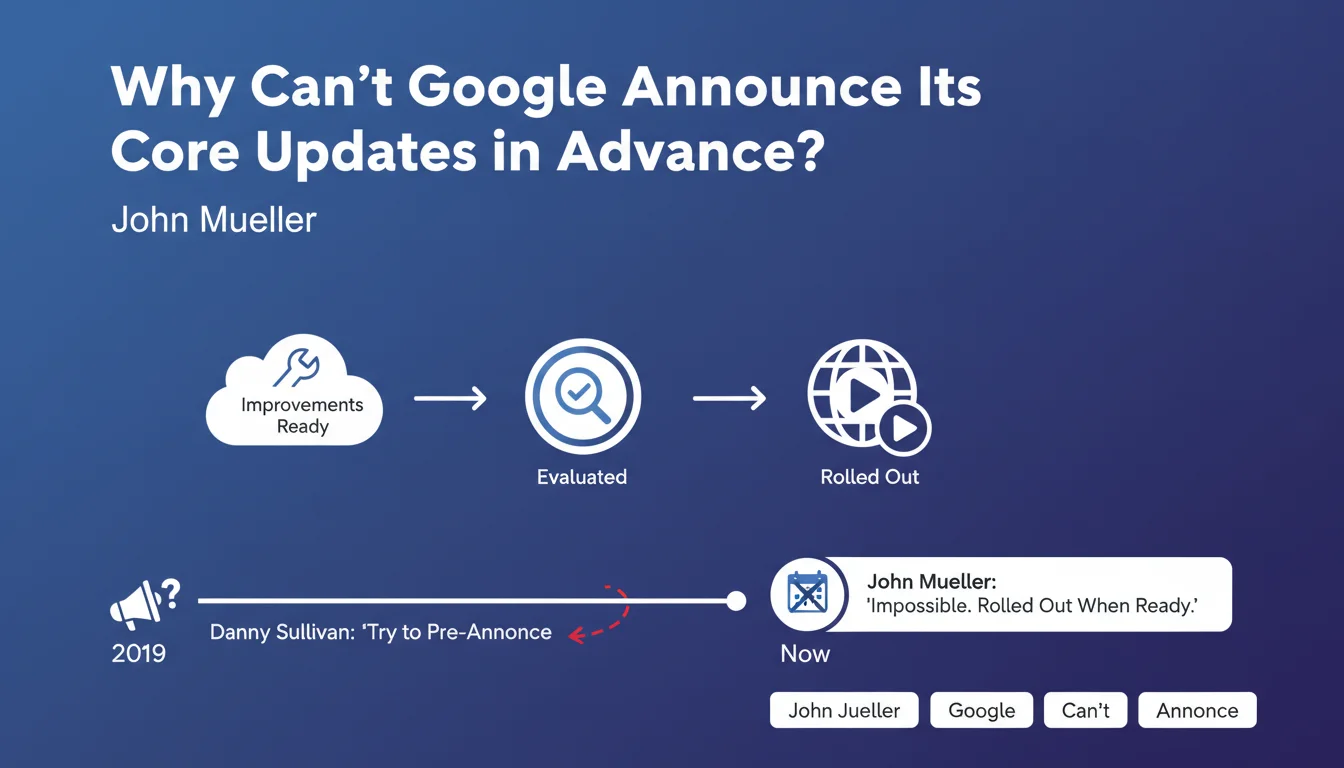
Barry Schwartz highlights a contradiction with previous statements. In June 2019, Danny Sullivan had stated that Google would try to pre-announce future Core Updates, which ultimately never happened.
What you need to understand
John Mueller recently clarified an essential point regarding Google's core algorithm updates (Core Updates). Contrary to what Danny Sullivan suggested in 2019, Google cannot communicate precise dates for these rollouts.
The reason is technical and operational: Core Updates are deployed as soon as they are ready and validated. There is no fixed schedule or pre-established timeline. These major updates depend on multiple internal factors including testing phases, results validation, and potential impact assessment.
This statement ends an apparent contradiction in Google's official communication. In 2019, the advance announcement of Core Updates seemed to be a practice that would become widespread, but operational reality decided otherwise.
- Core Updates have no predictable schedule - they are deployed according to their readiness status
- Google confirms the impossibility of announcing precise dates in advance for these major updates
- Communication generally happens at the time of deployment or a few hours before, but not weeks in advance
- This approach reflects the technical complexity of developing and validating ranking algorithms
SEO Expert opinion
This position from Google is perfectly consistent with what we've been observing in the field for several years. Core Updates indeed arrive without significant advance notice, and their timing seems more dictated by technical imperatives than by a marketing calendar.
The important nuance here concerns the distinction between advance announcement and communication at deployment time. Google generally communicates via its @searchliaison account when the update begins to be rolled out, which allows SEOs to understand the observed fluctuations. But indeed, no pre-announcement several weeks in advance is realistic.
It is also revealing that this clarification indirectly contradicts statements from 2019. This shows that even within Google, understanding of operational constraints evolves. What Danny Sullivan envisioned in 2019 proved to be technically or strategically inapplicable.
Practical impact and recommendations
- Abandon any strategy based on anticipating Core Updates - their timing is unpredictable and cannot be planned in your SEO roadmap
- Implement daily monitoring of your rankings and traffic to quickly detect signals of an ongoing rollout
- Maintain constant monitoring of official Google channels (@searchliaison on Twitter/X, Google Search Central) to identify announcements in real-time
- Systematically document your content quality: author expertise, sources, information freshness, depth of coverage
- Regularly audit your site according to E-E-A-T criteria (Experience, Expertise, Authoritativeness, Trustworthiness) without waiting for external signals
- Prepare rapid response protocols to analyze the impact of a Core Update within 48-72 hours following its announcement
- Avoid hasty corrections immediately after a drop - wait for the complete end of the rollout (generally 2 weeks) before analyzing the real impact
- Invest in continuous quality improvement rather than in one-off tactical optimizations
These strategic adjustments require a profound overhaul of your SEO approach, shifting from a reactive logic to a logic of permanent quality. The complexity of this transformation, combined with the need to maintain constant technical monitoring and correctly interpret algorithmic signals, represents a considerable challenge for internal teams often pulled in other priority directions. Support from a specialized SEO agency can prove particularly relevant in this context: it brings continuously updated expertise, proven audit methodologies, and rapid response capability during rollouts, while allowing you to focus on your core business.
💬 Comments (0)
Be the first to comment.