
Official statement
Other statements from this video 10 ▾
- □ Faut-il supprimer les données structurées HowTo de vos pages après l'arrêt des résultats enrichis ?
- □ Faut-il abandonner le balisage FAQ sur votre site après la restriction de Google ?
- □ Faut-il vraiment laisser votre CMS gérer vos données structurées ?
- □ Combien de fois Google déploie-t-il vraiment ses core updates ?
- □ Le système de contenu utile mesure-t-il vraiment la qualité à l'échelle du site ?
- □ Faut-il bloquer le contenu tiers de l'indexation pour éviter les pénalités du Helpful Content ?
- □ Pourquoi Google vous renvoie-t-il vers sa documentation après une chute de classement ?
- □ Faut-il s'abonner au Search Status Dashboard de Google pour anticiper les mises à jour ?
- □ Google filtre-t-il vraiment vos pages par langue pour chaque requête ?
- □ Google indexe-t-il vraiment vos fichiers CSV et faut-il s'en préoccuper ?
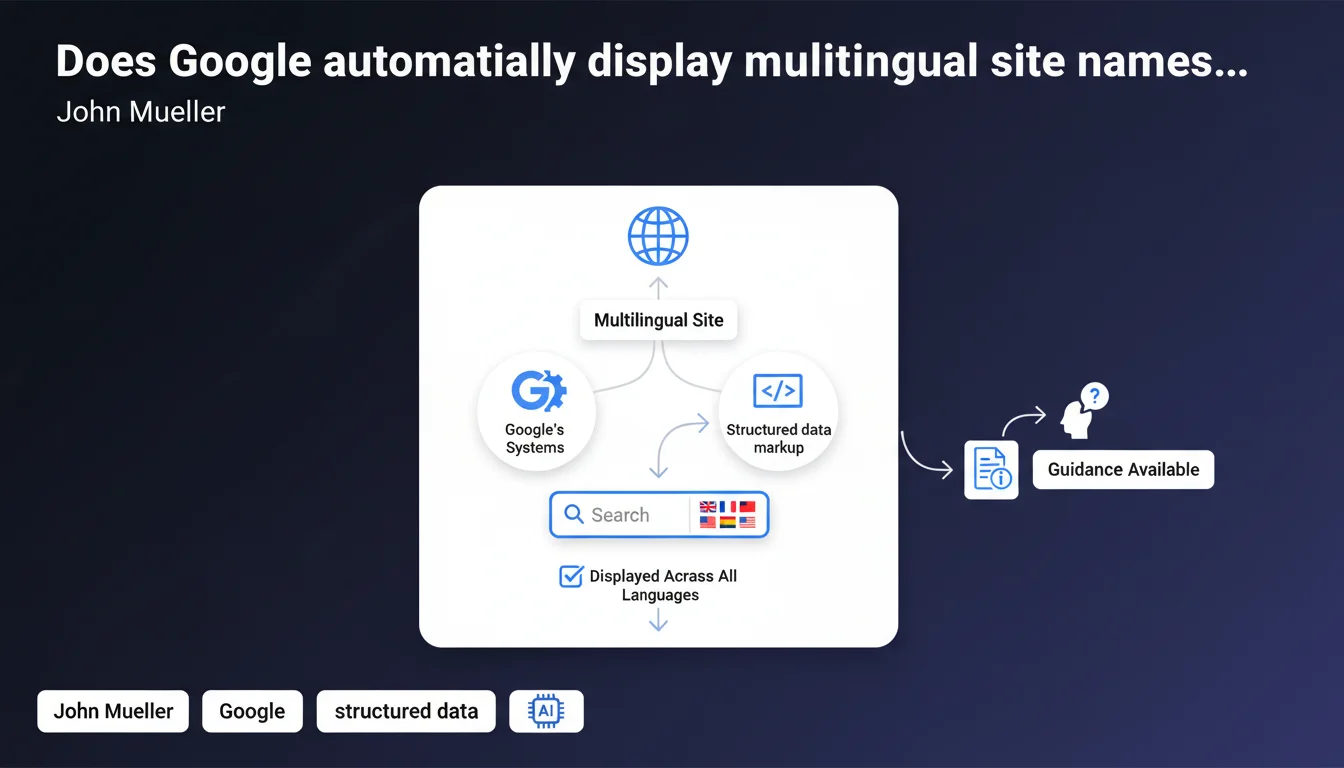
Google is rolling out site name display for all languages, leveraging its automated systems and structured data markup. If the displayed name doesn't match your expectations, optimization mechanisms exist to influence the selection. This multilingual expansion directly impacts your brand visibility in international SERPs.
What you need to understand
What's changing concretely with this expansion?
Until now, site name display in search results was being rolled out progressively, but remained limited to certain languages. Google is taking a major step by extending this functionality to all languages available in its search engine.
In practice? Your site can now see its name displayed consistently in SERPs, regardless of the linguistic market you're targeting. This evolution strengthens brand identity coherence at the international level and makes visual recognition easier for users.
How does Google determine which name to display?
The process relies on two pillars: Google's automated systems that analyze your site, and the structured data markup you implement. The algorithm examines multiple signals — title tags, logos, recurring name mentions — to identify the most relevant label.
Structured data markup (specifically WebSite and Organization schemas) allows you to explicitly indicate your preferred name. Without this indication, Google relies solely on its automated interpretation, which can lead to unwanted variations.
What should you do if the selected name doesn't fit your needs?
Mueller mentions available guidance for correcting this. This primarily involves optimizing your structured data markup — careful verification of your name tags, alternateName properties, and consistency with your other brand elements.
It's also critical to ensure consistency of name mentions throughout your entire site. Inconsistencies between homepage, internal pages, and structured elements can confuse the algorithm and generate random displays.
- Site name display is now universal across all languages
- Selection is based on Google's automation and structured data markup
- Optimization mechanisms exist to influence the displayed name
- Brand name consistency throughout the site is decisive
- Control is achieved through rigorous implementation of WebSite and Organization markup
SEO Expert opinion
Does this expansion really solve display problems?
Let's be honest: the multilingual rollout is an improvement, but it doesn't guarantee that the displayed name will match your expectations. In practice, we still see cases where Google ignores properly implemented structured data markup.
The "available guidance" mentioned by Mueller remains deliberately vague. No exhaustive documentation details the priority criteria between different signals — structured data, title tags, H1s, external mentions. [To verify]: to what extent does linguistic context influence the weighting of these signals?
Are automated systems reliable enough?
Automation has its limitations. For brands with spelling variations, acronyms, or different names across markets, automated selection can produce inconsistent results. A classic example: a company known by its acronym in France and its full name internationally.
The problem becomes more complex for multibrand sites or platforms hosting multiple entities. Google sometimes struggles to distinguish the parent site name from that of the main brand. And that's where it gets tricky: structured data markup should resolve this ambiguity, but we observe that the algorithm sometimes bypasses it.
What are the blind spots in this announcement?
Mueller doesn't clarify how to handle brand conflicts — what happens if two sites claim the same name via structured data? No indication of arbitration or verification mechanisms. [To verify]: is there a brand ownership verification system, similar to Google My Business?
Another gray area: the impact of algorithm updates on name selection. We've observed fluctuations after certain Core Updates, with names changing despite no modifications to site markup. Nothing in this announcement explains this instability or guarantees future stability.
Practical impact and recommendations
What are the priority actions to take?
First step: audit your structured data markup across all your language versions. Verify the presence and consistency of WebSite and Organization schemas, paying special attention to name and url properties.
Then test the actual display in SERPs for each linguistic market. A gap between the marked-up name and the displayed name signals a problem — either in implementation or algorithmic interpretation. Search Console provides no specific indicator on this point, so you must monitor manually.
How can you avoid common implementation mistakes?
Classic error: using name variations across pages (short version in footer, long version on homepage, acronym in title tags). Google interprets this inconsistency as a lack of clarity about your true identity.
Another pitfall: neglecting the alternateName property in Organization markup. If your brand has legitimate alternative names (former name, recognized acronym), declaring them explicitly helps the algorithm understand these variants without treating them as distinct entities.
- Implement WebSite markup with the
nameproperty on all language versions - Complete the Organization schema with
name,alternateName, andurl - Validate markup using Google's Rich Results Test
- Verify actual display in SERPs for each targeted market
- Standardize name mentions throughout your site (titles, H1s, footers, navigation)
- Document legitimate name variants via
alternateName - Monitor display fluctuations after Core Updates
- For multibrand sites, implement distinct markup per entity
The multilingual expansion of site names reinforces the importance of rigorous structured data markup. International sites must especially ensure consistency across language versions and avoid uncontrolled variations in brand names.
Given the complexity of multilingual implementations and the subtleties of algorithmic interpretation, support from a specialized SEO agency can prove valuable. Third-party expertise helps identify blind spots within your organization and optimize markup to maximize control over display in each market.
❓ Frequently Asked Questions
Le balisage structured data garantit-il que Google affichera le nom choisi ?
Faut-il un balisage différent pour chaque version linguistique du site ?
Où trouver les conseils officiels pour corriger un nom de site mal affiché ?
Combien de temps faut-il pour qu'une modification de balisage soit prise en compte ?
Peut-on avoir des noms de sites différents selon les types de requêtes ?
🎥 From the same video 10
Other SEO insights extracted from this same Google Search Central video · published on 05/10/2023
🎥 Watch the full video on YouTube →
💬 Comments (0)
Be the first to comment.