
Official statement
Other statements from this video 10 ▾
- □ Should you remove HowTo structured data from your pages now that Google has stopped displaying rich results?
- □ Should you really let your CMS handle your structured data?
- □ How often does Google really roll out its core updates?
- □ Does Google's Helpful Content System really measure quality at the entire site level?
- □ Should you block third-party content from indexation to avoid Helpful Content penalties?
- □ Why does Google direct you to its documentation when your rankings drop?
- □ Should you subscribe to Google's Search Status Dashboard RSS feed to stay ahead of ranking updates?
- □ Does Google automatically display multilingual site names correctly in search results?
- □ Does Google really filter your pages by language for every search query?
- □ Is Google really indexing your CSV files and should you be concerned about it?
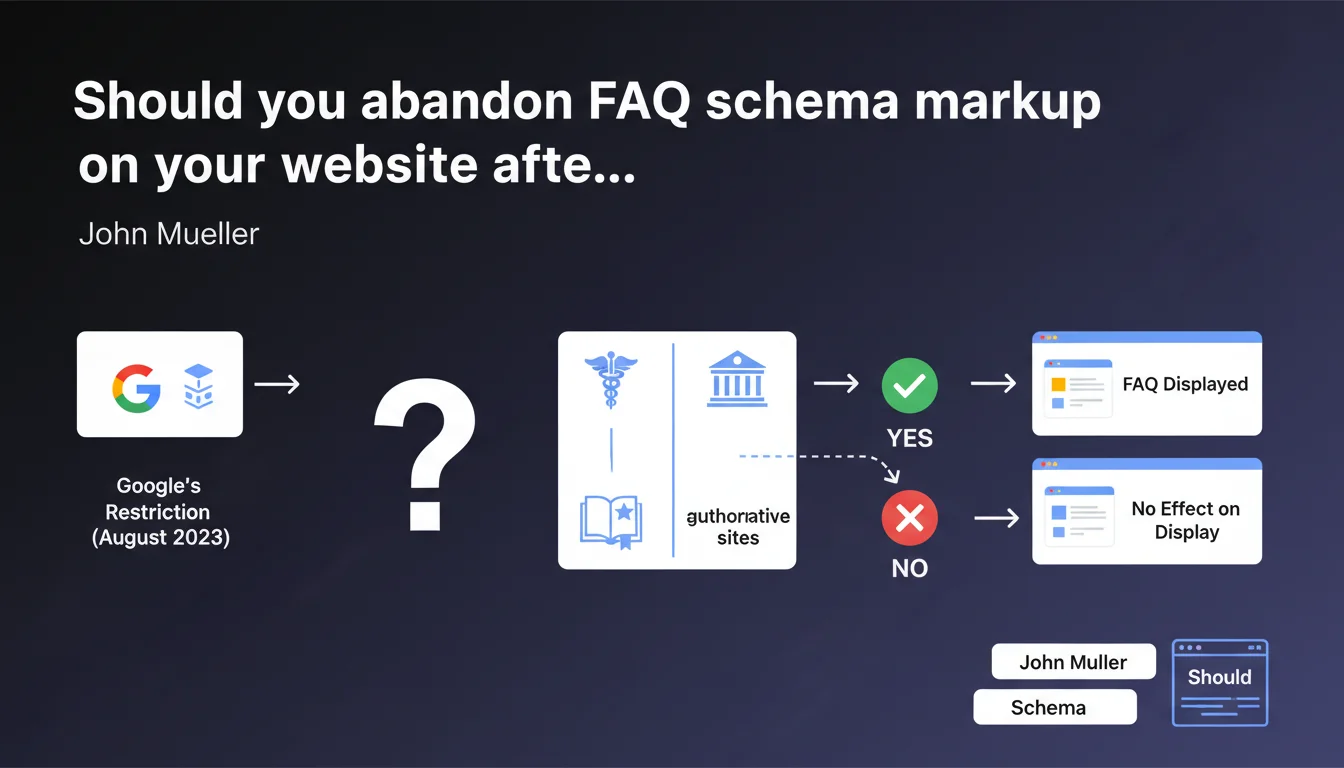
Google now limits the display of FAQ rich results exclusively to government sites, health sites, and recognized authority sites. For all other sites, FAQ markup remains technically valid but will no longer have any impact on SERP display. A restriction that radically changes the structured data strategy for the majority of websites.
What you need to understand
What exactly is changing with this restriction?
Google has decided to drastically restrict eligibility for FAQ rich results. Only three types of sites can now benefit from this display: official government sites, certified health sites, and sites that Google considers as "authoritative" in their field.
For everyone else — that is, the vast majority of websites — the Schema.org FAQPage markup can technically remain in place, but it will have absolutely no effect on display in search results. No error in Search Console, no alert: simply a complete absence of rich display.
Why is Google imposing this limitation now?
The official answer remains unclear, but massive abuse of FAQ markup likely explains this decision. Many sites were using FAQs to occupy disproportionate space in the SERPs, sometimes with artificial questions that provided no real value to users.
By limiting access to authoritative sites, Google is attempting to restore the relevance of these rich results while reducing SERP manipulation. This is consistent with their overall approach to "helpful content" and fighting visual spam in search results.
How can you tell if my site qualifies as an "authority site"?
That's where it gets tricky — Google provides no objective criteria to define what constitutes an "authority site". No DR threshold, no checklist, no badge in Search Console.
The only way to verify: implement FAQ markup and observe whether rich results display in the SERPs or not. This deliberate opacity leaves Google free to adjust its criteria without public justification.
- Targeted restriction: Only government, health, and "authority" sites eligible
- Markup still valid: No technical errors, just an absence of display
- Opaque criteria: No clear definition of what constitutes an "authority site"
- Massive impact: The majority of sites lose access to FAQ rich results
- Empirical verification: Observing SERPs remains the only way to confirm eligibility
SEO Expert opinion
Is this restriction consistent with field observations?
Absolutely. For several months already, we've been observing a progressive reduction in FAQ display for sites that previously benefited from it. This announcement simply formalizes a policy that was already in place de facto.
What raises questions is the definition of "authority site". On the ground, some sites with excellent link profiles and recognized expertise still don't see their FAQs display, while others, less obvious, retain this rich display. [To verify]: the exact criteria used by Google remain to be documented.
Should you remove FAQ markup from ineligible sites?
No — and this is a crucial point. FAQ markup remains semantically useful for Google's content understanding, even without rich display. It structures information, potentially helps ranking for question-based queries, and could serve other interfaces (Google Assistant, future features).
Removing this markup out of frustration would be a mistake. What must change is abandoning FAQ strategy as a SERP leverage for the majority of sites. Markup becomes a semantic structuring tool, not a display hack.
What are the risks for sites that continue to abuse markup?
Technically, no direct penalty risk — Google simply ignores the markup. But watch out for secondary effects on user experience: creating artificial FAQs purely for SEO often degrades the perceived quality of content.
The real risk is elsewhere: by investing time and resources into a tactic that's now ineffective, you're probably neglecting optimizations that would have real impact. Let's be honest — oversized FAQs have never been a sustainable SEO strategy.
Practical impact and recommendations
What concretely should you do on your existing sites?
First step: audit the current display of your FAQs in the SERPs. Search for your key pages and check whether FAQ rich results still appear. If not, you're likely affected by the restriction.
Next, evaluate the genuine quality of your FAQs. Ask yourself: do these questions provide authentic value to users, or were they created solely to inflate Google's display? If the answer leans toward the latter, redirect your content strategy.
What alternatives can compensate for the loss of visibility?
Focus on other types of structured data still accessible: HowTo (if relevant for your industry), Product, Recipe, Event, VideoObject. These markups remain widely available and less restricted — for now.
In parallel, invest in the quality of your meta descriptions and titles. Without FAQs occupying vertical space, your classic snippet becomes crucial again for CTR. A compelling title and well-crafted description can offset some of the visibility loss.
How do you optimize your structured data strategy long-term?
Stop putting all your eggs in one basket. The FAQ restriction is probably just the beginning of a broader tightening of rich result eligibility criteria. Prepare yourself for other types to follow the same path.
Build a content strategy that doesn't depend on display tricks. Sites that bet on content depth, editorial quality, and genuine authority in their field will be best positioned when Google continues to tighten the screws.
- Check the current display of your FAQs in SERPs for your key pages
- Audit the genuine quality of questions: user value vs. SEO tactic
- Maintain FAQ markup even without rich display (semantic utility)
- Explore alternatives: HowTo, Product, other structured data types
- Strengthen the quality of your meta descriptions and titles to offset visibility loss
- Diversify traffic sources and stop relying on rich results
- Invest in genuine authority and expertise rather than display tactics
❓ Frequently Asked Questions
Mon balisage FAQ génère-t-il des erreurs dans la Search Console après cette restriction ?
Puis-je encore espérer des résultats enrichis FAQ si mon site gagne en autorité ?
Les sites e-commerce peuvent-ils contourner cette restriction avec d'autres balisages ?
Cette restriction s'applique-t-elle également à Google Discover et aux autres surfaces Google ?
Faut-il privilégier le balisage HowTo plutôt que FAQ désormais ?
🎥 From the same video 10
Other SEO insights extracted from this same Google Search Central video · published on 05/10/2023
🎥 Watch the full video on YouTube →
💬 Comments (0)
Be the first to comment.