
Official statement
Other statements from this video 20 ▾
- □ Pourquoi Google ne peut-il jamais garantir que vos utilisateurs atterriront sur la bonne version linguistique de votre site ?
- □ Faut-il bannir les redirections automatiques pour les sites multilingues ?
- □ Faut-il bloquer l'exécution JavaScript pour les SPA avec SSR ?
- □ Faut-il baliser les mots étrangers avec l'attribut lang pour le SEO ?
- □ Le contenu dupliqué entraîne-t-il vraiment une pénalité Google ?
- □ Le rel=canonical est-il vraiment pris en compte par Google ou juste une suggestion ignorée ?
- □ Les FAQ dans les articles de blog sont-elles vraiment utiles pour le SEO ?
- □ Hreflang est-il vraiment obligatoire pour gérer un site international ?
- □ Le cache Google a-t-il un impact sur votre référencement ?
- □ Les résultats de recherche localisés : comment Google adapte-t-il vraiment son algorithme selon les pays et les langues ?
- □ Faut-il vraiment se limiter à une seule thématique sur son site pour bien ranker ?
- □ Combien de liens peut-on vraiment mettre sur une page sans pénalité Google ?
- □ L'URL référente dans Search Console impacte-t-elle vraiment votre classement ?
- □ Le nombre de mots est-il vraiment inutile pour le référencement ?
- □ Faut-il s'inquiéter de réutiliser les mêmes blocs de texte sur plusieurs pages ?
- □ Google valide-t-il vraiment la traduction automatique sur les sites multilingues ?
- □ Les URLs bloquées par robots.txt mais indexées posent-elles vraiment problème ?
- □ Faut-il vraiment dupliquer le schema Organisation sur toutes les pages du site ?
- □ Les avis auto-hébergés peuvent-ils afficher des étoiles dans les résultats de recherche Google ?
- □ Pourquoi les fusions de sites Web génèrent-elles des résultats imprévisibles aux yeux de Google ?
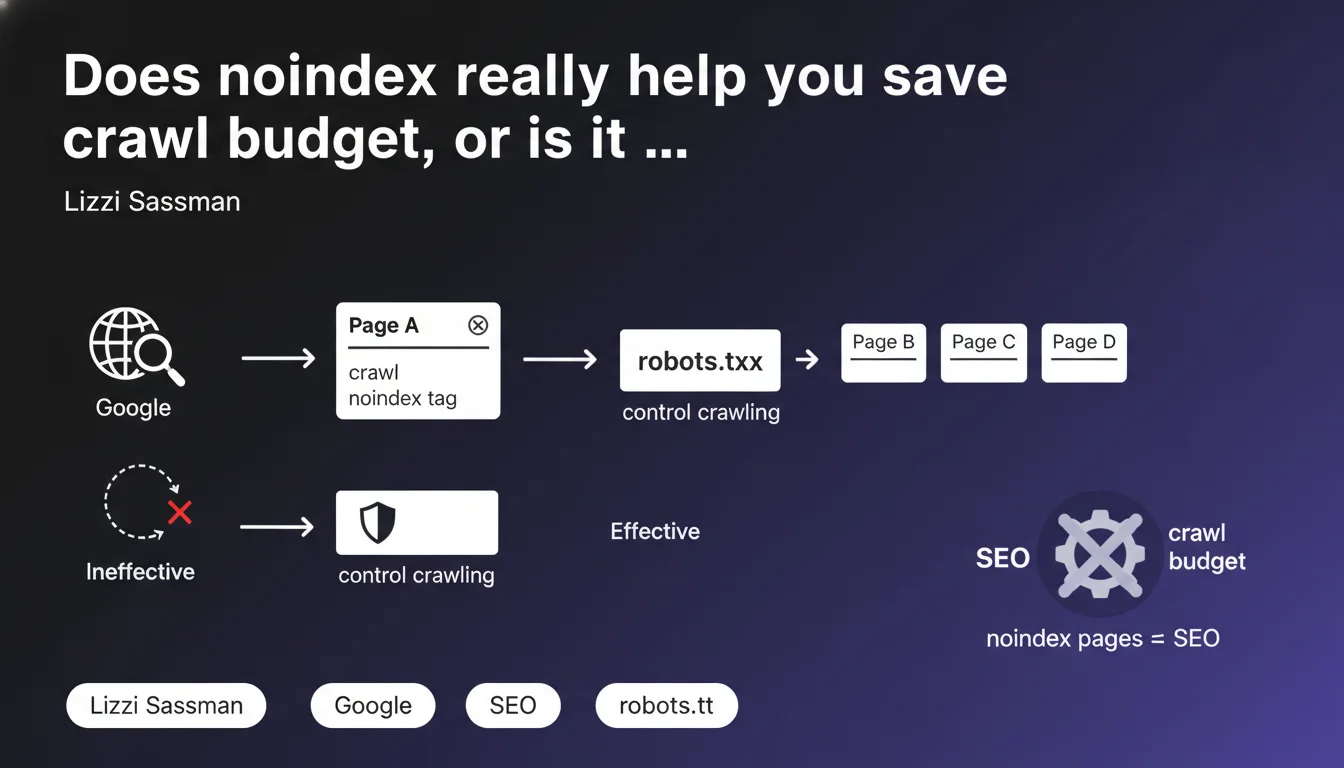
Google crawls pages to detect the noindex directive — using it to save crawl budget is therefore counterproductive. Only robots.txt truly blocks crawling. The number of noindex pages does not impact your site's overall SEO quality.
What you need to understand
Why can't noindex save you crawl budget?
The mechanism is straightforward: for a search engine to discover the noindex directive, it must first crawl the page, load the HTML (or check HTTP headers if it's an X-Robots-Tag), then identify the instruction. The crawl has already happened.
If the goal is to preserve crawl resources — for example on a site with millions of pages or dynamically generated sections — adding noindex only increases processing overhead: Googlebot visits, reads, temporarily indexes, then removes the page from the index. In short, it's inefficient.
What's the difference between noindex and robots.txt for crawling?
robots.txt blocks crawling upstream. Googlebot checks this file before visiting a URL and, if it's forbidden, it doesn't crawl it at all. No HTTP request, no budget consumption.
Noindex, on the other hand, acts after crawling, at the indexation level. The page is visited, analyzed, but won't appear in search results. Two different logics, two different stages of the pipeline.
Does the number of noindex pages penalize your site's overall SEO?
According to this statement, no. Google affirms that the volume of pages marked noindex does not affect the perceived quality of the site as a whole. What matters is the relevance and quality of indexable pages, not the number of excluded pages.
This contradicts a persistent belief: that too many noindex pages would send a negative signal ("this site is hiding quality issues"). [To verify] on very large-scale sites — but the official position is clear.
- Noindex does not block crawling, it blocks indexation after crawling
- robots.txt is the only lever to control crawl budget upstream
- The number of noindex pages is not a penalty factor according to Google
- Using noindex to save crawl budget is a technical contradiction
SEO Expert opinion
Is this statement consistent with real-world observations?
Yes, broadly speaking. On sites with constrained crawl budget (multi-SKU e-commerce, marketplaces, massive editorial media), blocking via robots.txt is much more effective than hoping noindex will lighten the load.
That said, the notion of "crawl budget" itself is often overstated. Google has repeated it: for most sites, it's not a bottleneck. The real issue is the quality of crawled pages, not their absolute quantity.
In what cases does noindex remain relevant?
Noindex retains its full value for managing indexation, not crawling. Internal search results pages, product sheets in permanent stockout, obsolete content worth keeping for user history — these are all cases where you want Google to crawl (to follow links, detect updates), but without indexing.
The trap is conflating the two objectives. If you want Googlebot to never touch a section (admin files, technical appendices, sensitive PDFs), robots.txt is the right approach. If you want it to explore but not display in the SERP, noindex does the job.
What nuance should be added about the volume of noindex pages?
Google says it doesn't affect overall SEO. Technically accurate — but watch out for indirect effects. If the majority of your site is noindex, it raises a real strategic question: why create so much non-indexable content?
An overly high ratio of noindex pages can reveal structural problems: uncontrolled duplication, automatic generation of low-value pages, poor architecture. It's not the volume of noindex that penalizes you, it's what it signals. [To verify] on extreme cases (90% noindex pages), but the logic holds.
Practical impact and recommendations
What should you do concretely to optimize crawl budget?
If you really want to control what Googlebot crawls, use robots.txt strategically. Identify sections that consume resources without delivering SEO value: infinite facets, combinatorial filters, archives of obsolete pages.
Then monitor via Search Console the crawl volume by page type. Google reports the number of requests per day, average response time, server errors. If these metrics are healthy, you probably don't have a crawl budget problem.
What errors should you avoid with noindex and robots.txt?
Classic mistake: blocking a URL in robots.txt AND adding noindex. Google can't crawl, so it never sees the noindex directive — result, the page can remain in the index with a truncated snippet ("No information available"). You must choose: either block crawling, or block indexation, rarely both.
Another trap: using noindex on strategic pages out of fear of duplication. If the content is legitimate and useful, use canonical instead of noindex. Noindex removes all ranking chances, canonical concentrates signals.
How do you verify that your site is configured correctly?
Start with a crawl audit (Screaming Frog, OnCrawl, Botify) to identify noindex pages and their volume. Cross-reference with server logs to see if Googlebot visits them frequently despite the noindex.
Next, compare with robots.txt: are there blocked sections that should be crawled to transmit PageRank? Are there noindex pages that could be blocked upstream via robots.txt to lighten the load?
- Use robots.txt to block crawling of non-strategic sections (facets, filters, archives)
- Reserve noindex for pages you want crawled but not indexed (internal search, temporary content)
- Never combine robots.txt and noindex on the same URL
- Regularly audit the ratio of indexable pages to total pages to detect inconsistencies
- Monitor crawl metrics in Search Console (requests per day, errors, response time)
- Prefer canonical to noindex for managing legitimate duplication
❓ Frequently Asked Questions
Peut-on combiner robots.txt et noindex sur la même page ?
Le noindex transmet-il du PageRank via les liens internes ?
Un trop grand nombre de pages noindex peut-il pénaliser un site ?
Quand utiliser robots.txt plutôt que noindex ?
Comment savoir si mon site souffre d'un problème de budget de crawl ?
🎥 From the same video 20
Other SEO insights extracted from this same Google Search Central video · published on 21/10/2022
🎥 Watch the full video on YouTube →
💬 Comments (0)
Be the first to comment.