
Official statement
Other statements from this video 20 ▾
- □ Why can't Google ever guarantee that your users will land on the right language version of your site?
- □ Are automatic redirects really killing your international SEO rankings?
- □ Should you really block JavaScript execution for SPAs with server-side rendering?
- □ Does duplicate content really trigger a Google penalty?
- □ Does Google really respect rel=canonical or is it just a suggestion that gets ignored?
- □ Are FAQs in blog articles really worth it for SEO rankings?
- □ Is hreflang really essential for managing a successful international website?
- □ Does Google's web cache actually affect your search rankings?
- □ How does Google really customize search results based on location and language? Here's what actually happens behind the scenes
- □ Does noindex really help you save crawl budget, or is it the wrong tool for the job?
- □ Do you really need to stick to just one topic on your site to rank well?
- □ How many links can you really put on a page without triggering a Google penalty?
- □ Does the referrer URL in Search Console really affect your search rankings?
- □ Does word count really matter for SEO ranking?
- □ Should you worry about reusing the same text blocks across multiple pages?
- □ Does Google really accept machine-translated content on multilingual websites?
- □ Does blocking URLs with robots.txt but leaving them indexed really hurt your SEO?
- □ Do you really need to duplicate the Organization schema on every page of your website?
- □ Can self-hosted reviews display star ratings in Google search results for local businesses?
- □ Why do website mergers produce unpredictable results in Google's eyes?
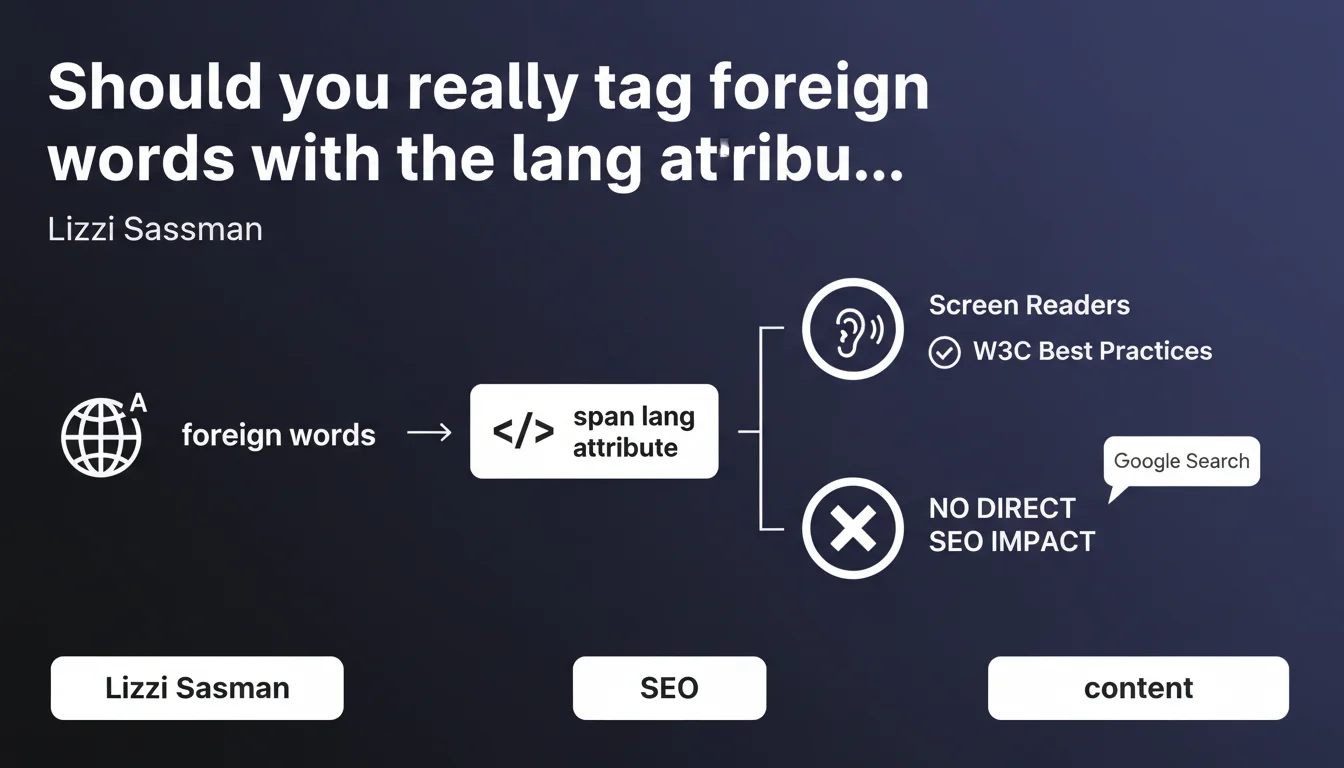
Google confirms that the lang attribute on <span> tags to mark words or phrases in a foreign language has zero direct SEO impact. This tag remains recommended for accessibility (screen readers) and follows W3C standards, but does not contribute to rankings or to how indexing robots understand your content.
What you need to understand
The statement from Lizzi Sassman clarifies a point that regularly generates questions: the use of the lang attribute to mark terms in a language different from the rest of your content.
Concretely, these are tags like <span lang="en">content marketing</span> within French text. Some developers and SEO professionals include them out of concern for standards compliance or intuition that they could help Google contextualize the content.
Does Google actually exploit the lang attribute to understand content?
No. Google confirms here that this attribute has no direct SEO impact. The search engine does not rely on this tag to index, rank, or interpret the linguistic relevance of your content.
Google's algorithms analyze semantic context, natural linguistic signals, and the overall page structure — not this type of granular markup. The lang attribute at document level (on the <html> tag) remains relevant for signaling the main language, but not for isolated fragments.
Why does this tag exist at all then?
It addresses accessibility requirements and W3C compliance. Screen readers use this attribute to adjust pronunciation and intonation when a foreign word appears in the reading flow.
For a blind user, hearing an English word pronounced with French phonetic rules degrades the experience. This is where lang="en" comes in — but that's where the SEO relevance stops.
- The lang attribute on fragments does not influence crawling, indexation, or ranking.
- It remains relevant for accessibility (WCAG) and standards compliance.
- Google doesn't need this tag to detect or interpret foreign words in text.
- The lang attribute on
<html>maintains its importance for signaling the document's primary language.
SEO Expert opinion
Is this statement consistent with observed practices?
Yes, completely. In practice, no correlation has ever been established between using lang on text fragments and improved rankings or visibility. A/B tests conducted on multilingual sites or those regularly containing foreign technical terms show no measurable differences.
Google has always favored contextual and semantic analysis over granular declarative markup. The engine detects content language through multiple signals: lexical frequency, grammatical structures, term co-occurrences. A single English word in French text is immediately understood without HTML scaffolding.
Should you still use this attribute?
It depends on your priorities. If your site aims for flawless accessibility (public sector, certified digital services, premium e-commerce), then yes — it's a good W3C and WCAG practice. But if your goal is purely SEO, you can skip it without risk.
Implementation costs on large content volumes can be significant. Developing logic to automatically tag foreign terms — especially with CMSs or static generators — takes time. If it doesn't deliver visibility gains, better to invest elsewhere.
lang attribute on fragments with that on <html> or <head>. The latter remains crucial so Google correctly identifies your document's primary language and indexes it in the right language versions of the SERP.What are the limitations of this statement?
Google doesn't specify whether future developments could integrate this signal — but frankly, it's unlikely. The engine tends to rely more on machine learning and advanced semantic analysis, not on declarative markup requiring manual maintenance.
[To verify]: in very specific contexts — academic publications, multilingual legal sites, technical documentation — it would be worthwhile to check whether Google indirectly exploits these markups through featured snippets or knowledge graph panels. No reliable data at this point, but it deserves controlled testing.
Practical impact and recommendations
What should you actually do on your site?
If you're already using the lang attribute on fragments, keep it for accessibility but don't count on it for SEO. If you've never implemented it, it's not a priority — unless you're targeting an accessibility certification or your audience includes a significant proportion of screen reader users.
Focus instead on signals that actually impact ranking: content quality, semantic structure (Hn), internal linking, useful structured data (FAQ, HowTo, Product), Core Web Vitals. The lang attribute on <html> remains non-negotiable for multilingual sites.
What mistakes should you avoid?
Don't launch a global overhaul to add lang on every foreign word thinking it'll boost your traffic. That's wasted effort. Equally, don't remove these tags if they're already in place and functional — they don't hurt, they serve accessibility.
Also avoid confusing content language with geographic targeting. The lang attribute signals a language (fr, en, de…), not a country. For geo-targeting, use hreflang in <link> tags or HTTP headers — that's what matters for Google.
How do you verify your site is compliant?
- Verify that the
langattribute is present on<html>and matches your content's primary language. - Use W3C Validator tools to detect linguistic markup inconsistencies.
- Test your pages with a screen reader (NVDA, JAWS) to ensure foreign fragments are correctly pronounced if you've implemented
lang. - Audit your
hreflangtags for multilingual sites — this is where critical SEO errors happen in international implementation. - Prioritize optimizations with measurable impact: performance, semantics, user experience.
The lang attribute on text fragments has zero direct SEO impact. If your goal is purely organic visibility and traffic, this isn't a priority. If you're targeting accessibility or W3C compliance, implement it — but understand it won't contribute to your rankings.
The truly effective SEO optimizations involve semantic structure, technical performance, and content quality. For complex or multilingual sites, these adjustments may require specialized expertise. Working with a dedicated SEO agency helps you avoid costly mistakes and focus on the levers that actually generate ROI.
❓ Frequently Asked Questions
L'attribut lang sur <html> a-t-il un impact SEO, contrairement à celui sur des fragments ?
Si j'utilise déjà l'attribut lang sur des mots étrangers, dois-je le retirer ?
Google détecte-t-il automatiquement les mots étrangers dans un texte sans balise lang ?
L'attribut lang peut-il impacter les featured snippets ou le knowledge graph ?
Quelle est la différence entre lang et hreflang ?
🎥 From the same video 20
Other SEO insights extracted from this same Google Search Central video · published on 21/10/2022
🎥 Watch the full video on YouTube →
💬 Comments (0)
Be the first to comment.