
Official statement
Other statements from this video 20 ▾
- □ Why can't Google ever guarantee that your users will land on the right language version of your site?
- □ Are automatic redirects really killing your international SEO rankings?
- □ Should you really block JavaScript execution for SPAs with server-side rendering?
- □ Should you really tag foreign words with the lang attribute for SEO purposes?
- □ Does duplicate content really trigger a Google penalty?
- □ Does Google really respect rel=canonical or is it just a suggestion that gets ignored?
- □ Are FAQs in blog articles really worth it for SEO rankings?
- □ Is hreflang really essential for managing a successful international website?
- □ Does Google's web cache actually affect your search rankings?
- □ How does Google really customize search results based on location and language? Here's what actually happens behind the scenes
- □ Does noindex really help you save crawl budget, or is it the wrong tool for the job?
- □ How many links can you really put on a page without triggering a Google penalty?
- □ Does the referrer URL in Search Console really affect your search rankings?
- □ Does word count really matter for SEO ranking?
- □ Should you worry about reusing the same text blocks across multiple pages?
- □ Does Google really accept machine-translated content on multilingual websites?
- □ Does blocking URLs with robots.txt but leaving them indexed really hurt your SEO?
- □ Do you really need to duplicate the Organization schema on every page of your website?
- □ Can self-hosted reviews display star ratings in Google search results for local businesses?
- □ Why do website mergers produce unpredictable results in Google's eyes?
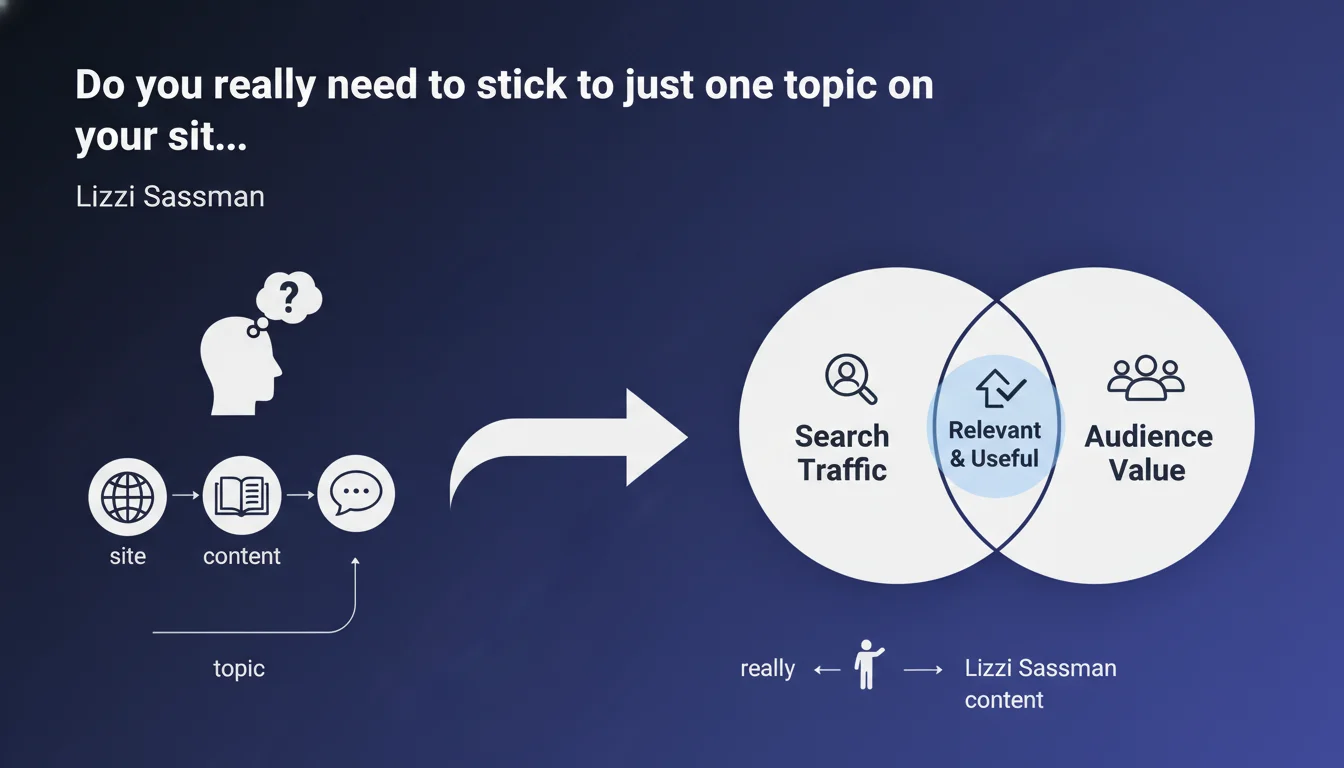
Google confirms that a website can cover multiple topics without penalty, provided these topics are relevant to the target audience. The decisive criterion: would your content be useful to someone visiting your site directly, or are you creating it solely to capture organic traffic? This distinction between real value and opportunistic optimization remains the core principle of quality evaluation.
What you need to understand
Why does Google emphasize audience relevance rather than strict thematic consistency?
For years, SEO dogma insisted that a site focus on an ultra-specific niche to establish its thematic authority. Google nuances this position: what matters is relevance to your actual audience, not artificial thematic consistency.
In practice? A fitness blog can discuss nutrition, sports equipment, muscle recovery, and even mental health — as long as these topics legitimately interest readers who come for fitness content. The question isn't "are these topics in the same Wikipedia category," but "would my audience naturally expect to find this information here?"
How does Google distinguish between legitimate diversification and SEO opportunism?
Sassman's criterion is brutally simple: would you write this content if search traffic didn't exist? If someone typed your URL directly, would they find this topic logical on your site?
This is a reframing of the intrinsic value test — and it's harder to game than it seems. A plumbing site that suddenly publishes 50 articles on cryptocurrencies because it's trending doesn't pass this test. A renovation site that discusses plumbing, electrical work, insulation, and interior design does.
Does this position contradict the concept of thematic authority?
No — it reframes it. Thematic authority remains a factor, but Google now defines it by audience rather than rigid taxonomy. Your authority isn't determined by Wikipedia or academic classification, but by who you are to your visitors.
If you're perceived as a lifestyle reference for young parents, discussing childcare AND family finances AND home improvement isn't dilution — it's a coherent extension of your positioning.
- Thematic diversity is permitted if it serves a defined audience, not if it chases opportunistic keywords
- The decisive test remains: "would someone visiting directly find this content expected here?"
- Thematic authority builds around an audience, not strict semantic categories
- Google seeks to identify content created solely for organic traffic versus content that provides real value
SEO Expert opinion
Is this statement consistent with what we observe in practice?
Yes and no. The best-ranking sites in competitive verticals remain ultra-specialized — think Healthline for health or NerdWallet for finance. Thematic diversity exists for them, but remains firmly anchored within a clear scope.
Conversely, we do see more generalist sites perform well — provided they've built strong editorial identity and loyal audience. The problem? This statement doesn't specify the threshold. At what point does diversity become problematic? [To verify]: Google has never provided a metric or indicator allowing practitioners to objectively measure whether your thematic diversity remains "relevant to your audience."
What risks does this vague directive pose for practitioners?
The danger lies in expansive interpretation. Many will read "you can cover multiple topics" and launch into opportunistic diversification, thinking it suffices to justify each topic with a tenuous link to the audience.
Let's be honest — the criterion "useful to someone visiting directly" is subjective and difficult to operationalize. Who decides this utility? Quality Raters, the algorithm, behavioral traffic? Google doesn't say. And that's where it breaks down: without measurable guardrails, this directive leaves the door open to both abuses and false positives.
In what cases does this rule fail to protect against performance loss?
A site can technically respect this directive — audience-relevant content — yet see its rankings decline. Why? Because thematic competition remains fierce. If you expand into topics where ultra-specialized players already dominate, your generalist authority won't carry weight.
Concrete example: a travel site adding a "personal finances for travelers" section might find it coherent for its audience. But against NerdWallet or Investopedia on finance queries, it has no chance — even if Google doesn't penalize it for creating this content. Audience relevance doesn't equal ranking ability.
Practical impact and recommendations
How do you assess whether thematic diversification is relevant for your site?
Start by asking brutally: if Google disappeared tomorrow, would you publish this content? If the answer is "probably not," you're in opportunistic optimization territory.
Next, test audience coherence. Look at your repeat visitors, email subscribers, social followers — do these people legitimately expect to find this new topic from you? Analyze behavioral data: do users consuming your content A naturally browse content B? If sessions remain siloed, that's a red flag.
What mistakes should you avoid when expanding thematically?
Never create a thematic section in isolation with no navigation links to the rest of your site. That's an obvious red flag that this content exists solely to chase organic traffic. Google spots these disconnected silo structures.
Also avoid sudden, massive diversification. Moving from 100% fitness to 50% fitness / 50% nutrition in three months sends a signal of suspicious editorial pivot. Expansion should be gradual, tested, validated by real engagement before intensification.
- Apply the direct value test: "would someone typing my URL find this topic logical?"
- Analyze behavioral data to identify natural thematic extensions (pages viewed together, user journeys)
- Verify that each new topic has a clear editorial link to your audience positioning
- Avoid isolated thematic sections without interconnection to the rest of your content
- Diversify progressively — abrupt expansion is a red flag for algorithms
- Monitor engagement metrics (time on page, bounce rate, pages per session) on new content
- Don't enter head-to-head competition with ultra-specialized players on their home turf
Thematic expansion is a legitimate strategy — but it demands rigor and editorial consistency. The risk of authority dilution or contradictory signals to algorithms is real.
These strategic decisions — identifying relevant thematic extensions, structuring architecture to preserve coherence, monitoring performance signals — are complex to navigate alone. A specialized SEO agency can support you through this analysis, cross-referencing behavioral data, competitive analysis, and gradual testing to validate each thematic extension without risking your existing authority.
❓ Frequently Asked Questions
Un site e-commerce peut-il avoir un blog traitant de sujets variés sans risque SEO ?
Comment savoir si j'ai dépassé la limite de diversité thématique acceptable ?
Est-ce que créer du contenu pour des requêtes à fort volume hors-sujet est désormais autorisé ?
Les sites d'actualités ou magazines généralistes sont-ils avantagés par cette position ?
Faut-il séparer les sujets différents dans des sous-domaines ou sous-répertoires distincts ?
🎥 From the same video 20
Other SEO insights extracted from this same Google Search Central video · published on 21/10/2022
🎥 Watch the full video on YouTube →
💬 Comments (0)
Be the first to comment.