
Official statement
Other statements from this video 20 ▾
- □ Why can't Google ever guarantee that your users will land on the right language version of your site?
- □ Are automatic redirects really killing your international SEO rankings?
- □ Should you really block JavaScript execution for SPAs with server-side rendering?
- □ Should you really tag foreign words with the lang attribute for SEO purposes?
- □ Does duplicate content really trigger a Google penalty?
- □ Does Google really respect rel=canonical or is it just a suggestion that gets ignored?
- □ Are FAQs in blog articles really worth it for SEO rankings?
- □ Is hreflang really essential for managing a successful international website?
- □ Does Google's web cache actually affect your search rankings?
- □ How does Google really customize search results based on location and language? Here's what actually happens behind the scenes
- □ Does noindex really help you save crawl budget, or is it the wrong tool for the job?
- □ Do you really need to stick to just one topic on your site to rank well?
- □ How many links can you really put on a page without triggering a Google penalty?
- □ Does the referrer URL in Search Console really affect your search rankings?
- □ Does word count really matter for SEO ranking?
- □ Should you worry about reusing the same text blocks across multiple pages?
- □ Does Google really accept machine-translated content on multilingual websites?
- □ Does blocking URLs with robots.txt but leaving them indexed really hurt your SEO?
- □ Can self-hosted reviews display star ratings in Google search results for local businesses?
- □ Why do website mergers produce unpredictable results in Google's eyes?
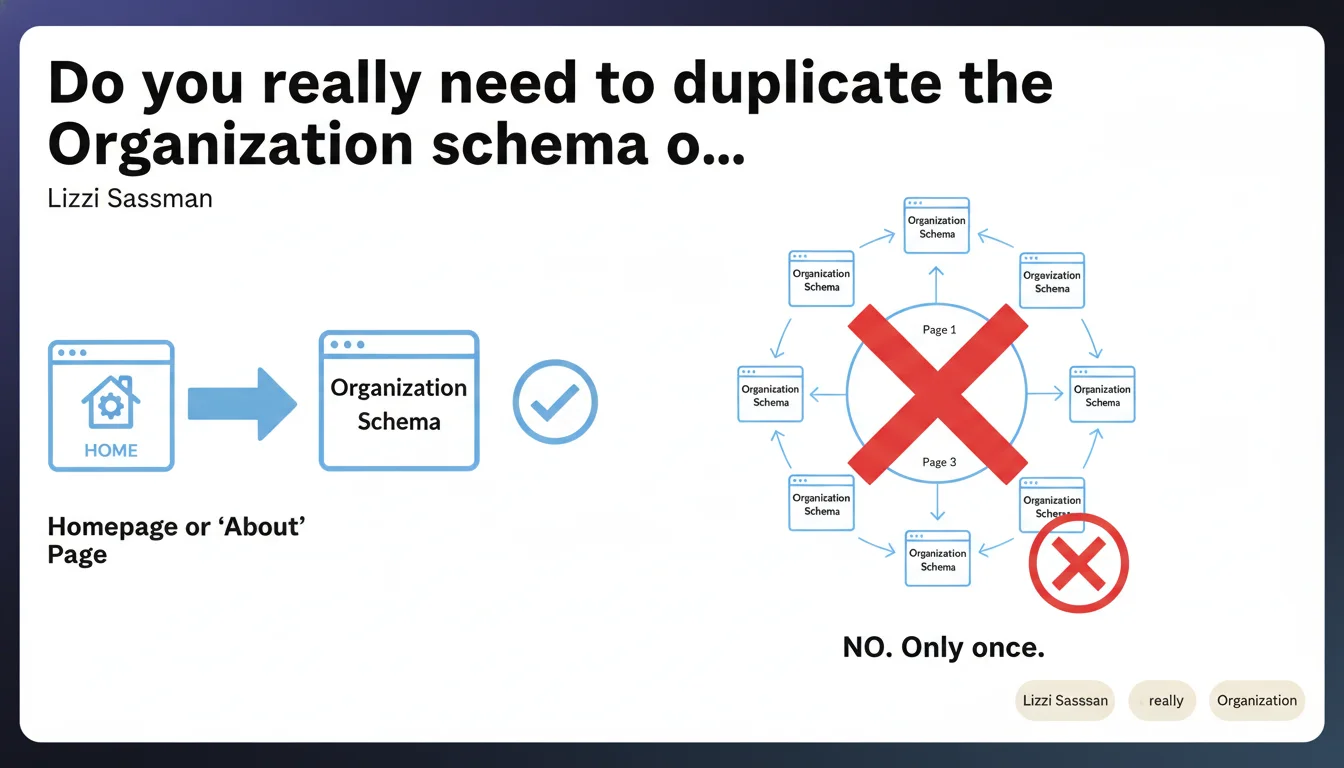
Google confirms that schema.org markup of type Organization should appear only once on a site, typically on the homepage or About page. Duplicating this markup on every page brings no benefit and even creates confusion for search engines. A welcome clarification that puts an end to a widespread but pointless practice.
What you need to understand
Why this Google clarification on Organization schema?
The Organization schema serves to identify the entity behind a website: name, logo, contact details, social profiles. The goal is to allow Google to understand who publishes the content and create a coherent Knowledge Graph.
Some websites add this markup on every page, thinking it will strengthen authority signals or improve brand recognition. This practice often stems from confusion with other types of schema (such as Article or Product) which must be present on every relevant page.
What is the technical logic behind this recommendation?
Google crawls and indexes pages, but for Organization-type structured data, it seeks to establish a unique identity per domain. Multiplying the same markup creates noise: the bot must then determine which occurrence is the reference, which can generate inconsistencies if the data varies slightly.
By limiting it to a single instance, processing is simplified and the risk of extraction errors is reduced. The homepage or About page are logical locations because they naturally represent the entity as a whole.
What are the concrete risks of excessive duplication?
Duplicating the Organization schema won't trigger a manual penalty, let's be clear. But it can create ambiguities in Search Console: multiple warnings for the same markup type, properties that contradict each other across pages, or outdated data that persists.
More troublesome: if you update your logo or contact details and forget to do it everywhere, Google can index an outdated version. This is the kind of friction that pollutes your reports and complicates diagnosis when you're trying to solve a real problem.
- A single instance of the Organization schema per site is sufficient
- Favor the homepage or About page as the location
- Other types of schema (Article, Product, FAQ, etc.) remain to be implemented page by page
- Avoid duplications that create noise in Search Console reports
- Don't confuse with WebSite schema, which also goes on the homepage only once
SEO Expert opinion
Is this statement consistent with real-world observations?
Yes, absolutely. Audits of sites showing Organization schema duplicated across hundreds of pages have never revealed measurable benefit. Worse: some sites with slightly different markup variants (changed URL in sameAs, different logo) end up with fragmented data in the Knowledge Panel.
Google has always favored consistency and simplicity for structured data. This clarification aligns with other recommendations: limit markup to what's strictly useful and avoid over-optimization.
What nuances should be applied to this rule?
First point: this rule applies to a single domain. If you manage a network of distinct sites (for example subsidiaries with their own domains), each site must have its own Organization schema — but only once per domain.
Second nuance: on a multi-entity site (for example a directory or portal listing multiple organizations), you can legitimately use Organization schema for each listed entity, but then each markup must describe a different organization, not yours in a loop.
Third point, often overlooked: Organization schema and WebSite schema are two distinct things. WebSite describes the site as a technical object (name, internal search URL), Organization describes the entity that publishes it. Both can coexist on the homepage without issue.
In what cases could this recommendation be circumvented?
Honestly? I can't think of any legitimate case. Some might argue that on a site with multiple brands, each section could have its own Organization schema. But in that case, you need to create distinct subdomains or at minimum clear dedicated pages, not scatter the markup everywhere.
If you're in doubt, ask yourself this question: "Does each page represent a different organization?" If the answer is no, a single instance is enough. [To verify] if you're in a merger/acquisition situation with multiple entities on the same domain — there, the situation warrants case-by-case examination.
Practical impact and recommendations
What should you do concretely to comply with this recommendation?
First step: identify where your Organization schema currently resides. Run a crawl with Screaming Frog or Sitebulb with structured data extraction enabled. Filter on Organization type and list all affected URLs.
If the markup is present on multiple pages, consolidate it on a single one: the homepage is the most logical choice, unless your About page is truly the reference (case of institutional or non-profit sites). Make sure this unique instance contains all relevant properties: name, url, logo, sameAs (social networks), contactPoint if relevant.
Then remove redundant occurrences on other pages. If your CMS automatically injects the schema via a plugin or template, modify the logic so it only loads on the target page. Verify with Google's Rich Results Test that the markup is valid.
What errors should you avoid when becoming compliant?
Don't brutally delete all instances without checking that the final version is complete and up to date. If your old occurrences contained different properties (for example a specific contactPoint for support), make sure to integrate them into the unique version.
Also avoid confusing Organization schema with LocalBusiness schema. If you have multiple physical locations, each can have its own LocalBusiness on its dedicated page — but the overall Organization remains unique.
Last frequent error: forgetting to update the JSON-LD file after a rebrand. If you change your logo, name, or social profiles, make the change once in the right place, not across 500 pages.
How can you verify that your site is compliant and optimized?
Use Search Console, Enhancements > Structured Data section. If you see warnings or errors related to Organization schema across many pages, that's a signal you probably have duplications.
Also test your homepage with the Schema Markup Validator or Rich Results Test. Check that your brand's Knowledge Panel (if you have one) displays the correct information: logo, social networks, description.
- Crawl the site to identify all pages containing Organization schema
- Consolidate markup on the homepage or About page only
- Remove redundant instances from other pages
- Verify that the unique version contains all relevant properties (name, url, logo, sameAs, contactPoint)
- Test markup validity with the Rich Results Test
- Check Search Console to eliminate warnings related to duplications
- Document the schema location to prevent regressions during future updates
This Google clarification greatly simplifies managing structured data for brand identity. A single well-placed, well-filled instance, and you're good. That said, becoming compliant can be tricky if your site relies on complex CMS architecture or if you manage multiple entities. If you lack time or technical resources, calling in an SEO-specialized agency can help you avoid costly mistakes and guarantee clean, documented, sustainable implementation.
❓ Frequently Asked Questions
Le schema Organisation doit-il être en JSON-LD ou peut-il être en microdata ?
Si j'ai plusieurs marques sur le même domaine, dois-je créer plusieurs schemas Organisation ?
Dois-je mettre à jour mon schema Organisation à chaque changement de logo ou d'adresse ?
Le schema WebSite et le schema Organisation peuvent-ils coexister sur la même page ?
Est-ce que supprimer les duplications du schema Organisation va améliorer mon classement ?
🎥 From the same video 20
Other SEO insights extracted from this same Google Search Central video · published on 21/10/2022
🎥 Watch the full video on YouTube →
💬 Comments (0)
Be the first to comment.