
Official statement
Other statements from this video 14 ▾
- □ Should you switch domains when cutting your catalog, or is keeping your existing one the smarter move?
- □ Can backlinks to a 404 page really be recovered, or are they permanently lost?
- □ Can you really have millions of 301 redirects without hurting your SEO?
- □ Should you really ignore 404 errors in Google Search Console?
- □ Do you really need to add paginated pages to your XML sitemap?
- □ Can Google really crawl links in dropdown menus on hover?
- □ How many redirects can you really have on a site without triggering an SEO penalty?
- □ Do you really need to align URL, title, and H1 to rank in SEO?
- □ Can blocking a redirect page with robots.txt really stop PageRank from passing through?
- □ Do multiple hyphens in your domain name actually hurt your SEO rankings?
- □ Do you really need to publish content every day to rank well on Google?
- □ Should you really stop using text in images for SEO?
- □ Does Google really limit deindexing to just two methods, or are there hidden alternatives?
- □ Do Core Web Vitals really override relevance in Google rankings?
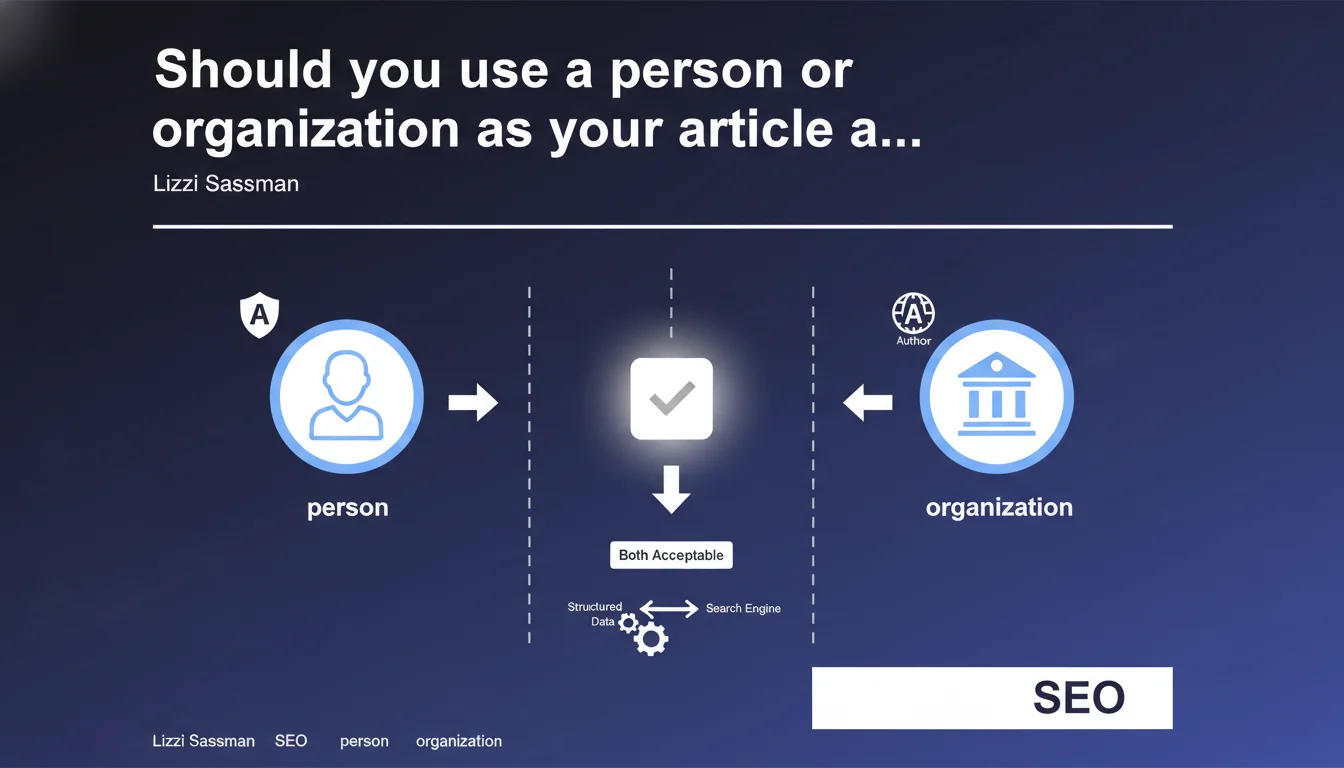
Google states there is no difference between declaring an organization or a person as the author in structured markup. Both options are technically acceptable. The question remains whether this stated neutrality aligns with the E-E-A-T signals that Google actually values in search results.
What you need to understand
Why is Google clarifying this equivalence now?
This clarification from Lizzi Sassman comes at a time when E-E-A-T guidelines (Experience, Expertise, Authoritativeness, Trustworthiness) are at the heart of SEO concerns. Many practitioners wonder whether identifying an individual author strengthens trust signals or not.
Google's official position is straightforward: the search engine technically accepts both formats in Schema.org structured markup. Whether you specify a Person or an Organization in the author property, it's valid. No penalty, no bonus.
What does this actually mean for crawling and indexing?
From a technical standpoint, GoogleBot treats both entity types the same way. JSON-LD or microdata that declares an author — whether it's a named person or a brand — will be understood and processed without issue.
This doesn't mean Google values these two options identically in its ranking algorithm. Technical acceptance doesn't imply semantic equivalence or equal weighting in quality criteria.
- Both formats (Person / Organization) are technically valid in Schema.org markup
- No penalty is applied if you choose one over the other
- Google can interpret and display this information in rich snippets
- This declaration doesn't guarantee that both options carry the same algorithmic weight for ranking purposes
Does this change the E-E-A-T recommendations?
Not really. Google's quality guidelines emphasize transparency and clear identification of who produces the content. Saying that an organization or a person are "equivalent" at the markup level doesn't resolve the fundamental question: who is legitimately qualified to speak about this topic?
For YMYL content (health, finance, legal), an identified author with verifiable credentials remains often more reassuring — and likely better perceived by the algorithm — than a generic corporate mention.
SEO Expert opinion
Is this statement consistent with what we observe in practice?
Technically, yes. Nobody has ever reported indexing failures or refusals because a site used Organization instead of Person. The markup is interpreted without issue.
But — and this is where it gets tricky — the absence of technical penalties doesn't mean the absence of algorithmic differentiation. On competitive queries, particularly in YMYL categories, content signed by identifiable experts tends to perform better. Coincidence? Unlikely.
What nuances should we apply to this statement?
Google isn't saying the two options produce the same ranking effects. The equivalence refers to markup validity, not SEO impact. A critical distinction.
A medical blog article signed "XYZ Editorial Team" versus one signed "Dr. Martin Dupont, Cardiologist" — both with valid markup — don't send the same credibility and authority signals. Google can perfectly accept both while favoring the latter in its search results.
[To verify] : it would be worthwhile to test at scale whether attribution to a person with consistent online presence (social profiles, Knowledge Graph) generates measurable differences in CTR or average positioning. Public data on this specific point is lacking.
In which cases does this rule not really apply?
Let's be honest: for an e-commerce site publishing generic product descriptions, nobody expects to see an identified author. The organization makes perfect sense. Same for institutional corporate pages.
Conversely, for high-value editorial content — analyses, expert guides, medical opinions — attribution to a person remains an expected trust standard. Google can claim it's "acceptable" both ways, but the Quality Raters Guidelines explicitly value transparency about who writes.
Practical impact and recommendations
What should you do concretely on your site?
If you're publishing expert content (advice, analysis, opinions), prioritize attribution to a real person with a bio, verifiable credentials, and consistent digital presence. Use Schema.org Person markup with a URL pointing to a detailed author profile.
For corporate, institutional, or purely factual content (announcements, press releases, product descriptions), Organization is entirely appropriate. No need to force individual signatures if they add nothing.
What mistakes should you absolutely avoid?
Don't create fake authors or phantom profiles just to check the "identified person" box. Google and users quickly detect stock photos and hollow bios. Better to embrace organization attribution than invent a fictional expert.
Also avoid inconsistency: if you declare an author in the markup but no mention appears visually on the page, or the bio is missing, you're sending contradictory signals. The markup should reflect what the user sees.
How do you verify that your implementation is correct?
- Test your pages in Google's Rich Results Test to validate Schema.org markup
- Verify that author information (Person or Organization) is consistent between the markup and visible HTML display
- Ensure that author profiles (if Person) have a dedicated page with bio, credentials, and social links
- Audit your YMYL content to identify which pieces would benefit from an expert signature rather than corporate attribution
- Monitor changes in CTR and positioning after adding or modifying author attribution
❓ Frequently Asked Questions
Dois-je obligatoirement renseigner un auteur dans le balisage structuré ?
Puis-je utiliser Organization comme auteur pour tous mes articles de blog ?
Que se passe-t-il si je change l'auteur de Organization à Person sur mes pages existantes ?
Est-ce que déclarer un auteur Person améliore forcément mon positionnement ?
Peut-on combiner Organization et Person dans le même balisage auteur ?
🎥 From the same video 14
Other SEO insights extracted from this same Google Search Central video · published on 29/12/2022
🎥 Watch the full video on YouTube →
💬 Comments (0)
Be the first to comment.