
Official statement
Other statements from this video 14 ▾
- □ Faut-il changer de domaine lors d'une réduction de catalogue ou conserver l'existant ?
- □ Les backlinks vers une page 404 sont-ils définitivement perdus ou récupérables ?
- □ Peut-on vraiment avoir des millions de redirections 301 sans impacter son SEO ?
- □ Faut-il vraiment ignorer les erreurs 404 dans Google Search Console ?
- □ Faut-il vraiment ajouter les pages paginées dans le sitemap XML ?
- □ Google crawle-t-il vraiment les liens dans les menus déroulants au survol ?
- □ Combien de redirections peut-on vraiment mettre sur un site sans pénalité SEO ?
- □ Faut-il privilégier une personne ou une organisation comme auteur d'un article pour le SEO ?
- □ Faut-il vraiment aligner URL, title et H1 pour ranker en SEO ?
- □ Bloquer une page de redirection par robots.txt peut-il vraiment empêcher le passage du PageRank ?
- □ Les tirets multiples dans un nom de domaine pénalisent-ils votre SEO ?
- □ Faut-il vraiment abandonner le texte dans les images pour le SEO ?
- □ Désindexer des URLs : Google limite-t-il vraiment les options à deux méthodes ?
- □ Les Core Web Vitals écrasent-ils vraiment la pertinence dans le classement Google ?
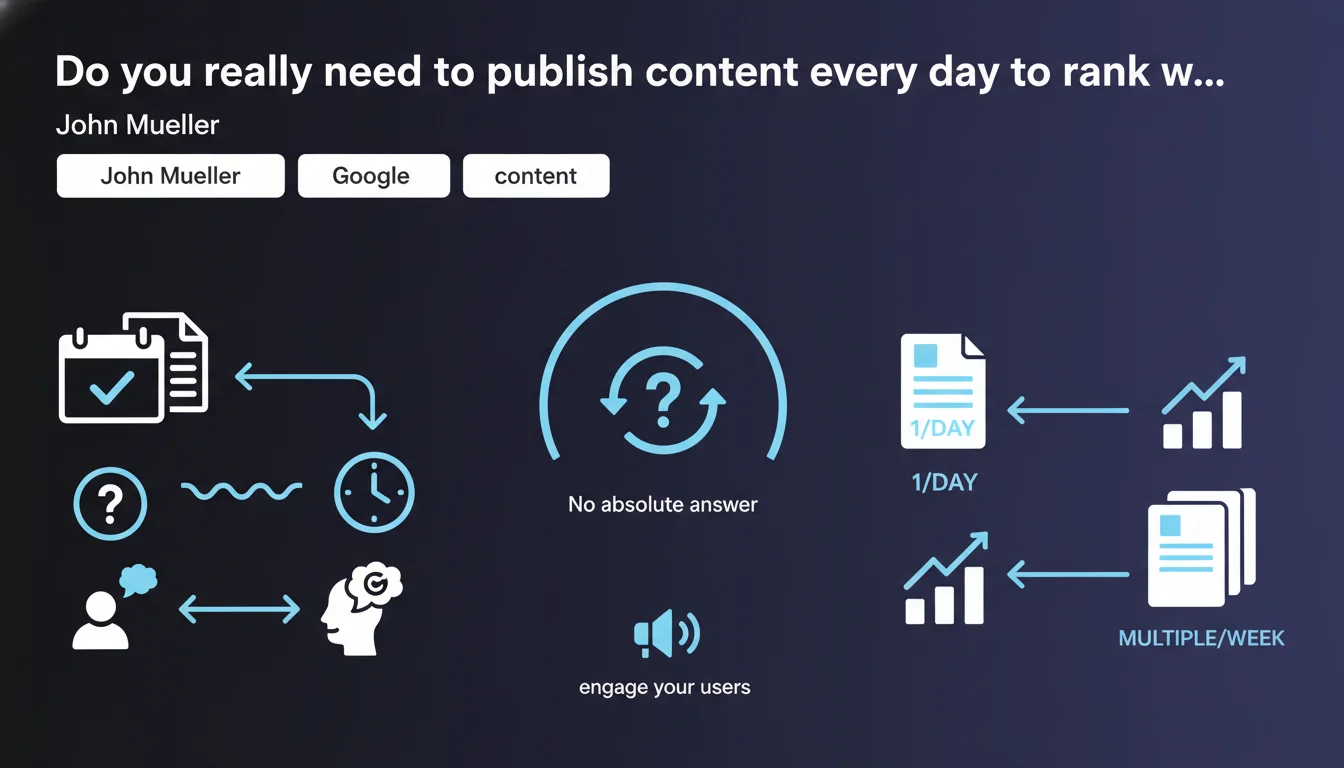
Google states that there is no ideal publication frequency for SEO. Publishing one article per day or several per week depends primarily on your user engagement strategy, not on a quota imposed by the algorithm. Quality and relevance take priority over raw volume.
What you need to understand
Why does Google refuse to give a precise number?
Mueller deliberately avoids setting a universal rhythm because Google's algorithms don't count publications as an isolated KPI. What matters is how content responds to search intent and generates engagement.
A site publishing mediocre content daily will never outrank a competitor publishing exhaustive, relevant content once a week. Frequency becomes a secondary lever—a side effect, not a direct cause of ranking.
Does this statement mean freshness doesn't matter?
Not at all. Freshness remains a documented ranking signal, particularly for QDF queries (Query Deserves Freshness) like news, trends, or technology products.
What Mueller is saying is that publishing for the sake of publishing—without strategic consideration—triggers no algorithmic bonus. If your niche doesn't require frequent updates (e.g., residential plumbing), forcing a daily rhythm won't help.
How should you interpret "engaging your users" in this context?
Google is shifting the focus here: editorial decisions must be dictated by your audience, not by the algorithm. If your users expect daily content (media, finance, sports), then publish daily. Otherwise, focus on depth.
- No magic quota: no frequency guarantees better crawling or indexation
- Freshness remains contextual: it primarily applies to time-sensitive queries
- User engagement comes first: session duration, return rate, and shares matter more than publication volume
- Editorial consistency: a sustainable, regular rhythm beats a sprint followed by radio silence
SEO Expert opinion
Is this statement consistent with real-world observations?
Yes and no. In competitive niches, publishing frequently creates a measurable indirect advantage: more content = more entry points = more long-tail captured = more topical authority built. Sites publishing regularly statistically have more pages in the top 10.
But correlation isn't causation. What matters is that these sites also heavily invest in quality, internal linking, and semantic depth. [To verify]: it's difficult to separate what comes from pure volume versus overall investment in the content ecosystem.
When does this rule absolutely not apply?
In three specific cases, frequency becomes critical despite Mueller's statement.
First case: news sites and media. Google News and Discover explicitly reward freshness and publication pace. A media outlet publishing twice a week will never get the visibility of a competitor publishing ten times a day—even with equivalent quality.
Second case: the battle for topical authority. Comprehensively covering a topic requires volume. If a competitor has 200 articles on Python and you have 20, they'll structurally dominate the SERPs even if your 20 articles are excellent.
Third case: newly launched sites. A new site must reach critical mass in content to trigger regular crawling and build a ranking surface. Publishing once a month mechanically delays this bootstrap phase.
Should you ignore publication frequency in your SEO strategy?
No. You need to calibrate it intelligently. Frequency is a results accelerator, not an absolute prerequisite. If you publish mediocre content daily, you'll lose. If you publish exceptional content once a quarter, you'll progress slowly.
The sweet spot? Find the maximum sustainable rhythm that maintains high quality standards. For some, that's one article per day. For others, one per week. The mistake would be setting this rhythm arbitrarily without considering your resources and capacity to deliver depth.
Practical impact and recommendations
How do you determine the optimal publication frequency for your site?
Start by analyzing your audience's expectations and your market dynamics. A B2B site selling complex SaaS solutions faces different constraints than a lifestyle blog or a tech media outlet.
Audit your direct competitors in the SERPs: what's their cadence? How many indexed pages do they have? Is their topical coverage exhaustive or incomplete? If you're structurally behind on volume, you'll need to accelerate temporarily to close the gap.
Next, evaluate your internal resources. Two exceptional articles per month beat ten hastily written ones. Consistency beats intensity: a regular rhythm (even modest) always outperforms a sprint followed by three months of silence.
What errors should you absolutely avoid regarding publication frequency?
Error #1: publishing to fill an editorial calendar. If you have nothing substantial to say, don't publish. Google detects thin content and low-value pages—they dilute your overall authority.
Error #2: neglecting updates to existing content in favor of new pieces. Refreshing and deepening a high-performing article that's two years old is often more profitable than publishing a new one on an adjacent topic.
Error #3: ignoring engagement signals. If your new articles generate high bounce rates and zero shares, the problem isn't frequency—it's relevance or quality.
What should you actually implement?
- Define a sustainable publication rhythm based on your resources (writing, validation, technical optimization)
- Prioritize depth over volume: one exhaustive 3000-word guide beats five superficial 600-word articles
- Set up an update schedule to refresh existing content every 6-12 months based on performance
- Monitor engagement metrics (time on page, scroll depth, return rate) to validate that your chosen rhythm resonates with the audience
- Adjust frequency based on seasonal peaks or industry events (e.g., e-commerce before Black Friday)
- Build a topical authority strategy: identify thematic clusters to cover exhaustively before expanding
- Never sacrifice editorial quality and technical optimization (heading structure, internal linking, schema markup) for volume
Publication frequency is not a direct SEO lever, but a strategic parameter to calibrate based on your market, resources, and objectives. Volume without quality leads nowhere—and quality without sufficient thematic coverage leaves you vulnerable to more comprehensive competitors.
Find your optimal rhythm, maintain it consistently, and adjust based on observed performance. Orchestrating this balance between volume, quality, updates, and topical coverage requires expertise and constant monitoring. If you lack clarity on these trade-offs or have limited internal resources, partnering with a specialized SEO agency can help you structure a high-performing and sustainable editorial strategy over time.
❓ Frequently Asked Questions
Publier tous les jours améliore-t-il le crawl de Googlebot ?
Un site avec 500 articles bat-il toujours un site avec 50 articles ?
Dois-je privilégier la création de nouveaux articles ou la mise à jour des anciens ?
La fréquence de publication joue-t-elle différemment selon les secteurs ?
Comment mesurer si ma fréquence de publication est adaptée ?
🎥 From the same video 14
Other SEO insights extracted from this same Google Search Central video · published on 29/12/2022
🎥 Watch the full video on YouTube →
💬 Comments (0)
Be the first to comment.