
Official statement
Other statements from this video 14 ▾
- □ Faut-il changer de domaine lors d'une réduction de catalogue ou conserver l'existant ?
- □ Les backlinks vers une page 404 sont-ils définitivement perdus ou récupérables ?
- □ Peut-on vraiment avoir des millions de redirections 301 sans impacter son SEO ?
- □ Faut-il vraiment ignorer les erreurs 404 dans Google Search Console ?
- □ Faut-il vraiment ajouter les pages paginées dans le sitemap XML ?
- □ Google crawle-t-il vraiment les liens dans les menus déroulants au survol ?
- □ Combien de redirections peut-on vraiment mettre sur un site sans pénalité SEO ?
- □ Faut-il privilégier une personne ou une organisation comme auteur d'un article pour le SEO ?
- □ Bloquer une page de redirection par robots.txt peut-il vraiment empêcher le passage du PageRank ?
- □ Les tirets multiples dans un nom de domaine pénalisent-ils votre SEO ?
- □ Faut-il publier du contenu tous les jours pour bien ranker sur Google ?
- □ Faut-il vraiment abandonner le texte dans les images pour le SEO ?
- □ Désindexer des URLs : Google limite-t-il vraiment les options à deux méthodes ?
- □ Les Core Web Vitals écrasent-ils vraiment la pertinence dans le classement Google ?
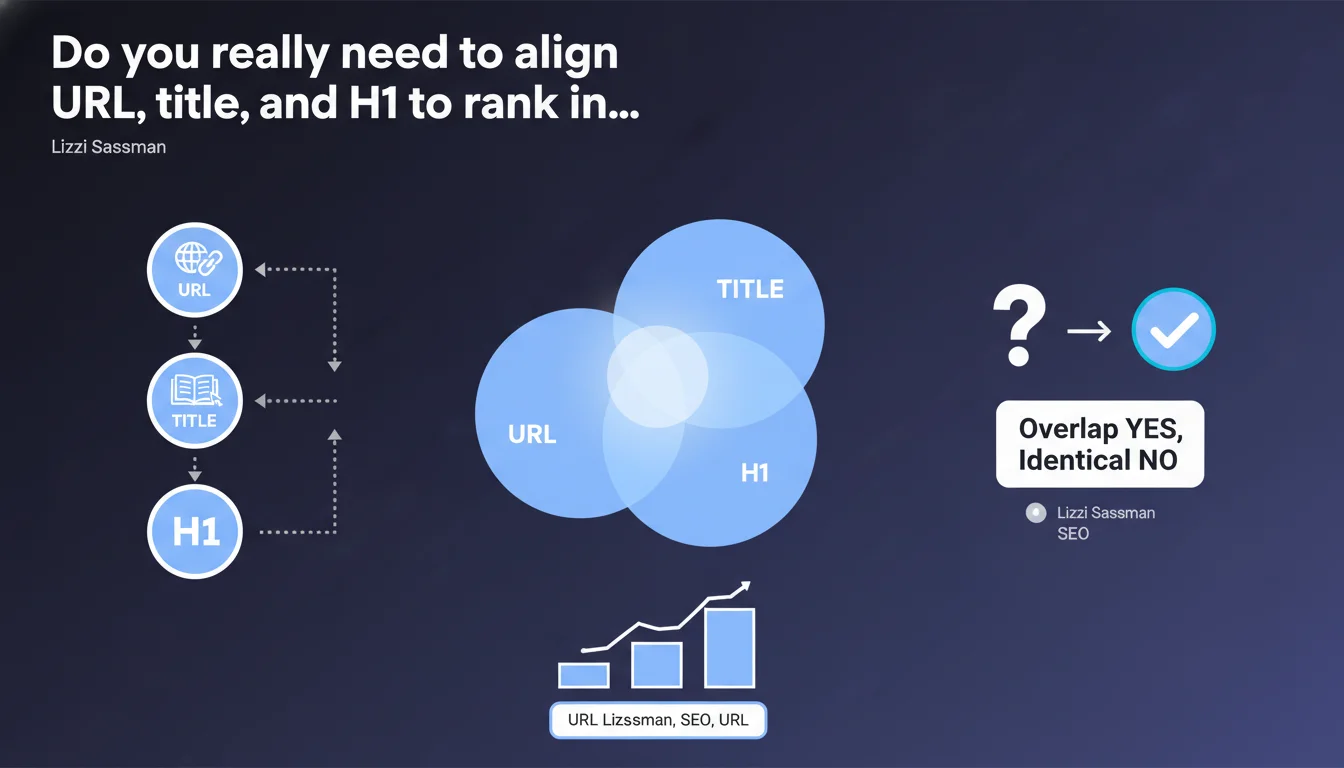
Google confirms that URL, page title, and H1 tag don't need to be identical. Semantic overlap is sufficient; word-for-word matching is unnecessary. This clarification unravels a persistent belief among some practitioners who stubbornly force strict coherence when Google is really looking for contextual relevance above all.
What you need to understand
Why does this statement shatter a long-standing misconception?
For years, the obsession with matching URL, title, and H1 word-for-word was sold as an unmissable SEO "best practice." Some consultants even turned it into an on-page quality metric.
Google sets the record straight: this strict matching has never been a ranking factor. What matters is semantic coherence, not the robotic duplication of identical terms across three different locations.
What does Google mean by "overlap"?
The term is deliberately vague. Overlap means that your primary keywords and semantic field should be reflected across these three elements, but not necessarily in the same order or with the exact same wording.
In practice? A URL like /seo-image-optimization, a title "How to optimize your images for SEO," and an H1 "Image optimization: the complete SEO guide" work perfectly together — without word-for-word matching.
In what contexts should you still pay attention to alignment?
Strict alignment makes sense in very specific contexts: brand, factual accuracy (product pages, technical sheets), or when user navigation demands immediate visual coherence between displayed URL and content.
But even then, Google will never penalize you for variation if it improves experience or clarity. The engine seeks to understand intent, not to play the role of lexical duplication detector.
- Word-for-word alignment is not a ranking factor
- Google prioritizes semantic and contextual coherence
- Overlap of primary keywords is more than sufficient
- Variation can even improve UX and readability
- The obsession with strict identity is a waste of time
SEO Expert opinion
Is this statement consistent with what we observe in real-world practice?
Absolutely. Audits of first-page ranking sites have long shown that URL, title, and H1 frequently diverge — and this doesn't prevent rankings at all if overall relevance is solid.
Sites clinging to strict matching often do so out of cargo cult thinking, not because A/B tests have proven measurable gains. Google is simply confirming what experienced practitioners already know.
What nuances should you add to this rule?
Caution — this is not a free pass to throw anything together. If your URL talks about "running shoes" and your H1 discusses "nutrition tips," Google will struggle to understand your page's intent. The overlap must remain semantically logical.
Moreover, in ultra-competitive sectors (finance, health, high-stakes e-commerce), reinforced coherence can serve as a signal of editorial quality — not for Google, but for users quickly scanning the SERP. [To verify]: no official data proves that Google assigns specific weight to this coherence in E-E-A-T-sensitive niches, but the indirect UX effect may play a role.
In what cases could this rule create problems?
If you manage a multilingual site or complex structure with inherited canonical URLs from an old information architecture, forcing strict matching can become an unnecessary technical headache. Google tells you: relax, focus on relevance.
On the other hand, if your CMS automatically generates H1s from titles and you let it slide without editorial control, you risk inconsistencies that hurt UX — and Google will eventually catch that through behavioral signals.
Practical impact and recommendations
What should you do concretely right now?
Stop wasting time forcing exact matching between URL, title, and H1. Instead, focus on clarity of intent and semantic richness of each element.
Use the URL for structure and navigation (short, readable), the title to capture attention in SERPs (CTR-optimized), and the H1 to provide immediate context to the reader once on the page. They can — and often should — diverge to fulfill their respective roles.
What mistakes should you avoid at all costs?
Don't fall into the opposite trap by creating major semantic inconsistencies. If your URL says "bike-buying-guide," your title talks about "electric scooters," and your H1 discusses "vintage motorcycles," Google will struggle — and so will your user.
Another pitfall: letting your CMS automatically generate H1s identical to the title out of laziness. Even if Google tolerates it, you're missing an opportunity to enrich the semantic field and improve user experience.
How can you verify your site aligns with this logic?
- Audit a sample of your strategic pages: do URL, title, and H1 share a common semantic core?
- Verify that each element fulfills its role: URL = structure, title = SERP hook, H1 = page context
- Identify pages where URL/title/H1 are strictly identical — test variations to improve CTR and engagement
- Remove internal processes that force word-for-word matching without UX justification
- Prioritize semantic coherence over lexical duplication
❓ Frequently Asked Questions
Google pénalise-t-il si URL, title et H1 sont strictement identiques ?
Quel niveau de chevauchement est recommandé entre ces trois éléments ?
Puis-je avoir un H1 complètement différent de mon title sans risque ?
Cette règle s'applique-t-elle aussi aux pages e-commerce avec des noms de produits standardisés ?
Faut-il modifier mes pages existantes qui ont URL/title/H1 identiques ?
🎥 From the same video 14
Other SEO insights extracted from this same Google Search Central video · published on 29/12/2022
🎥 Watch the full video on YouTube →
💬 Comments (0)
Be the first to comment.