
Official statement
Other statements from this video 14 ▾
- □ Should you switch domains when cutting your catalog, or is keeping your existing one the smarter move?
- □ Can backlinks to a 404 page really be recovered, or are they permanently lost?
- □ Can you really have millions of 301 redirects without hurting your SEO?
- □ Should you really ignore 404 errors in Google Search Console?
- □ Do you really need to add paginated pages to your XML sitemap?
- □ Can Google really crawl links in dropdown menus on hover?
- □ How many redirects can you really have on a site without triggering an SEO penalty?
- □ Should you use a person or organization as your article author for SEO purposes?
- □ Do you really need to align URL, title, and H1 to rank in SEO?
- □ Can blocking a redirect page with robots.txt really stop PageRank from passing through?
- □ Do multiple hyphens in your domain name actually hurt your SEO rankings?
- □ Do you really need to publish content every day to rank well on Google?
- □ Should you really stop using text in images for SEO?
- □ Does Google really limit deindexing to just two methods, or are there hidden alternatives?
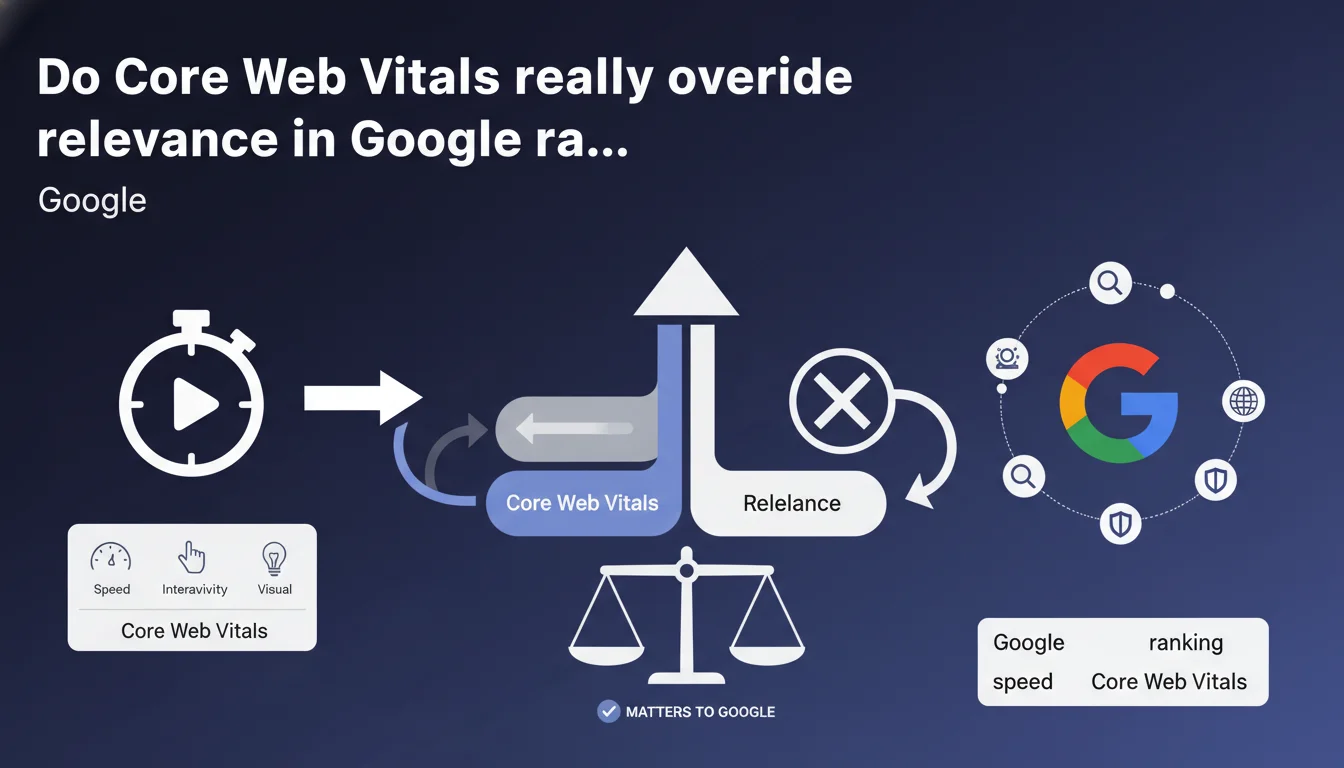
Google confirms that Core Web Vitals are part of the Page Experience factor, but do not supersede content relevance. Speed and user experience matter, without being decisive against highly relevant content. It's a signal among others — neither negligible nor absolute priority.
What you need to understand
What exactly does "does not override relevance" mean?
Google clearly indicates a hierarchy of ranking factors. If your page perfectly matches search intent with rich, relevant content, mediocre Core Web Vitals won't send you plummeting to the bottom of results.
Conversely, an ultra-fast site with thin content won't miraculously climb to the first page. Relevance remains the foundation — Core Web Vitals act more as a differentiator between content of equivalent quality.
Why does Google measure these metrics for "most" sites?
This deliberately vague phrasing hides a technical reality: Google cannot measure Core Web Vitals for every site, particularly those with low traffic or insufficient CrUX data. Small sites or rarely visited pages partially escape this evaluation.
This also means Google likely uses estimation methods or lab data to supplement missing field data. But the algorithm cannot base itself on metrics that are absent.
What is the real weight of Page Experience in rankings?
Google remains deliberately vague on this point. What we know: it's a tie-breaker between equivalent pages. Two pieces of content of equal quality? The one with better Core Web Vitals gains the advantage.
In practical field experience, the impact is marginal but measurable — typically a few positions, rarely a complete upheaval. Cases of spectacular gains often concern sites that accumulated multiple major technical problems.
- Content relevance always trumps technical performance
- Core Web Vitals serve as a tie-breaker between close competitors
- Google can only measure these metrics for sites with sufficient real user data
- Page Experience = composite signal including speed, HTTPS, mobile-friendly, intrusive interstitials
- SEO impact remains moderate but not negligible in competitive sectors
SEO Expert opinion
Is this statement consistent with field observations?
Yes, largely. A/B tests and correlation studies consistently show that fixing only Core Web Vitals is never enough to overcome a content or authority deficit. I've seen sites turn green on all indicators without gaining a single position — because the problem was elsewhere.
Conversely, on ultra-competitive queries where 5-6 sites battle for top positions with similar content, user experience becomes the deciding criterion. In e-commerce particularly, an LCP of 1.8s versus 3.2s can make the difference between position 3 and position 7.
What nuances should be added to this official communication?
Google speaks of "Page Experience" as a single factor, but it's actually an aggregate of multiple signals whose individual weight remains opaque. A site can have excellent Core Web Vitals but fail on mobile compatibility or intrusive interstitials — and vice versa.
Another rarely mentioned point: sector variance.
In what cases doesn't this rule really apply?
On queries with strong YMYL components (health, finance, legal), relevance and authority override everything. A reference medical site with mediocre Core Web Vitals will keep its positions against a faster but less credible competitor.
Same applies to niche sites with minimal competition: if you're alone addressing a specific topic, your technical metrics matter little. Google will rank you for lack of alternative. [To be verified]: the real impact on featured snippets and position zero remains debated — some tests suggest greater weight, others do not.
Practical impact and recommendations
What should be prioritized concretely in your SEO strategy?
Let's be direct: if your content is weak or your authority insufficient, optimizing Core Web Vitals is premature. Simple rule — invest first in editorial quality, coherent internal linking, and quality backlinks.
Once these foundations are solid, Core Web Vitals become relevant. Focus on LCP (Largest Contentful Paint) as priority — it's the metric that correlates best with actual bounce rate and conversions. A fast server, optimized images in WebP, a CDN: 80% of the problem solved.
What mistakes should be avoided when optimizing Page Experience?
Never sacrifice functionality for speed. I've seen sites remove all analytics or A/B testing scripts to shave 0.2s off LCP — only to lose tracking and optimization capability. ROI must remain positive.
Another common trap: focusing on lab data (Lighthouse, PageSpeed Insights) while ignoring CrUX field data. Google doesn't rank your site based on what a lab tool measures, but on real user experience from Chrome. If your visitors mostly have slow connections or old hardware, your real scores will inevitably be lower.
How to measure real impact on organic traffic?
Isolate variables. If you simultaneously deploy content overhaul, technical migration, AND Core Web Vitals optimization, it's impossible to attribute gains. Proceed in testable phases, ideally with control groups.
Monitor business metrics, not just rankings. A gain of 2 average positions translating to +15% conversions beats 5 position gains with no commercial impact. Core Web Vitals often improve conversion rate more than raw traffic.
- Audit relevance and authority first before investing heavily in technology
- Prioritize LCP, then CLS, then INP (which replaces FID)
- Measure with CrUX (Chrome User Experience Report), not just Lighthouse
- Optimize images: modern format (WebP/AVIF), lazy loading, adapted dimensions
- Implement a performant CDN if your audience is geographically dispersed
- Reduce unnecessary JavaScript, defer what isn't critical above the fold
- Test impact on page cohorts before global deployment
- Monitor correlations between Core Web Vitals improvement and conversion rate
❓ Frequently Asked Questions
Un site avec d'excellents Core Web Vitals mais un contenu moyen peut-il surpasser un concurrent avec un contenu riche mais lent ?
Comment Google mesure-t-il les Core Web Vitals pour mon site ?
Les Core Web Vitals ont-ils le même poids dans tous les secteurs ?
Faut-il viser le vert sur tous les Core Web Vitals pour voir un impact SEO ?
Les données lab (Lighthouse, PageSpeed Insights) sont-elles fiables pour optimiser mon SEO ?
🎥 From the same video 14
Other SEO insights extracted from this same Google Search Central video · published on 29/12/2022
🎥 Watch the full video on YouTube →
💬 Comments (0)
Be the first to comment.