
Official statement
What you need to understand
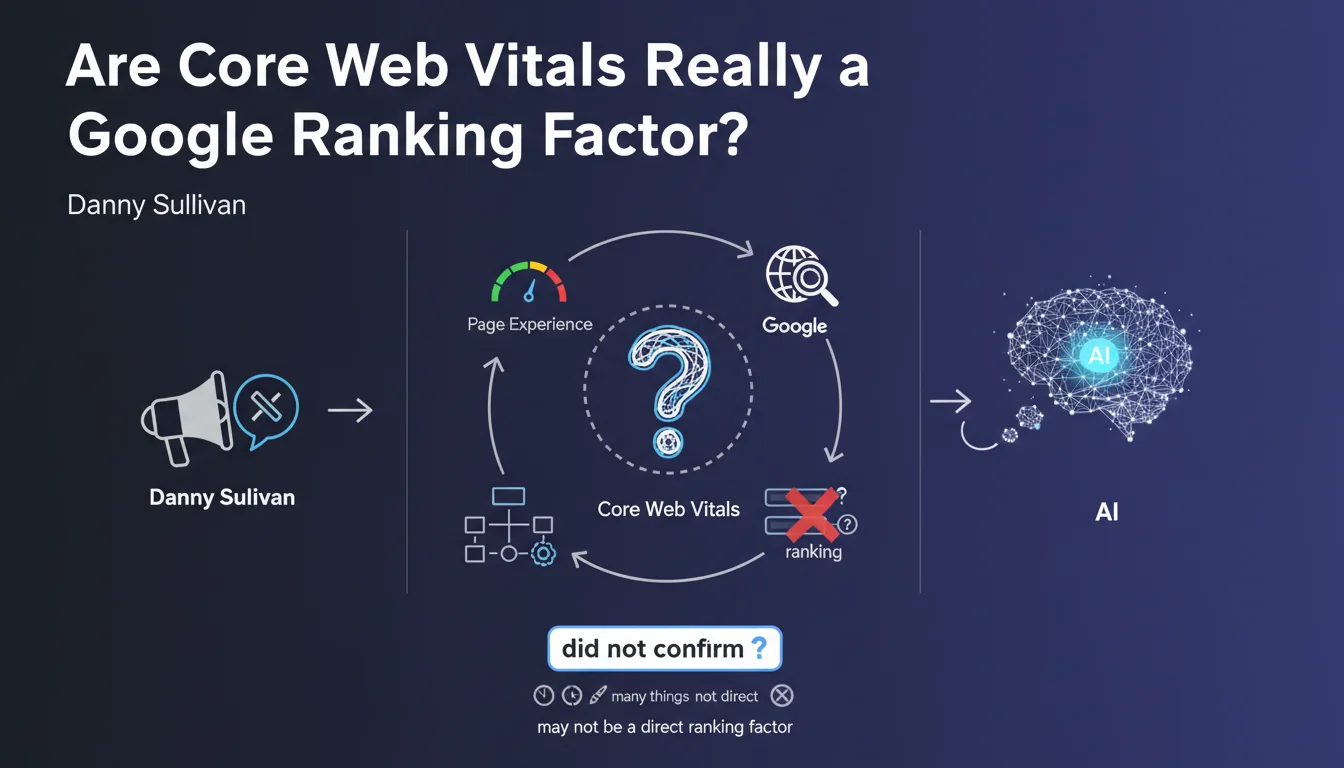
Google has created major confusion by nuancing its discourse on Core Web Vitals. While these metrics were presented as a ranking signal during the rollout of the Page Experience Update, Danny Sullivan now states that he does not confirm they are direct ranking factors.
This statement raises an important distinction: a signal can influence ranking indirectly without being a direct and isolated factor. Google examines hundreds of signals simultaneously, and the impact of each one varies depending on the query context.
In practice, this means that Core Web Vitals alone do not guarantee better positioning. They are part of a complex set of criteria where content relevance remains dominant.
- Core Web Vitals are not confirmed as direct ranking factors by Google
- They can indirectly influence user experience and therefore behavioral signals
- The weight of CWV varies depending on the type of query and competitive context
- Content relevance remains the priority criterion in the algorithm
- Google uses hundreds of signals that interact with each other
SEO Expert opinion
This statement is consistent with what we observe in the field. Sites with excellent Core Web Vitals do not systematically outperform competitors with more relevant content but average technical performance.
The important nuance lies in the indirect effect: a slow site generates more pogo-sticking and reduces user engagement. These behavioral signals actually impact ranking. CWV therefore act as an amplifier or a brake, but rarely as a decisive lever on their own.
Google's ambiguous communication probably reflects a reality: the algorithm is constantly evolving and the weight of signals is not fixed. What matters today can be reweighted tomorrow based on machine learning insights.
Practical impact and recommendations
- Keep your Core Web Vitals in the green zone, but don't seek absolute perfection at the expense of other optimizations
- Prioritize first the creation of relevant and in-depth content that responds to search intents
- Monitor user engagement metrics (time on page, bounce rate) which are more reliable indicators of actual impact
- Invest in CWV primarily for high-traffic pages and key conversion pages
- Don't delay launching quality content while waiting for perfect technical performance
- Focus your technical efforts on optimizations that simultaneously improve CWV and actual user experience
- Test the real business impact: conversions and engagement rather than perfect scores on PageSpeed Insights
- Document your traffic changes during CWV optimizations to measure their concrete impact on your site
Technical optimization of web performance requires specialized skills in development, hosting and architecture. Reconciling technical excellence and content strategy demands a comprehensive and coordinated approach. For companies wishing to structure a complete approach without mobilizing internal expert resources on all these aspects, support from a specialized SEO agency provides strategic vision and coherent technical implementation, tailored to your real business objectives.
💬 Comments (0)
Be the first to comment.