
Official statement
Other statements from this video 14 ▾
- □ Faut-il changer de domaine lors d'une réduction de catalogue ou conserver l'existant ?
- □ Les backlinks vers une page 404 sont-ils définitivement perdus ou récupérables ?
- □ Faut-il vraiment ignorer les erreurs 404 dans Google Search Console ?
- □ Faut-il vraiment ajouter les pages paginées dans le sitemap XML ?
- □ Google crawle-t-il vraiment les liens dans les menus déroulants au survol ?
- □ Combien de redirections peut-on vraiment mettre sur un site sans pénalité SEO ?
- □ Faut-il privilégier une personne ou une organisation comme auteur d'un article pour le SEO ?
- □ Faut-il vraiment aligner URL, title et H1 pour ranker en SEO ?
- □ Bloquer une page de redirection par robots.txt peut-il vraiment empêcher le passage du PageRank ?
- □ Les tirets multiples dans un nom de domaine pénalisent-ils votre SEO ?
- □ Faut-il publier du contenu tous les jours pour bien ranker sur Google ?
- □ Faut-il vraiment abandonner le texte dans les images pour le SEO ?
- □ Désindexer des URLs : Google limite-t-il vraiment les options à deux méthodes ?
- □ Les Core Web Vitals écrasent-ils vraiment la pertinence dans le classement Google ?
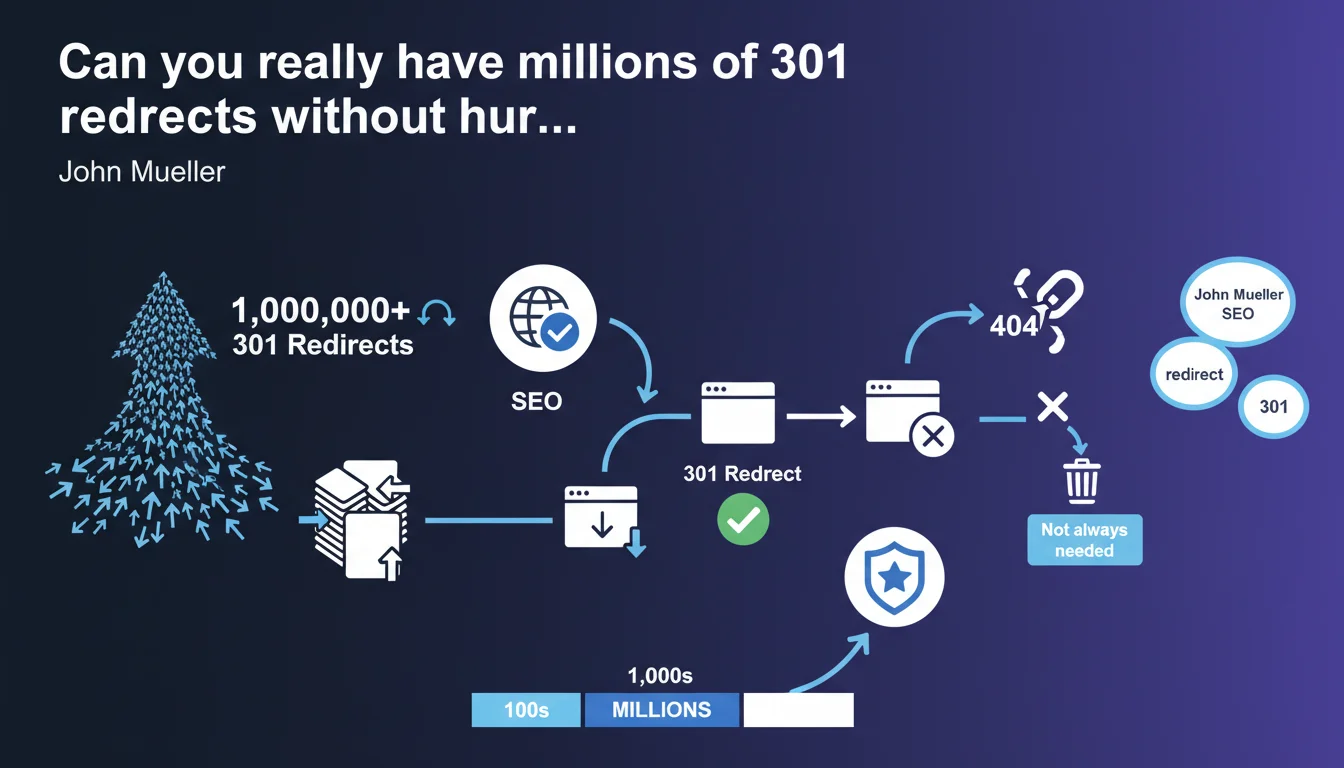
Google states that there is no limit to the number of 301 redirects on a website. Millions of redirects are perfectly acceptable if your architecture requires it. You are not obligated to systematically redirect every 404 error.
What you need to understand
Why this clarification on 301 redirects now?
The SEO community has maintained for years a stubborn belief: too many redirects would harm crawling, dilute PageRank, or cause penalties. Mueller's statement crushes this myth head-on.
Google clarifies that a website can technically handle millions of redirects without any problem for its algorithms. What matters is the relevance of these redirects in your architecture — not their absolute number.
Should you redirect all 404 errors?
No. In fact, the opposite is recommended.
A 404 error on a URL with no traffic history, no backlinks, no real SEO value has no reason to be redirected. Creating « just in case » redirects dilutes analysis and complicates maintenance for nothing.
What happens technically with a 301 redirect?
A 301 redirect transfers nearly all of the PageRank from the source URL to the destination URL. Google follows these redirects during crawling and updates its index accordingly.
The delay in consolidating signals (backlinks, authority) depends on crawl frequency, not on the total number of redirects on the site.
- No quantitative limit on the number of 301 redirects on a website
- 404 is a normal and useful HTTP code — do not systematically redirect
- PageRank transfer via 301 remains effective regardless of scale
- The relevance of the redirect matters more than its existence
SEO Expert opinion
Is this statement consistent with real-world observations?
Yes, generally. E-commerce sites with hundreds of thousands of redirects (discontinued products, multiple redesigns) do not show visibility loss linked to the volume of 301s.
However — and Mueller remains silent on this — redirect chains (A → B → C) remain problematic. PageRank dilutes with each hop, crawl time increases, and Google may abandon midway. [To verify]: the exact number of hops tolerated before abandonment varies by source (between 3 and 5).
What are the real problems with massive redirects?
Volume is not the issue. It is quality and relevance that matter.
Redirecting 10,000 old product pages to the homepage? Disastrous for UX and useless for SEO. Redirecting 10,000 old URLs to their perfectly relevant current equivalents? No problem at all.
In what cases does this rule not apply?
Mueller talks about classic permanent redirects, not edge cases or manifest abuse.
JavaScript redirects on the client side, meta-refresh, repeated 302 temporary redirects, or cloaking systems disguised as redirects: none of that falls under the scope of this reassuring statement.
Practical impact and recommendations
What should you actually do after this statement?
Stop panicking about the raw number of redirects. Focus on their relevance and effectiveness.
During a redesign or migration, do not artificially limit yourself. If you have 50,000 URLs to intelligently redirect, do it. What matters: that each redirect points to the most relevant destination possible.
What mistakes to avoid with 301 redirects?
Do not default to redirecting all 404s to the homepage. This is a bad practice that degrades user experience and sends confused signals to Google.
Avoid redirect chains. Regularly audit your redirect file to detect and fix chains A → B → C. Redirect directly A → C.
- Audit redirect chains and resolve them to direct links
- Only create a redirect if the source URL has identifiable SEO value (traffic, backlinks, history)
- Document massive redirects during redesigns to facilitate future maintenance
- Monitor server response times if redirect volume exceeds tens of thousands
- Prioritize caching redirect rules on the server side (nginx, Apache)
- Never massively redirect to the homepage — prioritize category pages or thematic equivalents
❓ Frequently Asked Questions
Combien de redirections 301 peut-on avoir sans risque ?
Faut-il rediriger toutes les pages en 404 ?
Les redirections 301 font-elles perdre du PageRank ?
Combien de temps Google met-il à prendre en compte une redirection 301 ?
Les redirections 301 ralentissent-elles le crawl de Google ?
🎥 From the same video 14
Other SEO insights extracted from this same Google Search Central video · published on 29/12/2022
🎥 Watch the full video on YouTube →
💬 Comments (0)
Be the first to comment.