
Official statement
Other statements from this video 20 ▾
- □ Why can't Google ever guarantee that your users will land on the right language version of your site?
- □ Are automatic redirects really killing your international SEO rankings?
- □ Should you really tag foreign words with the lang attribute for SEO purposes?
- □ Does duplicate content really trigger a Google penalty?
- □ Does Google really respect rel=canonical or is it just a suggestion that gets ignored?
- □ Are FAQs in blog articles really worth it for SEO rankings?
- □ Is hreflang really essential for managing a successful international website?
- □ Does Google's web cache actually affect your search rankings?
- □ How does Google really customize search results based on location and language? Here's what actually happens behind the scenes
- □ Does noindex really help you save crawl budget, or is it the wrong tool for the job?
- □ Do you really need to stick to just one topic on your site to rank well?
- □ How many links can you really put on a page without triggering a Google penalty?
- □ Does the referrer URL in Search Console really affect your search rankings?
- □ Does word count really matter for SEO ranking?
- □ Should you worry about reusing the same text blocks across multiple pages?
- □ Does Google really accept machine-translated content on multilingual websites?
- □ Does blocking URLs with robots.txt but leaving them indexed really hurt your SEO?
- □ Do you really need to duplicate the Organization schema on every page of your website?
- □ Can self-hosted reviews display star ratings in Google search results for local businesses?
- □ Why do website mergers produce unpredictable results in Google's eyes?
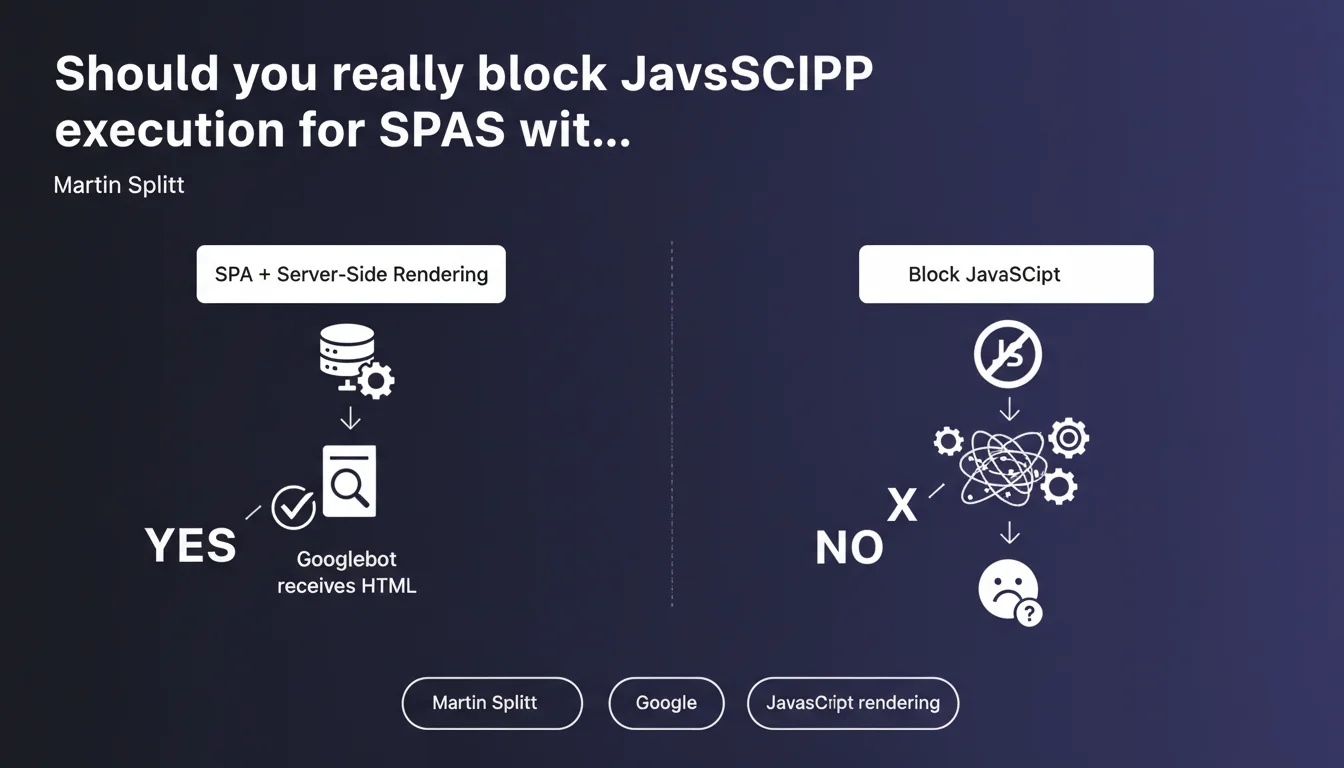
For single-page applications with server-side rendering, blocking Googlebot's JavaScript execution provides no real benefit. In fact, it unnecessarily complicates your infrastructure since Googlebot already leverages the pre-rendered HTML. The added complexity offers nothing in return for indexation or crawl budget.
What you need to understand
Why does this question even come up for SSR SPAs?
Single-page applications (SPAs) have long been an SEO headache. Historically, they generated content on the client side via JavaScript, making indexation problematic. Server-side rendering (SSR) emerged as a solution: the server generates the complete HTML before sending it to the browser.
Some practitioners imagine it would be wise to block JavaScript execution for Googlebot on these SSR architectures — the idea being to save crawl budget or avoid inconsistencies between initial HTML and hydrated content. This is precisely the hypothesis that Martin Splitt debunks.
What does Googlebot actually do with an SSR SPA?
When Googlebot crawls an SSR page, it first receives the complete pre-rendered HTML. This content is immediately exploitable for indexation. Next, if JavaScript is available, Googlebot executes it — a process called client-side hydration.
JavaScript execution doesn't replace the initial content: it enriches interactivity and may reveal additional content. Blocking this step deprives Googlebot of a complete view of the actual user experience, without any measurable resource savings.
What are the risks of blocking JavaScript on SSR SPAs?
Introducing a specific rule to prevent Googlebot from executing JavaScript adds a layer of technical complexity: user-agent detection, custom server configuration or robots.txt rules, additional maintenance. All of this for no identified gain.
Worse, if JavaScript hydration modifies certain page elements (adding internal links, lazy-loading images, updating structured data), blocking execution deprives Googlebot of these signals. You create a divergence between what the bot sees and what users experience — exactly what you should avoid.
- SSR HTML is sufficient for basic indexation, but JavaScript completes Googlebot's vision
- Blocking JavaScript on SSR SPAs increases complexity without real crawl budget benefits
- Bot/user divergence: risk of losing indexation signals (links, images, structured data)
- No measurable advantage to this restriction according to official statement
SEO Expert opinion
Is this statement consistent with real-world observations?
Yes, generally. Audits show that well-implemented SSR SPAs are indexed effectively without specific JavaScript access manipulation. Modern frameworks (Next.js, Nuxt, SvelteKit) generate complete server-side HTML — Googlebot has never had difficulty with this format.
However, some practitioners report crawl budget gains by limiting JavaScript on massive sites with thousands of pages. [To be verified]: are these gains related to JavaScript blocking or other optimizations (reducing third-party resources, analytics scripts, etc.)? Splitt's statement doesn't quantify the crawl budget impact — it simply claims there's "no benefit," which remains vague.
In what cases might this rule not apply?
Let's be honest: this statement targets clean SSR SPAs. If your SPA uses partial or hybrid SSR, with critical content only accessible post-hydration, the situation changes. In that case, blocking JavaScript becomes truly counterproductive — but it's mostly a sign of poorly designed architecture.
For very high-volume sites (millions of pages, high refresh rates), some experts continue testing JavaScript restrictions on non-critical resources. Splitt's statement doesn't explicitly cover these edge cases. If you're in that situation, A/B testing remains essential.
What technical nuance must be understood?
The statement speaks of "preventing Googlebot from executing JavaScript bundles." Concretely, this would mean blocking .js files via robots.txt or returning 403/404 to Googlebot for these resources. This is not the same as reducing bundle size, deferring their loading, or optimizing their execution.
Reducing JavaScript weight, minifying, tree-shaking, code-splitting — all these optimizations remain relevant. What Splitt contests is the idea of completely blocking access to bundles for Googlebot under the pretense of saving crawl budget. Important distinction.
Practical impact and recommendations
What should you concretely do for SSR SPAs?
First rule: don't block JavaScript for Googlebot. No Disallow rules in robots.txt targeting .js bundles, no user-agent detection returning truncated content. Let Googlebot access all resources necessary for page execution.
Next, verify that your SSR HTML is complete and self-contained. Test with a browser that has JavaScript disabled: essential content must be present. If you depend on JavaScript to display text, internal links, or structured data, your SSR is insufficient — and blocking JavaScript would make things worse.
What mistakes should you avoid when implementing SSR?
Avoid hydration that overwrites content. Some frameworks reinitialize the DOM during hydration, creating a flash of unstyled content (FOUC) or worse, modifying already-indexable elements. Googlebot may capture an inconsistent transitional state.
Don't overload hydration with heavy business logic. If your client-side JavaScript needs to make API calls to complete the page, that's a sign your SSR is incomplete. Critical content must be pre-rendered server-side, not reconstructed client-side.
How can you verify your site complies with this recommendation?
Use the URL inspection tool in Google Search Console. Compare the raw HTML ("HTML" tab or "More details") with the displayed rendering. If both versions are identical or nearly identical, your SSR works correctly and JavaScript only adds interactivity.
Also test with curl or a headless bot without JavaScript. If essential content is missing, your SSR is failing — and blocking JavaScript would be catastrophic. Finally, monitor server logs: if Googlebot makes many requests to your .js bundles, that's normal. It's not a problem to fix.
- Allow complete Googlebot access to all JavaScript files (no Disallow in robots.txt)
- Verify SSR HTML autonomy: critical content present without JavaScript execution
- Test hydration: no content overwriting, no major FOUC
- Inspect in Search Console: compare raw HTML and final rendering
- Monitor logs: accept that Googlebot loads JavaScript bundles
- Don't create complex rules to block JavaScript specifically for Googlebot
In summary: for SSR SPAs, simplify your approach. Let Googlebot access everything, focus on robust SSR and clean hydration. The added complexity of JavaScript blocking brings nothing to the table.
These optimizations — performant SSR, controlled hydration, log monitoring — may require deep technical expertise and fine knowledge of modern frameworks. If your team lacks resources or experience with these architectures, working with an SEO agency specialized in JavaScript SEO can prove valuable for personalized guidance and avoiding costly mistakes.
❓ Frequently Asked Questions
Dois-je bloquer les fichiers JavaScript pour économiser du crawl budget sur un SPA SSR ?
Que se passe-t-il si je bloque JavaScript pour Googlebot sur un SPA SSR ?
Comment vérifier que mon SPA SSR est correctement indexé sans bloquer JavaScript ?
Cette recommandation vaut-elle aussi pour les SPA sans SSR (CSR pur) ?
Le SSR élimine-t-il complètement les problèmes d'indexation JavaScript ?
🎥 From the same video 20
Other SEO insights extracted from this same Google Search Central video · published on 21/10/2022
🎥 Watch the full video on YouTube →
💬 Comments (0)
Be the first to comment.