
Official statement
Other statements from this video 20 ▾
- □ Pourquoi Google ne peut-il jamais garantir que vos utilisateurs atterriront sur la bonne version linguistique de votre site ?
- □ Faut-il bannir les redirections automatiques pour les sites multilingues ?
- □ Faut-il bloquer l'exécution JavaScript pour les SPA avec SSR ?
- □ Faut-il baliser les mots étrangers avec l'attribut lang pour le SEO ?
- □ Le contenu dupliqué entraîne-t-il vraiment une pénalité Google ?
- □ Le rel=canonical est-il vraiment pris en compte par Google ou juste une suggestion ignorée ?
- □ Les FAQ dans les articles de blog sont-elles vraiment utiles pour le SEO ?
- □ Le cache Google a-t-il un impact sur votre référencement ?
- □ Les résultats de recherche localisés : comment Google adapte-t-il vraiment son algorithme selon les pays et les langues ?
- □ Le noindex est-il vraiment inutile pour gérer le budget de crawl ?
- □ Faut-il vraiment se limiter à une seule thématique sur son site pour bien ranker ?
- □ Combien de liens peut-on vraiment mettre sur une page sans pénalité Google ?
- □ L'URL référente dans Search Console impacte-t-elle vraiment votre classement ?
- □ Le nombre de mots est-il vraiment inutile pour le référencement ?
- □ Faut-il s'inquiéter de réutiliser les mêmes blocs de texte sur plusieurs pages ?
- □ Google valide-t-il vraiment la traduction automatique sur les sites multilingues ?
- □ Les URLs bloquées par robots.txt mais indexées posent-elles vraiment problème ?
- □ Faut-il vraiment dupliquer le schema Organisation sur toutes les pages du site ?
- □ Les avis auto-hébergés peuvent-ils afficher des étoiles dans les résultats de recherche Google ?
- □ Pourquoi les fusions de sites Web génèrent-elles des résultats imprévisibles aux yeux de Google ?
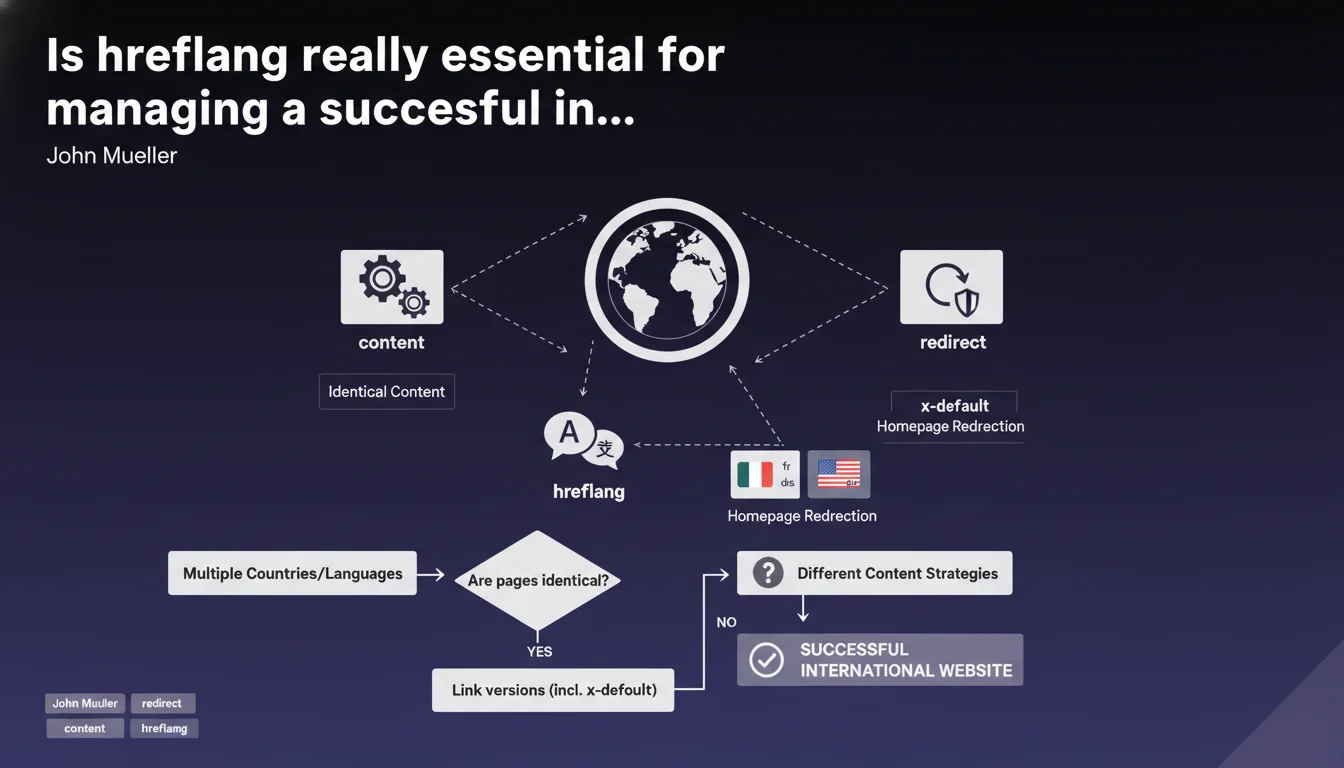
For websites offering the same content in multiple languages or countries, Google states that hreflang is the appropriate approach. You must link all linguistic and geographic versions together, including setting up a homepage with redirection via x-default.
What you need to understand
Does Google really mandate hreflang for all international websites?
The term "mandatory" is misleading — and that's where the confusion lies. Mueller talks about an "appropriate" approach, not an absolute technical requirement for indexing. In other words: a multilingual site without hreflang will be indexed, but Google will struggle to display the correct version to the right user.
Hreflang serves to explicitly indicate relationships between equivalent pages in different languages or targeting different countries. Without this markup, Google relies on implicit signals (detected language, server geolocation, ccTLD) — with a non-negligible error rate.
What does "linking versions together" actually mean in practice?
Each linguistic version must point to all other versions, including itself. If you have a page in French (fr-FR), British English (en-GB), and Spanish (es-ES), each of the three pages must contain all three hreflang annotations in its source code or XML sitemap.
The mention of x-default is crucial: this special tag indicates which page to display by default when no version matches the user's profile. Typically, you point to a language selection page or the international English version.
What are the essential points to remember?
- Hreflang is not a ranking factor but a signal for geographic and linguistic targeting
- Each page must contain a self-reference (pointing to itself) in addition to other versions
- X-default acts as a safety net for users matching no defined target
- Annotations can be placed in HTML, XML sitemap, or HTTP headers — all three methods are equivalent
- Google recommends this approach for equivalent content, not for radically different content between countries
SEO Expert opinion
Is this statement aligned with what we observe in the field?
Yes and no. In practice, high-performing international websites work very well without hreflang — provided they have clear architecture (subdomains or subdirectories by language, well-differentiated content, coherent geo signals). The problem arises when the same content exists in multiple similar versions: that's where Google regularly fumbles.
Mueller's statement implies that hreflang solves all international targeting problems. Let's be honest: that's not always the case. Implementation errors are frequent (broken links, missing self-references, conflicts between hreflang and canonical) and Google doesn't automatically correct them — it simply ignores faulty annotations.
When can you skip hreflang?
If your site targets a single language per distinct domain (example: .fr for France, .de for Germany, .co.uk for UK) and the content is sufficiently differentiated, hreflang adds little value. Google will naturally detect the language and geographic target via the ccTLD and the content itself.
However, as soon as you manage multiple linguistic variants on the same domain (.com with /fr/, /en/, /es/), or near-identical content for multiple French-speaking countries for example, hreflang becomes essential to avoid cannibalization and erratic displays in local SERPs.
What areas of ambiguity remain in this statement?
Mueller remains vague about e-commerce sites with near-identical content between European countries sharing the same language (Belgium/France/French-speaking Switzerland, for example). Should you create distinct versions with hreflang or consider that a single version suffices? [To verify] — official recommendations don't clearly settle this.
Similarly, the real impact of x-default on international SEO performance lacks concrete data. We know it serves as a fallback, but its actual influence on traffic from non-targeted zones remains unclear. Field observations suggest modest or even null effect in some cases.
Practical impact and recommendations
What should you do concretely to implement hreflang correctly?
First step: map all your linguistic and geographic versions. List each URL with its language-country code (fr-FR, en-GB, es-MX, etc.). Ensure each page has an equivalent in other languages — or use x-default if no match exists.
Next, decide on your implementation method. The XML sitemap is often simplest to manage on large sites: a single file centralizes all annotations. Implementation in HTML (link rel="alternate" tags) works better for small sites or when you want granular control page by page.
Test rigorously with Search Console — verify that Google detects all your annotations correctly and no syntax errors or broken links block interpretation. Hreflang errors are silent: Google doesn't always report them clearly, it simply ignores faulty tags.
What critical errors must you avoid absolutely?
Never mix the three methods (HTML + sitemap + HTTP headers) on the same pages — choose one and stick with it. Contradictory signals cause Google to ignore everything.
Avoid incomplete hreflang chains: if page A points to B and C, then B and C must also point to A (and to themselves). An hreflang relationship must be bidirectional and complete, otherwise Google considers it unreliable.
Don't use hreflang to manage radically different content. If your product offering changes significantly between countries, create distinct pages without hreflang — Google will treat them as unique content rather than linguistic variants.
How do you verify your implementation is working?
- Validate the syntax of your language-country codes (ISO 639-1 format for language, ISO 3166-1 Alpha 2 for country)
- Check that each page points to all other versions including itself
- Verify the presence of x-default pointing to your fallback page
- Test in Search Console (International Targeting section): Google must detect your annotations without error
- Monitor server logs: ensure Googlebot crawls all your linguistic versions properly
- Analyze local SERPs: search your target queries from different countries (via VPN or specialized tools) to see which version appears
Hreflang is not a luxury for international sites with equivalent content in multiple languages — it's an operational necessity to prevent Google from displaying the wrong version to your users. Implementation requires rigor and thorough testing, as errors are frequent and often invisible.
These international technical optimizations can quickly become labyrinthine, especially on sites with numerous linguistic versions and complex architectures. If you encounter persistent difficulties or recurring errors despite your efforts, hiring an SEO agency specialized in international search engine optimization can save you valuable time and prevent costly traffic losses.
❓ Frequently Asked Questions
Peut-on utiliser hreflang uniquement pour certaines pages d'un site ?
Faut-il obligatoirement un x-default même si toutes les cibles sont couvertes ?
Que se passe-t-il si mes annotations hreflang contiennent des erreurs ?
Hreflang fonctionne-t-il aussi pour Bing et les autres moteurs ?
Dois-je créer une page distincte par variante régionale d'une même langue ?
🎥 From the same video 20
Other SEO insights extracted from this same Google Search Central video · published on 21/10/2022
🎥 Watch the full video on YouTube →
💬 Comments (0)
Be the first to comment.