
Official statement
Other statements from this video 20 ▾
- □ Pourquoi Google ne peut-il jamais garantir que vos utilisateurs atterriront sur la bonne version linguistique de votre site ?
- □ Faut-il bannir les redirections automatiques pour les sites multilingues ?
- □ Faut-il bloquer l'exécution JavaScript pour les SPA avec SSR ?
- □ Faut-il baliser les mots étrangers avec l'attribut lang pour le SEO ?
- □ Le contenu dupliqué entraîne-t-il vraiment une pénalité Google ?
- □ Le rel=canonical est-il vraiment pris en compte par Google ou juste une suggestion ignorée ?
- □ Les FAQ dans les articles de blog sont-elles vraiment utiles pour le SEO ?
- □ Hreflang est-il vraiment obligatoire pour gérer un site international ?
- □ Le cache Google a-t-il un impact sur votre référencement ?
- □ Les résultats de recherche localisés : comment Google adapte-t-il vraiment son algorithme selon les pays et les langues ?
- □ Le noindex est-il vraiment inutile pour gérer le budget de crawl ?
- □ Faut-il vraiment se limiter à une seule thématique sur son site pour bien ranker ?
- □ Combien de liens peut-on vraiment mettre sur une page sans pénalité Google ?
- □ L'URL référente dans Search Console impacte-t-elle vraiment votre classement ?
- □ Le nombre de mots est-il vraiment inutile pour le référencement ?
- □ Faut-il s'inquiéter de réutiliser les mêmes blocs de texte sur plusieurs pages ?
- □ Google valide-t-il vraiment la traduction automatique sur les sites multilingues ?
- □ Faut-il vraiment dupliquer le schema Organisation sur toutes les pages du site ?
- □ Les avis auto-hébergés peuvent-ils afficher des étoiles dans les résultats de recherche Google ?
- □ Pourquoi les fusions de sites Web génèrent-elles des résultats imprévisibles aux yeux de Google ?
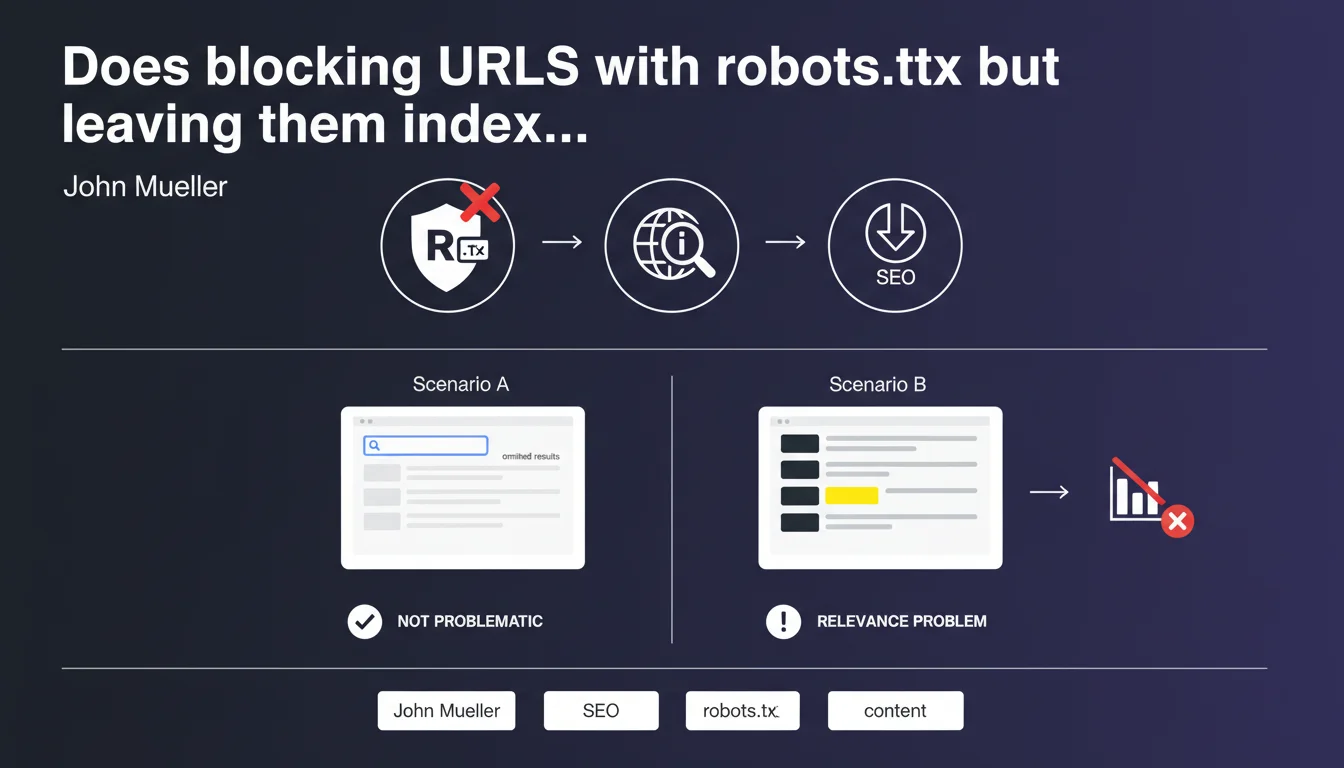
URLs blocked by robots.txt that appear only in the omitted results of a site: search have no impact on site performance. The only real problem emerges when these URLs rank in place of your main content — a sign of a relevance issue that needs fixing.
What you need to understand
Why do URLs blocked by robots.txt end up indexed?
Blocking a URL via robots.txt prevents Googlebot from crawling the page, but doesn't prevent its indexation. If other sites link to this URL with an anchor text, Google can index it without ever seeing its content.
The engine then relies on external signals — backlinks, anchor text, context — to create a minimal entry in its index. This is where these ghost URLs come from, appearing with the note "No information available for this page".
What does "omitted results" mean in a site: search?
When you search site:yourdomain.com, Google displays the pages it considers most relevant first. Secondary, redundant, or low-quality URLs are relegated to the omitted results — accessible by clicking the link at the end of the list.
These pages exist in the index but Google estimates they offer no value to the user. According to Mueller, if your URLs blocked by robots.txt are stuck in there, it has no consequence.
When do these URLs become a real problem?
The alarm goes off when a URL blocked by robots.txt ranks in the main search results instead of your legitimate content. This reveals a relevance issue: Google can't identify which page best represents your topic.
In concrete terms? You may have duplicate content issues, keyword cannibalization, or your strategic pages lack clear signals (canonical tags, internal linking, semantic optimization).
- robots.txt blocking doesn't prevent indexation if backlinks exist
- URLs indexed without crawled content can end up in omitted results
- As long as they remain invisible in regular search, there's no negative impact
- If they rank replacing your real content, you have a relevance problem
- The signal to watch: substitution in SERPs, not mere presence in the index
SEO Expert opinion
Is this statement consistent with real-world observations?
Yes, completely. We regularly see URLs blocked by robots.txt that sit in the index without ever causing ranking issues. The real criterion is visibility in SERPs, not simple indexation.
What Mueller doesn't clarify — and this is where it gets tricky — is how Google decides which URL deserves to rank or not. "Relevance" remains a fuzzy concept. [To verify] on large volumes of indexed URLs: at what point does Google start thinking your site lacks structural clarity?
In which cases does this rule not apply?
If you block with robots.txt pages that receive massive backlinks and significant direct traffic, Google may judge them more relevant than your official pages — even without crawling their content. Result: they rank, and you lose control.
Another edge case: multilingual or multi-version sites. Blocking one version with robots.txt without clear hreflang tags can create indexation chaos. Google clings to external links and ends up displaying the wrong language version in SERPs.
Should you really ignore these indexed URLs?
Let's be honest: having hundreds of URLs blocked but indexed is rarely a good sign. Even if Mueller says it's not a problem, it's often a symptom of wasted crawl budget or fuzzy architecture.
If you don't want a page indexed, the best practice is to leave it crawlable and add a noindex tag. Or, if it has no SEO value, delete it outright with a 410 Gone.
Practical impact and recommendations
What should you actually do if blocked URLs are ranking?
First, identify why Google judges them more relevant than your official pages. Compare signals: age, backlinks, anchor text, position in internal linking. Most of the time, the problem stems from lack of clarity on the page meant to rank.
Next, strengthen the relevance of your legitimate content: optimize title/meta tags, enrich content, add targeted internal links, acquire quality backlinks. The goal: give Google an indisputable signal about which page to prioritize.
What mistakes should you absolutely avoid?
Never combine robots.txt and noindex. This is a classic mistake: you block a URL via robots.txt then add a noindex tag to it. Google can't crawl the page, so never sees the noindex directive — result: the URL stays indexed indefinitely.
Don't let useless URLs linger in the index under the pretext that "it doesn't cause problems". It's true while they're invisible, but an algorithm change or a surge in backlinks could propel them into SERPs overnight.
How do you audit and clean up effectively?
Run a site:yourdomain.com search and browse the omitted results. Note all URLs blocked by robots.txt that appear. Cross-reference this list with your server logs to see if Google attempts to crawl them despite the block.
For truly useless URLs, the best solution remains permanent deletion with a 410 Gone code. For those with value but shouldn't be indexed, remove them from robots.txt and add a noindex tag.
- Run regular site: searches to detect indexed blocked URLs
- Never block via robots.txt a page you want to deindex — use noindex
- Strengthen the relevance of your official pages with optimized content and targeted internal links
- Permanently delete (410) URLs with no SEO value instead of blocking them
- Verify your canonical tags and hreflang are consistent
- Monitor backlinks pointing to blocked URLs — they can create issues
❓ Frequently Asked Questions
Peut-on désindexer une URL en la bloquant simplement par robots.txt ?
Les URLs bloquées par robots.txt mais indexées consomment-elles du crawl budget ?
Comment savoir si une URL bloquée se classe dans les résultats principaux ?
Faut-il supprimer toutes les URLs bloquées par robots.txt de l'index ?
Peut-on combiner robots.txt et balise noindex ?
🎥 From the same video 20
Other SEO insights extracted from this same Google Search Central video · published on 21/10/2022
🎥 Watch the full video on YouTube →
💬 Comments (0)
Be the first to comment.